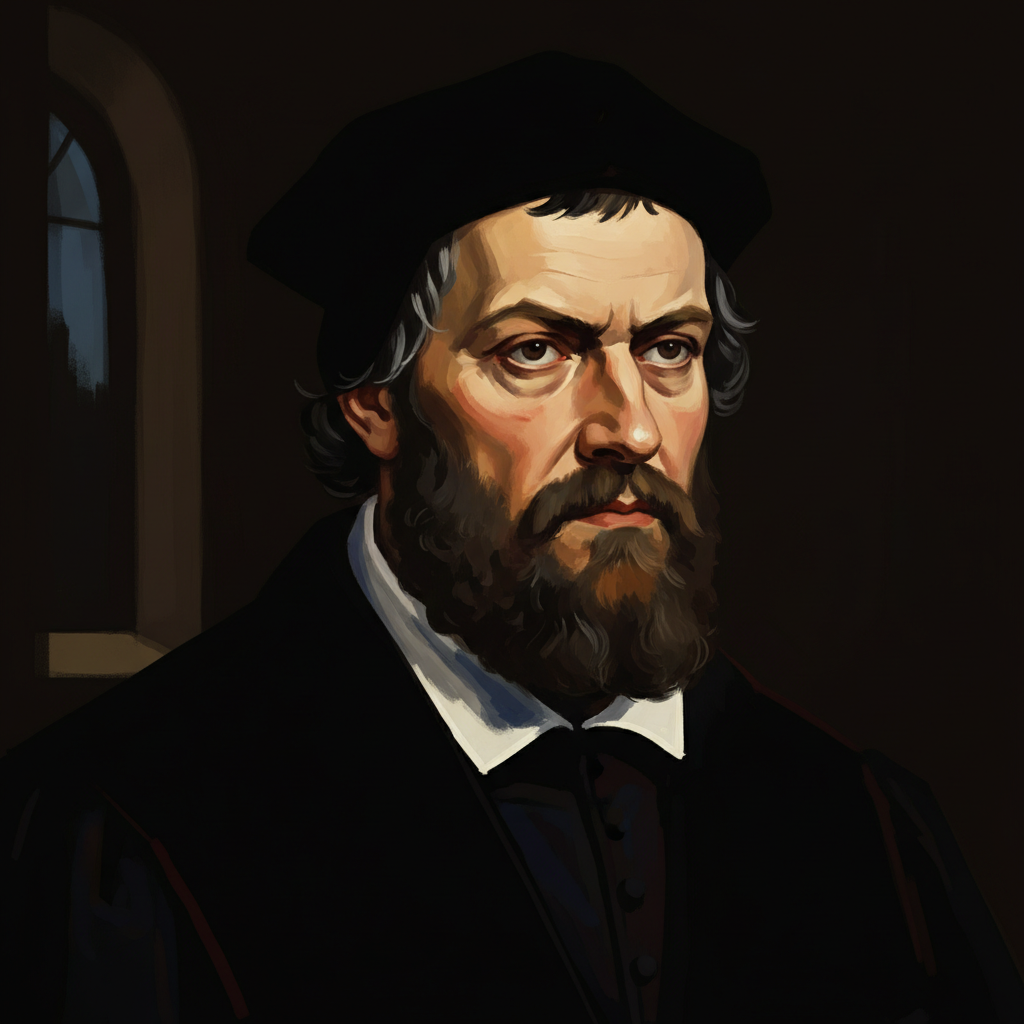
Martin Luther — "I cannot pray without cursing."
I cannot pray without cursing.
I cannot pray without cursing.
Click any product to generate a realistic preview. Up to 3 at a time.
* Initial load can take up to 90 seconds — revising the preview in another color is nearly instant.
"I have held many things in my hands, and I have lost them all; but whatever I have placed in God’s hands, that I still possess."
"The greatest blessing of all is to have a wife who is pious, God-fearing, and domestic."
"Here I stand; I can do no other. God help me. Amen."
"With threefold horrible sins against God and men have these peasants loaded themselves, for which they have deserved a manifold death of body and soul."
"Let us therefore beware of the Jews, and their synagogues, and let us burn their synagogues, and let us destroy their houses, and let us take away their prayer-books and Talmuds, and let us forbid the…"
German theologian whose 95 Theses (1517) launched the Protestant Reformation and broke the Catholic Church's monopoly on Western Christianity. Closely associated with Philipp Melanchthon (Lutheran systematizer) and John Calvin (later Reformer who built on Luther's break). For an intellectual contrast, see Pope Leo X, Renaissance pope (1513-1521) — Leo X's indulgence sales triggered Luther's break and Leo excommunicated him in 1521 — Luther's entire Reformation is structured as a direct answer to the indulgence-funded Vatican Leo represented.
Found in 1 providers: deepseek
1 source checked
Luther admits that genuine prayer, for him, inevitably carries condemnation alongside petition. When he asks God to hallow His name or bring His kingdom, he is simultaneously denouncing everything that opposes it—corruption, hypocrisy, false teaching, evil. Authentic devotion cannot be polite or neutral; blessing what is good requires rejecting what is wrong. Prayer and protest are two sides of the same breath.
Luther was a combative theologian whose career was built on denunciation—nailing 95 Theses against indulgences, calling the Pope the Antichrist, and writing ferocious polemics against opponents. His prayers in the Large Catechism explicitly link petitioning God's kingdom with cursing the devil's. This quote captures his conviction that reforming the Church demanded naming enemies, not just praising God, fusing piety with righteous anger throughout his ministry.
In the early sixteenth century, the Reformation split Western Christendom. Luther operated amid the 1520s–40s clashes with Rome, the Peasants' War, and wars between Catholic and Protestant princes. Religious language was weaponized: excommunications, papal bulls, and imperial edicts flew alongside sermons. Cursing enemies of the Gospel was standard rhetorical practice, echoing the imprecatory Psalms. Prayer was never private devotion alone—it was a public, contested act of allegiance in a fracturing Christian world.
AI-generated insights based on extensive research and information for context. Factual errors? Email [email protected].
Your cart is empty