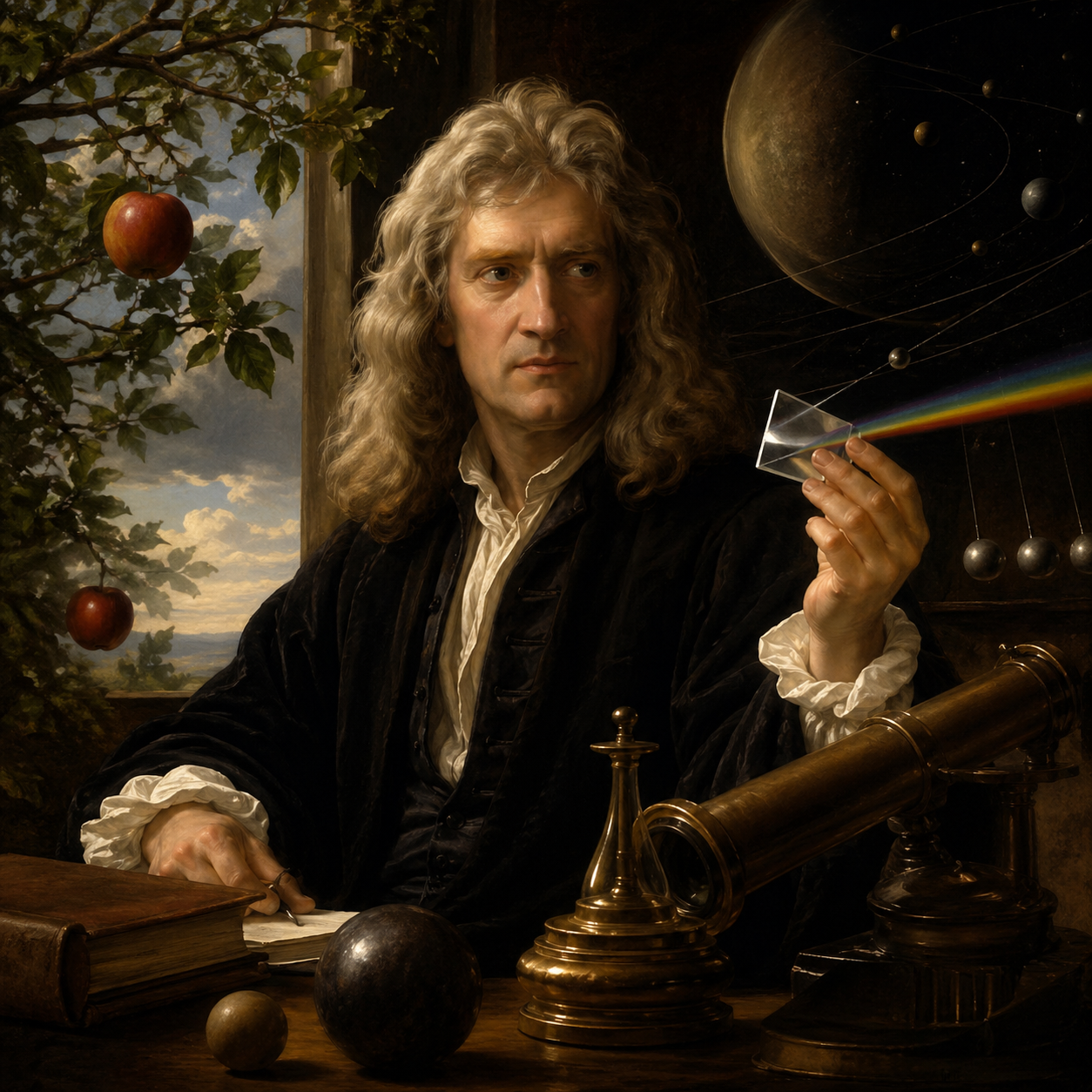
Isaac Newton — "I consider my experiments as a kind of play."
I consider my experiments as a kind of play.
I consider my experiments as a kind of play.
Click any product to generate a realistic preview. Up to 3 at a time.
* Initial load can take up to 90 seconds — revising the preview in another color is nearly instant.
"He who thinks half-heartedly will not believe in God; but he who thinks seriously will believe in God, and will not doubt that God is the author of the world."
"Truth is the offspring of silence and meditation."
"I have a fundamental belief in the Bible as the Word of God, written by those who were inspired. I study the Bible daily."
"Atheism is so senseless. When I look at the solar system, I see the earth at the right distance from the sun to receive the proper amounts of heat and light. This did not happen by chance."
"The cause of gravity is what I do not pretend to know."
Found in 1 providers: grok
1 source checked
Newton is saying that scientific experimentation feels naturally enjoyable to him — driven by curiosity rather than obligation. When you are truly passionate about something, effort transforms into delight. The framing of play suggests exploration without fear of failure, an open-ended process where discovery itself is the reward. In modern terms, this captures the idea of flow state: being so absorbed in meaningful work that the boundary between labor and leisure dissolves.
Newton spent years in solitary, obsessive experimentation — refraction through prisms, gravity's mathematics, even secretive alchemical work. His famous annus mirabilis of 1665–66, when Cambridge closed for plague and he retreated to Woolsthorpe, saw him develop calculus, optics, and universal gravitation in near-isolation. No deadlines, no audience — just relentless curiosity. This quote captures the inner drive that defined him: a man who worked not for applause but because the problems themselves were irresistible.
The early modern period was the Scientific Revolution — a fundamental shift from scholastic authority to empirical inquiry. Natural philosophers were challenging Aristotelian dogma, and experiment itself was a contested, novel concept. Figures like Galileo had recently faced persecution for their findings. In this climate, framing experimentation as play was quietly radical — it rejected the burden of proving social utility and asserted curiosity as a legitimate, even joyful, foundation for understanding the natural world.
AI-generated insights based on extensive research and information for context. Factual errors? Email [email protected].
Your cart is empty