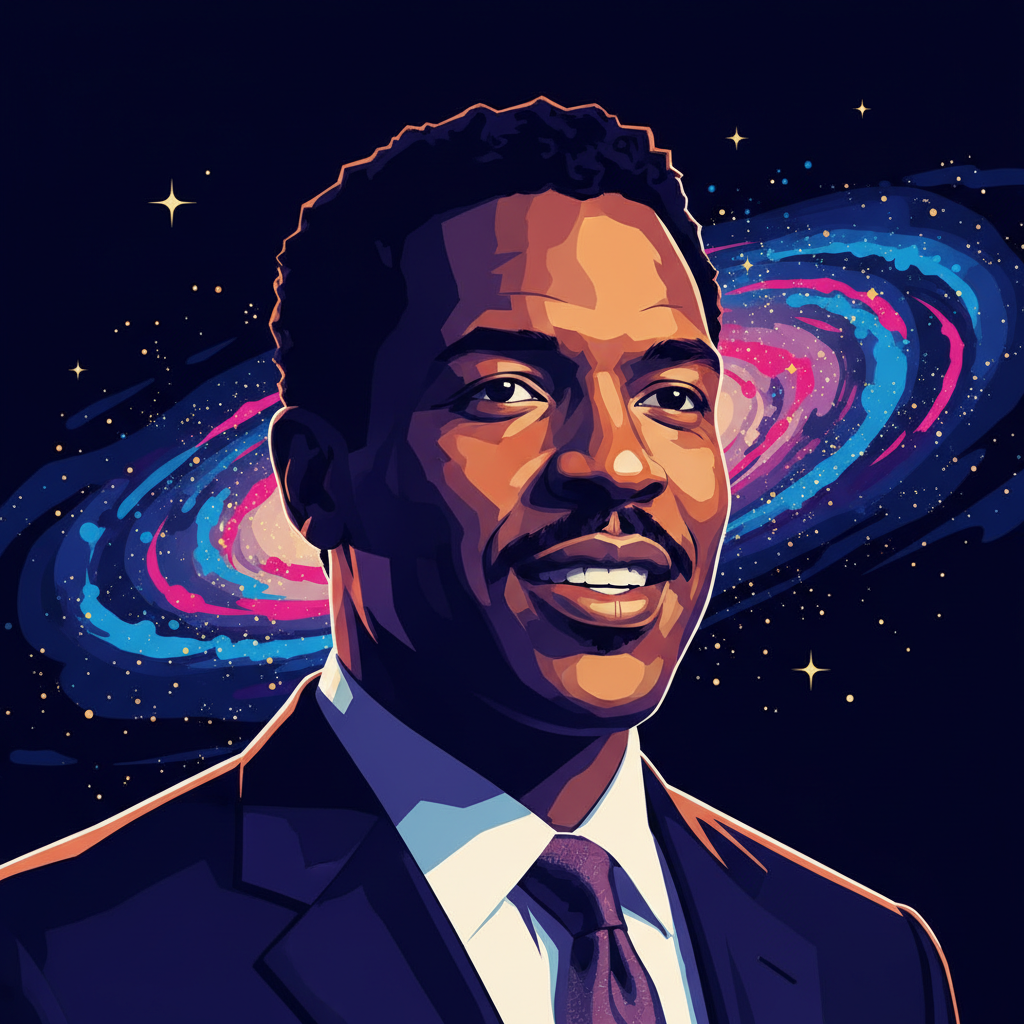
Neil deGrasse Tyson — "I don't believe in magic. I believe in physics."
I don't believe in magic. I believe in physics.
I don't believe in magic. I believe in physics.
Click any product to generate a realistic preview. Up to 3 at a time.
* Initial load can take up to 90 seconds — revising the preview in another color is nearly instant.
"My biggest problem with flat-Earthers is that they're not asking good questions. They're starting with the answer and working backward."
"If you want to make an apple pie from scratch, you must first invent the universe."
"My goal is to get people to think about the universe, not just about themselves."
"The more you know about the universe, the less you can believe in God."
"The problem with society is not lack of knowledge, but the illusion of knowledge."
American astrophysicist, Hayden Planetarium director, and Cosmos: A Spacetime Odyssey host who carries the Carl Sagan public-science mantle. Closely associated with Bill Nye (fellow science communicator) and Brian Greene (theoretical physicist and string-theory popularizer). For an intellectual contrast, see Ken Ham, founder of Answers in Genesis and the Creation Museum — Ham's career has been organized around defending biblical 6-day creationism — exactly the science-education position Tyson's mainstream-science communication is structured to refute.
Found in 1 providers: grok
1 source checked
The universe operates according to physical laws, not supernatural forces. When something seems miraculous or impossible to explain, physics — not magic — holds the answer. This is a declaration of empiricism: reality is discoverable through science, observation, and mathematics. Wonder doesn't require mystery to be real; the natural world, understood through physics, is more astonishing than any invented supernatural explanation could ever be.
Tyson, director of the Hayden Planetarium and host of Cosmos: A Spacetime Odyssey, built his career demystifying the universe for mass audiences. He consistently confronts pseudoscience, astrology, and magical thinking in interviews, books, and on StarTalk Radio. For Tyson, physics isn't a dry abstraction — it's the deepest expression of cosmic awe. His life's work is proving that scientific understanding produces more genuine wonder than any supernatural belief system.
Tyson rose to prominence during a period marked by rising science denialism — climate skepticism, anti-vaccination movements, flat-earth conspiracies — amplified by social media. Post-2000 American culture saw deepening conflict between empirical science and magical or conspiratorial thinking. Simultaneously, pop culture embraced fantasy and mysticism. Tyson's blunt preference for physics over magic served as a cultural counterweight, asserting that rigorous scientific inquiry, not superstition, should guide how society understands and navigates reality.
AI-generated insights based on extensive research and information for context. Factual errors? Email [email protected].
Your cart is empty