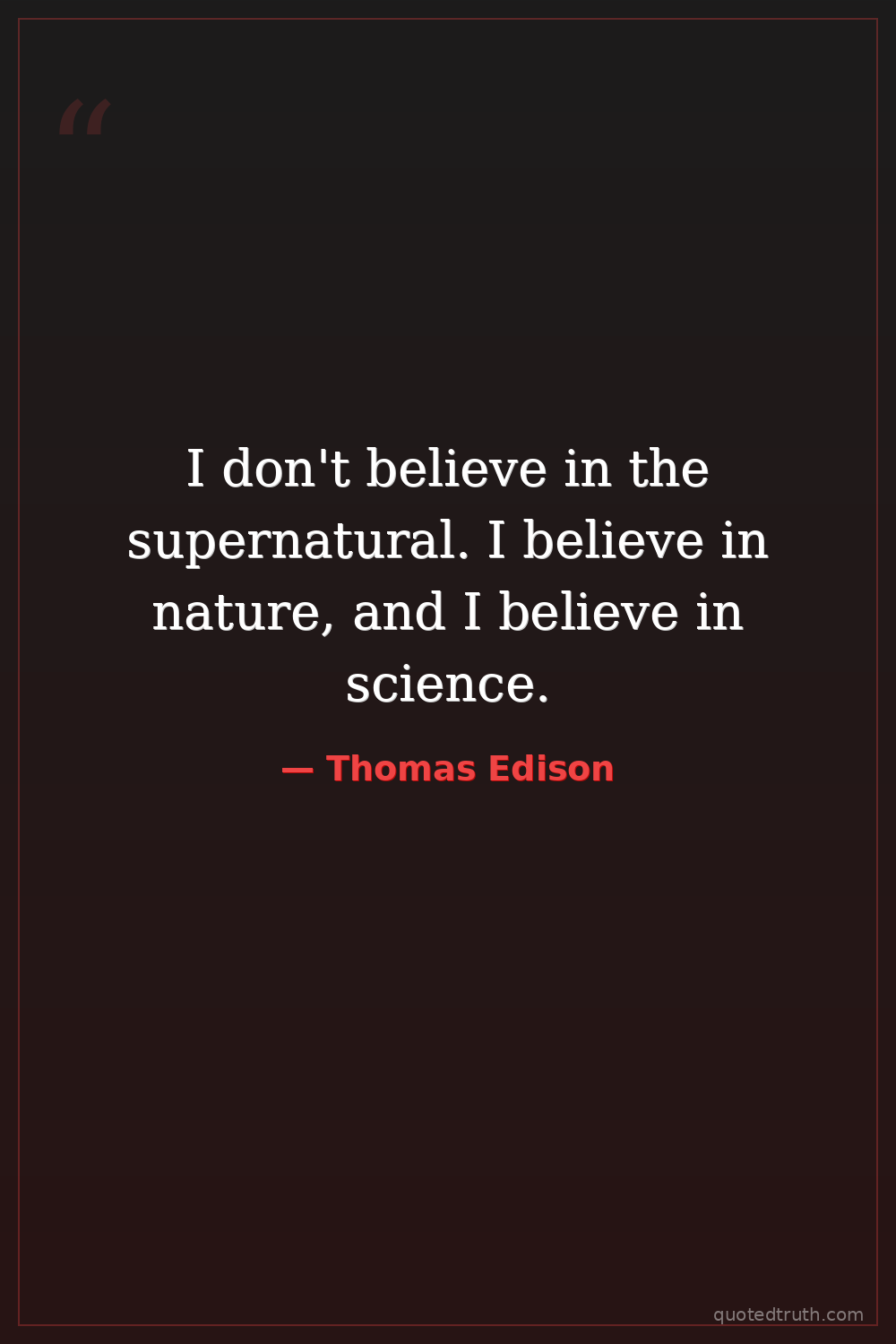
Thomas Edison — "I don't believe in the supernatural. I believe in nature, and I believe in scien…"
I don't believe in the supernatural. I believe in nature, and I believe in science.
I don't believe in the supernatural. I believe in nature, and I believe in science.
Click any product to generate a realistic preview. Up to 3 at a time.
* Initial load can take up to 90 seconds — revising the preview in another color is nearly instant.
"I owe my success to the fact that I never had a clock in my workroom. Seventy-five of us worked twenty hours every day and slept only four hours — and thrived on it."
"All bibles are man-made."
"I can hire half of the people in the country to do the thinking for me, but I can't hire people to be enthusiastic."
"Many of life's failures are people who did not realize how close they were to success when they gave up."
"My life has been a series of experiments."
Found in 1 providers: grok
1 source checked
The quote is a straightforward declaration of scientific materialism: the universe operates by natural laws discoverable through observation and experiment, not by supernatural forces. Edison is saying that belief belongs to the empirical world — nature and science — not to mysticism or religion. Everything real can be investigated, tested, and understood. Mystery isn't proof of the divine; it's simply a problem not yet solved.
Edison built his career on relentless empirical testing — famously trying over a thousand filament materials before perfecting the incandescent bulb. He rejected organized religion and described his worldview as trust in a 'Supreme Intelligence' expressed through natural law, not scripture. His Menlo Park laboratory embodied the idea that observation and iteration, not faith, produce results. Science was not merely his profession; it was his complete framework for understanding existence.
Edison's most productive decades — the 1870s through 1920s — coincided with fierce public battles between religious tradition and scientific progress. Darwin's theory had fractured Western intellectual consensus since 1859, and the 1925 Scopes Trial dramatized the conflict nationally. Electricity, the phonograph, and motion pictures were transforming daily life in ways that once seemed miraculous, making Edison's insistence that these wonders had purely natural explanations both culturally provocative and deeply reassuring to a modernizing public.
AI-generated insights based on extensive research and information for context. Factual errors? Email [email protected].
Your cart is empty