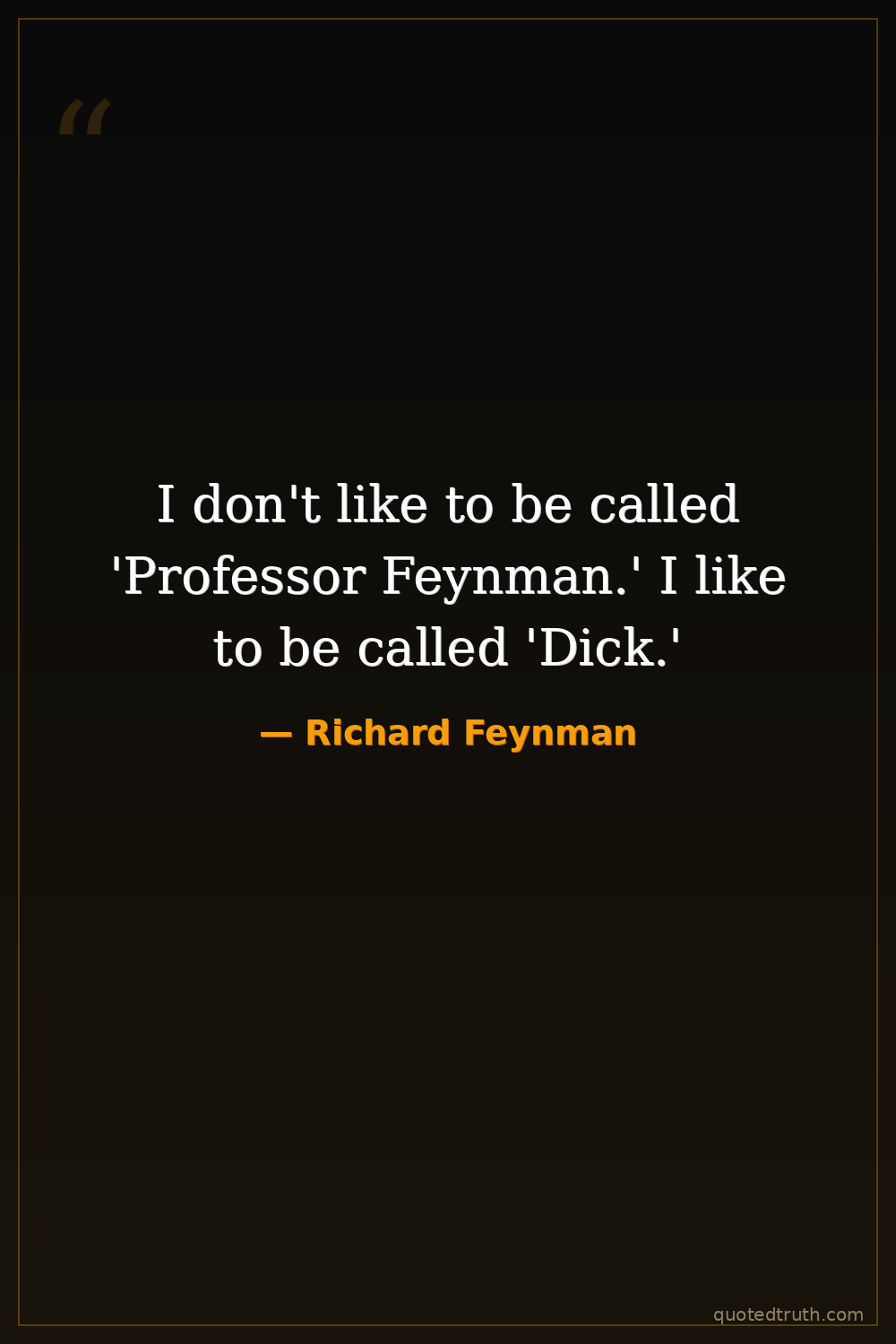
Richard Feynman — "I don't like to be called 'Professor Feynman.' I like to be called 'Dick.'"
I don't like to be called 'Professor Feynman.' I like to be called 'Dick.'
I don't like to be called 'Professor Feynman.' I like to be called 'Dick.'
Click any product to generate a realistic preview. Up to 3 at a time.
* Initial load can take up to 90 seconds — revising the preview in another color is nearly instant.
"Why do you suppose that, when you are not speaking English, you speak with an accent?"
"People would often think I'm a faker, but I'm usually honest, in a certain way- in such a way that often nobody believes me!"
"I was in an intellectual fight with my father, and I kept saying, 'But the books say it!' And he said, 'The books are wrong!'"
"The great thing about science is that it's a way of not fooling yourself."
"I think that when you're doing science, you're trying to find out something that nobody knows."
American theoretical physicist who shared the 1965 Nobel for QED, developed Feynman diagrams, and wrote the Feynman Lectures on Physics. Closely associated with Julian Schwinger (co-Nobelist for QED) and Murray Gell-Mann (Caltech rival and Eightfold-Way physicist). For an intellectual contrast, see Deepak Chopra, physician and quantum-mysticism author — Feynman's Caltech 'cargo cult science' commencement address is the precise template for what he saw as misuse of physics terminology — Chopra-style appropriation of quantum vocabulary for metaphysical claims is the canonical example of what Feynman called 'fooling yourself'.
Found in 1 providers: grok
1 source checked
The speaker rejects formal titles in favor of his first name, expressing a preference for approachability over institutional hierarchy. He wants human connection rather than academic distance—treating everyone as equals rather than positioning himself above others through credentials or rank. It reflects a disdain for pretension and a belief that real relationships are built on familiarity, not authority.
Feynman was famously anti-authoritarian despite winning the Nobel Prize in Physics. He played bongo drums in strip clubs, cracked safes at Los Alamos for fun, and gave legendary Caltech lectures in shorts. He believed pomposity killed intellectual honesty. Insisting on 'Dick' over 'Professor' was consistent with a lifelong rejection of prestige as a substitute for genuine understanding and authentic human connection.
Post-WWII American academia was deeply hierarchical, with professorial titles carrying enormous social weight. Cold War institutions like universities and government labs ran on rank and credentials. Scientists held near-sacred cultural authority after the Manhattan Project. Feynman's casual irreverence was a deliberate counter-signal—insisting that curiosity and directness mattered more than the formal structures that defined mid-20th-century intellectual life.
AI-generated insights based on extensive research and information for context. Factual errors? Email [email protected].
Your cart is empty