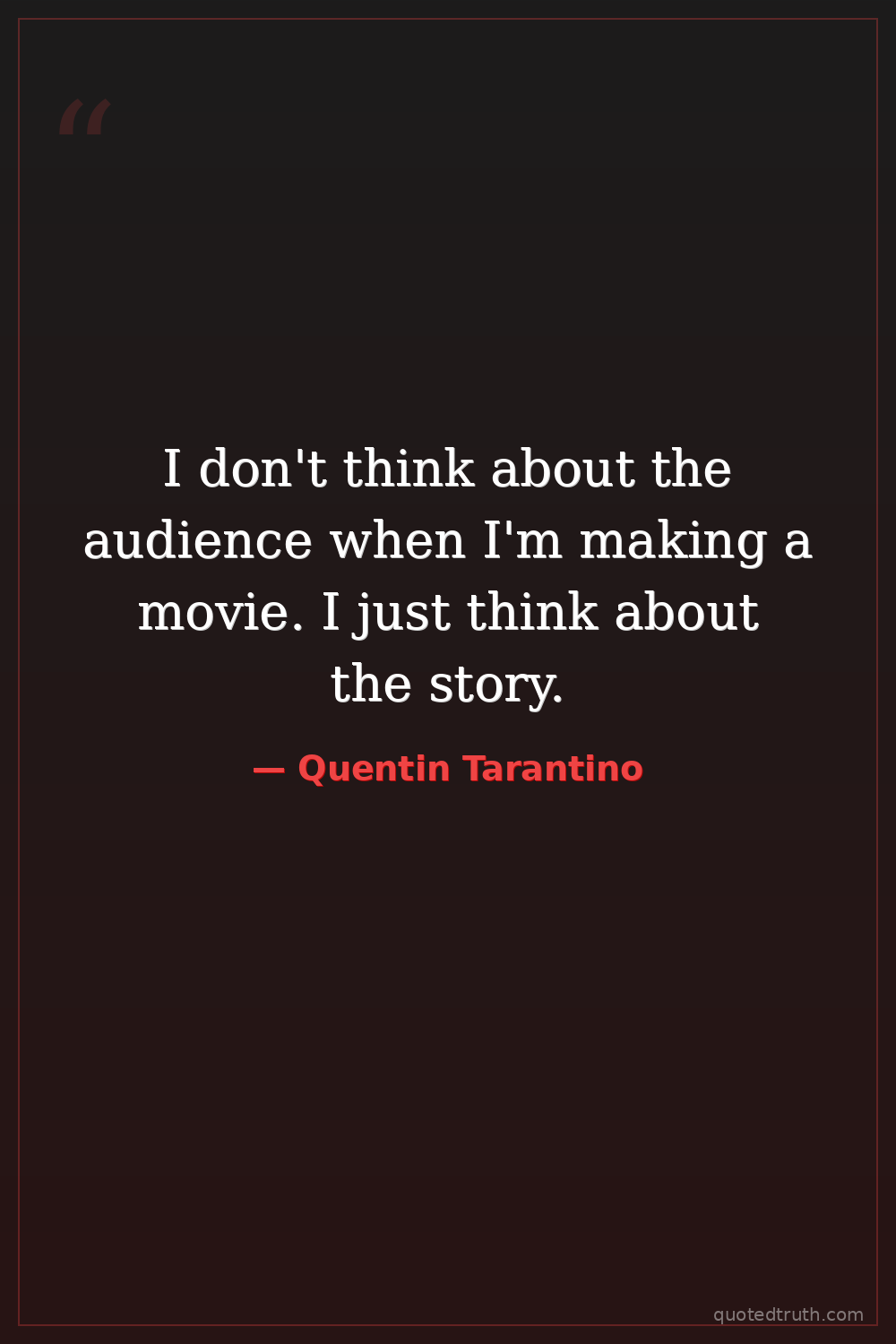
Quentin Tarantino — "I don't think about the audience when I'm making a movie. I just think about the…"
I don't think about the audience when I'm making a movie. I just think about the story.
I don't think about the audience when I'm making a movie. I just think about the story.
Click any product to generate a realistic preview. Up to 3 at a time.
* Initial load can take up to 90 seconds — revising the preview in another color is nearly instant.
"I've always been a big fan of dialogue. I think dialogue is the most important part of a movie."
"If I've made it a little easier for artists to work in violence, great!"
"I'm a big fan of film noir. It's my favorite genre."
"I have absolutely no hypocrisy or contradiction whatsoever to say that you know I abhor violence in real life and I can love it in genre. and I can love it in stories and I can love it in uh novels."
"The flaw is Paul Dano. Obviously, it's supposed to be a two-hander, and it's also so drastically obvious that it's not a two-hander. … He is weak sauce, man. He's a weak sister."
American filmmaker (Pulp Fiction, Kill Bill, Inglourious Basterds) whose intertextual genre-collage redefined 1990s independent cinema. Closely associated with Robert Rodriguez (frequent collaborator (From Dusk Till Dawn, Sin City)) and Paul Thomas Anderson (1990s indie-auteur peer). For an intellectual contrast, see Stanley Kubrick, meticulous formalist filmmaker (1928-1999) — Kubrick's films erase influences into singular monolithic vision through year-long shoots and 100-take perfectionism; Tarantino's foreground every reference as a deliberate tribute — the two opposite ways auteurist cinema can be made.
Your cart is empty