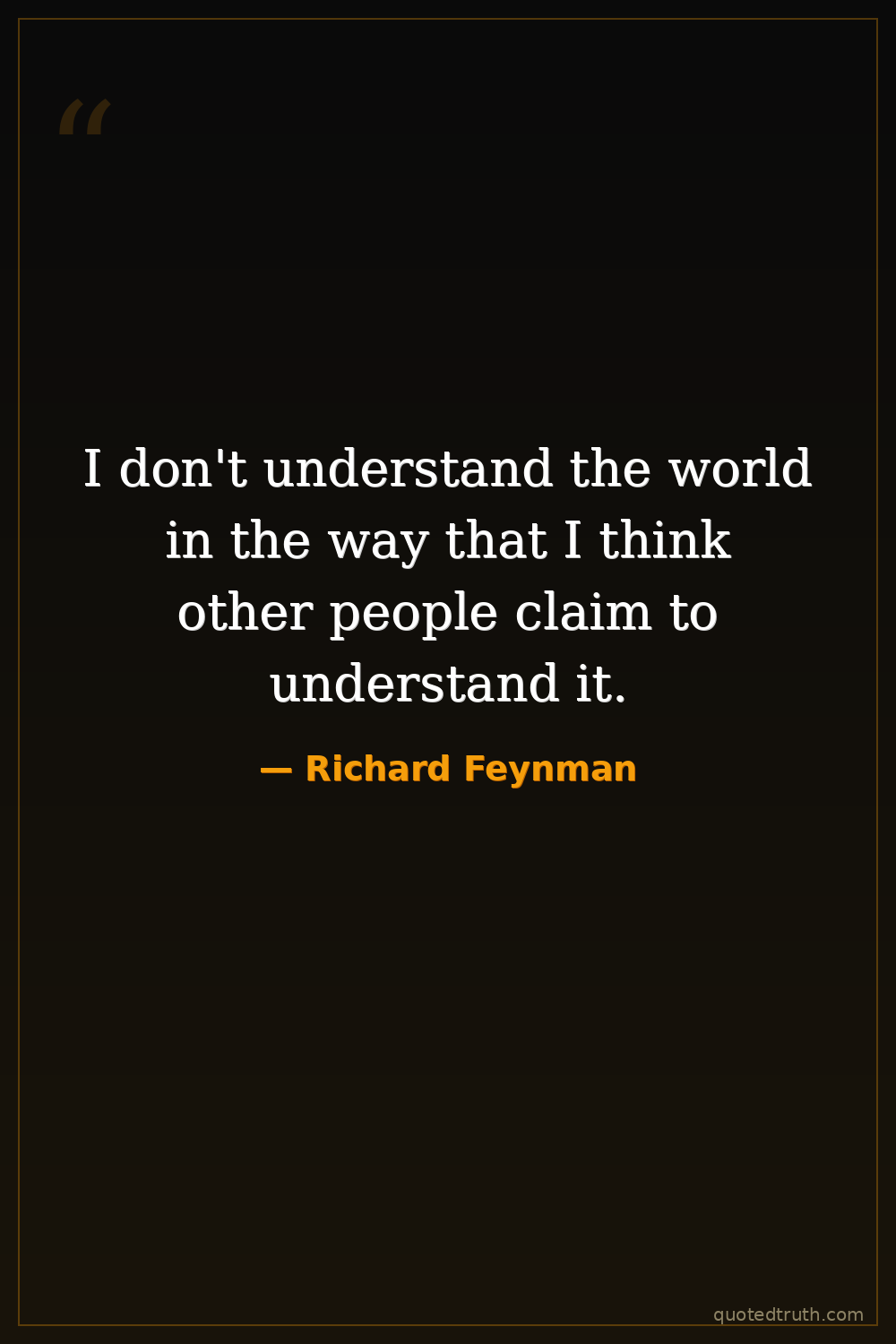
Richard Feynman — "I don't understand the world in the way that I think other people claim to under…"
I don't understand the world in the way that I think other people claim to understand it.
I don't understand the world in the way that I think other people claim to understand it.
Click any product to generate a realistic preview. Up to 3 at a time.
* Initial load can take up to 90 seconds — revising the preview in another color is nearly instant.
"I don't have to be polite when I'm doing science."
"I don't think I'm a very good teacher. I just try to explain things clearly."
"I can live with doubt and uncertainty and not knowing. I think it's much more interesting to live not knowing than to have answers which might be wrong."
"I have a great deal of difficulty with the idea of 'truth' in the philosophical sense."
"I would rather have a world with five billion people that didn't know how to read than a world with five billion people that all knew how to read and all thought the same thing."
American theoretical physicist who shared the 1965 Nobel for QED, developed Feynman diagrams, and wrote the Feynman Lectures on Physics. Closely associated with Julian Schwinger (co-Nobelist for QED) and Murray Gell-Mann (Caltech rival and Eightfold-Way physicist). For an intellectual contrast, see Deepak Chopra, physician and quantum-mysticism author — Feynman's Caltech 'cargo cult science' commencement address is the precise template for what he saw as misuse of physics terminology — Chopra-style appropriation of quantum vocabulary for metaphysical claims is the canonical example of what Feynman called 'fooling yourself'.
Found in 1 providers: grok
1 source checked
Feynman admits his understanding of the world is fundamentally different from how most people claim theirs works. He's skeptical of confident declarations of understanding, suggesting most people mistake familiarity for genuine comprehension. True understanding requires deep, rigorous examination — not surface-level recognition. He's comfortable sitting with uncertainty rather than performing false confidence about how reality operates.
Feynman won the Nobel Prize for quantum electrodynamics, a field so counterintuitive that even its founders found it baffling. He famously distinguished between knowing a name and actually understanding something. His Feynman Technique for learning, his Caltech lectures, and his work on the Challenger disaster all reflect a relentless demand for honest, first-principles comprehension over borrowed certainty.
Post-WWII physics transformed science into an institution with enormous authority and public prestige. Scientists were expected to project confidence and mastery. Amid Cold War competition, the Manhattan Project legacy, and rapid technological progress, admitting ignorance was professionally risky. Feynman's intellectual honesty was countercultural — celebrating uncertainty in an era when science was being sold as humanity's master key to all answers.
AI-generated insights based on extensive research and information for context. Factual errors? Email [email protected].
Your cart is empty