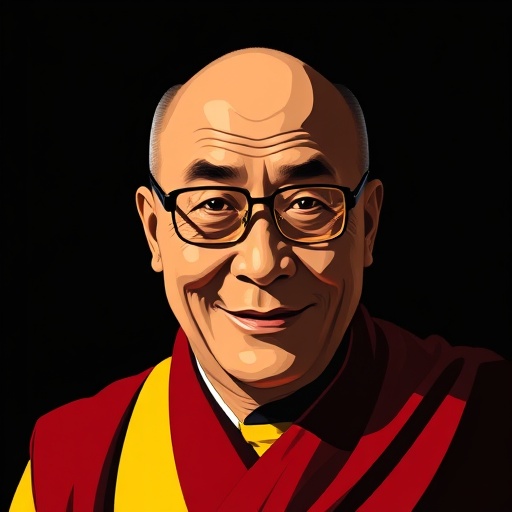
Dalai Lama (14th) — "I feel that if one has a good heart, one will be happy."
I feel that if one has a good heart, one will be happy.
I feel that if one has a good heart, one will be happy.
Click any product to generate a realistic preview. Up to 3 at a time.
* Initial load can take up to 90 seconds — revising the preview in another color is nearly instant.
"Europe, I think, Europe is for Europeans."
"Sometimes I think I am a little bit lazy."
"I think the most important thing is to be a good human being. That is the essence of all religions."
"I think the very purpose of our life is to seek happiness."
"I consider myself a simple Buddhist monk. My life is not complicated."
Found in 1 providers: grok
1 source checked
Genuine happiness isn't produced by wealth, status, or circumstances but springs directly from moral character — specifically, from caring about others. A person who cultivates kindness, empathy, and integrity creates the internal conditions that make contentment possible. The quote rejects the consumerist idea that acquiring more leads to satisfaction and instead locates happiness inside the person, as a byproduct of how they treat the world around them.
Tenzin Gyatso has spent decades teaching that compassion — not doctrine — is the root of well-being, a message he maintained after China's occupation forced him into exile in 1959. His book The Art of Happiness and his advocacy for secular ethics demonstrate this conviction: inner goodness transcends religion, politics, and suffering. Despite losing his homeland, he consistently models contentment rooted in warmheartedness rather than bitterness or material recovery.
The Dalai Lama came of age during the Cold War and Tibet's brutal absorption by China in 1950. By the time he rose to global prominence in the 1980s–90s, Western consumerism was peaking — prosperity spreading yet depression and anxiety rising sharply. His message landed as a counterpoint: despite geopolitical upheaval and displacement, inner moral goodness remains available to anyone. The 1989 Nobel Peace Prize amplified this philosophy to a global audience.
AI-generated insights based on extensive research and information for context. Factual errors? Email [email protected].
Your cart is empty