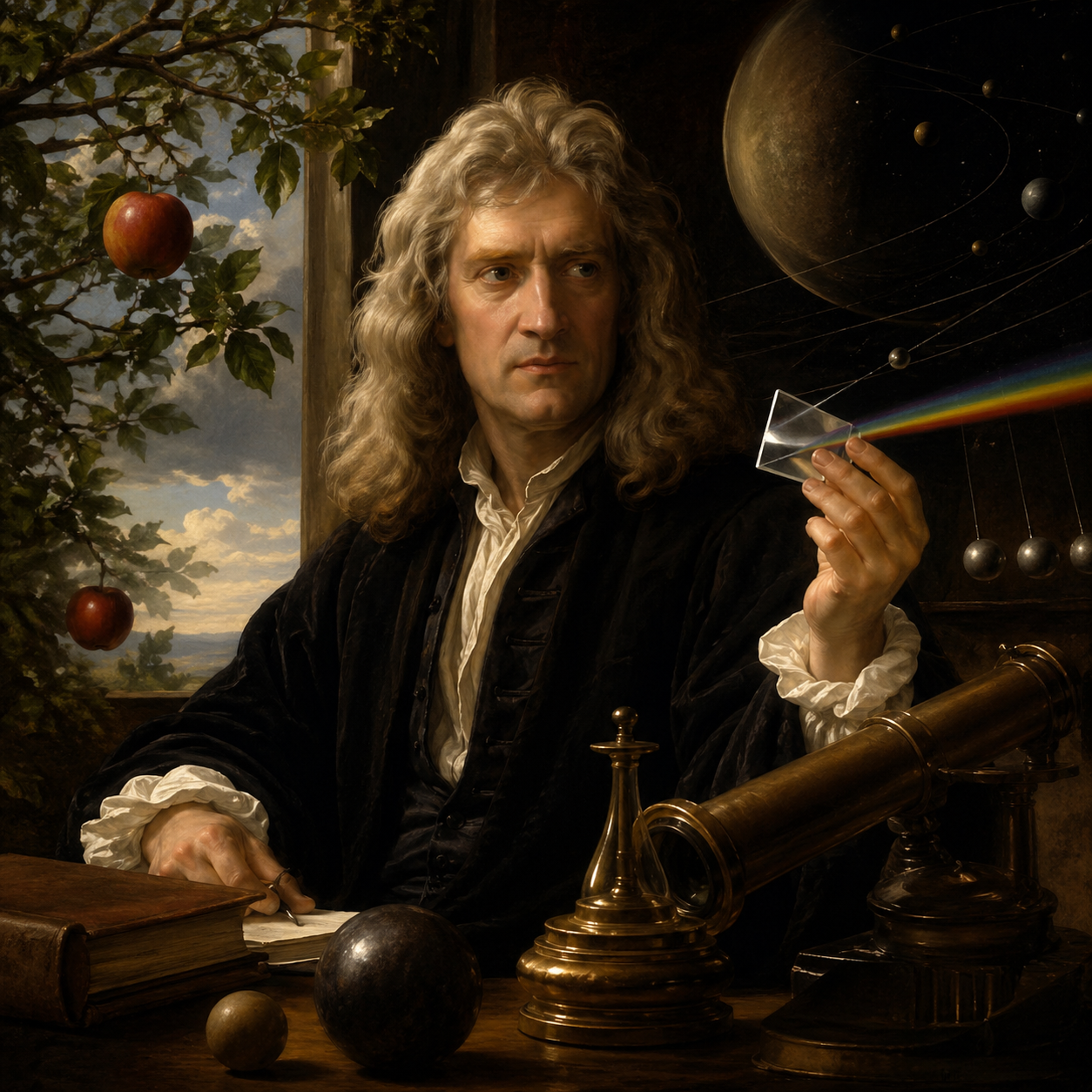
Isaac Newton — "I feign no hypotheses."
I feign no hypotheses.
I feign no hypotheses.
Click any product to generate a realistic preview. Up to 3 at a time.
* Initial load can take up to 90 seconds — revising the preview in another color is nearly instant.
"The cause of gravity is what I do not pretend to know."
"The description of right lines and circles, upon which geometry is founded, belongs to mechanics. Geometry does not teach us to draw these lines, but requires them to be drawn."
"The whole difficulty of philosophy seems to consist in this—from the phenomena of motions to investigate the forces of nature, and then from these forces to demonstrate the other phenomena."
"God in the beginning formed matter in solid, massy, hard, impenetrable, moveable particles, of such sizes and figures, and with such other properties, and in such proportion to space, as most conduced…"
"Truth is ever to be found in simplicity, and not in the multiplicity and confusion of things."
Found in 2 providers: deepseek,grok
2 sources checked
I don't invent explanations I can't prove. When I don't have experimental evidence for something, I won't pretend I do. Science should describe what we observe and measure, not fabricate convenient stories to fill gaps. If the data doesn't support a claim, that claim doesn't belong in serious inquiry — silence is more honest than speculation dressed up as knowledge.
Newton wrote this in the Principia Mathematica defending his law of universal gravitation. Critics demanded he explain why gravity worked — what mechanism caused it. Newton refused to speculate without evidence. This was radical intellectual discipline: he had derived the mathematical laws governing planetary motion precisely, but wouldn't fabricate a causal mechanism he couldn't demonstrate. His entire career was built on this empirical rigor.
In Newton's era, natural philosophers routinely invented elaborate mechanical explanations — vortices, ethers, occult forces — to account for phenomena. Descartes filled the universe with invisible swirling matter to explain planetary orbits. Newton's refusal to do the same was a deliberate break with that tradition, helping establish the modern scientific standard that observation and mathematics, not invented mechanisms, constitute legitimate natural philosophy.
AI-generated insights based on extensive research and information for context. Factual errors? Email [email protected].
Your cart is empty