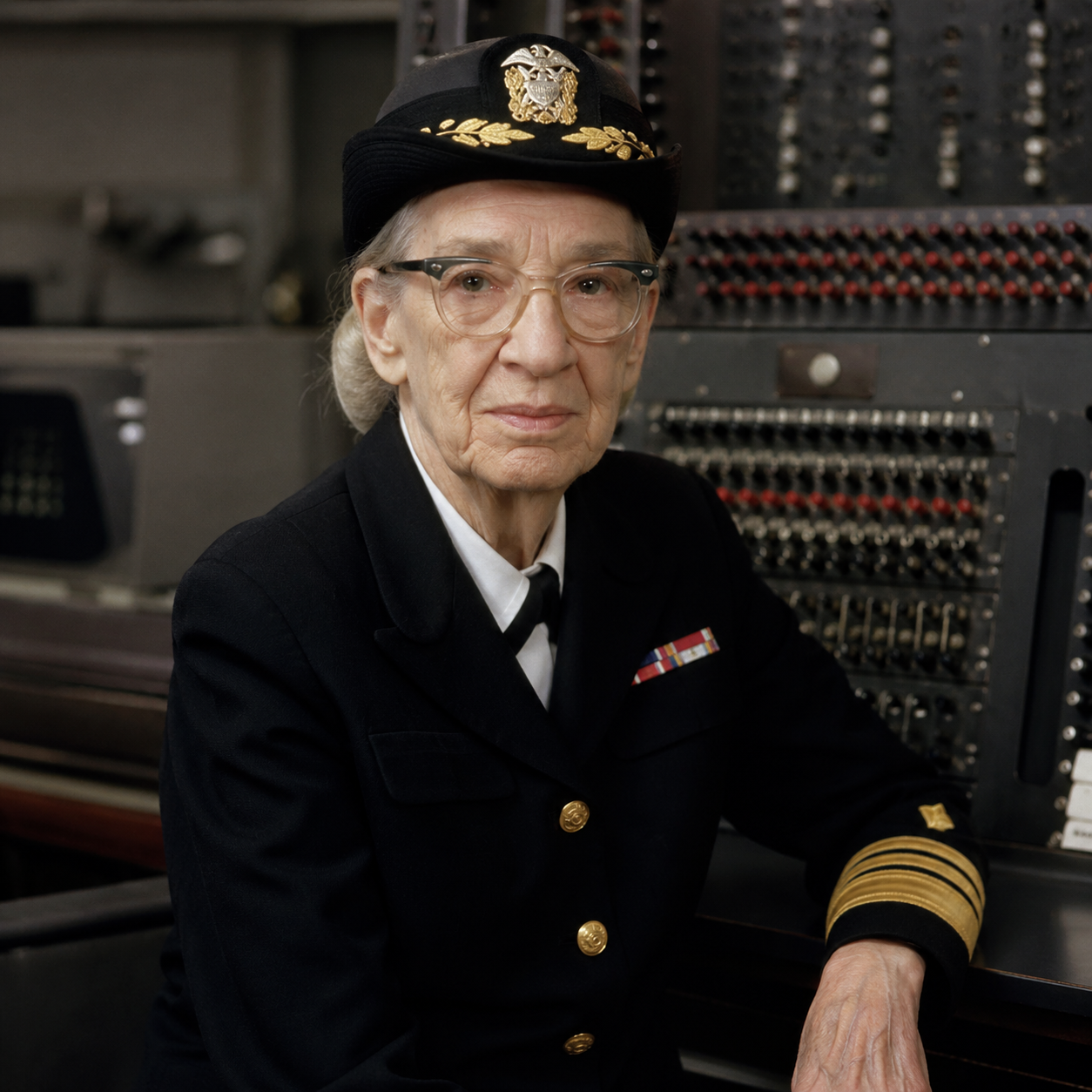
Grace Hopper — "I had a running compiler and nobody would touch it. They told me computers could…"
I had a running compiler and nobody would touch it. They told me computers could only do arithmetic.
I had a running compiler and nobody would touch it. They told me computers could only do arithmetic.
Click any product to generate a realistic preview. Up to 3 at a time.
* Initial load can take up to 90 seconds — revising the preview in another color is nearly instant.
"We're flooding people with information. We need to feed it through a processor. A human must turn information into intelligence or knowledge. We've tended to forget that no computer will ever ask a ne…"
"I never met a computer I didn't like."
"From then on, when anything went wrong with a computer, we said it had bugs in it."
"You don't teach people how to be curious. You give them the tools through which they can express their curiosity."
"Life was simple before World War II. After that, we had systems."
Recalling the initial resistance and skepticism towards her development of the first compiler.
Date: Circa 1952 (spoken about later, e.g., in 1987 speech)
Life & AgingFound in 1 providers: gemini
1 source checked
Hopper built a program that translated human-readable instructions into machine code — a compiler — but colleagues dismissed it as impossible because they believed computers were pure calculators, nothing more. The quote captures the frustration of introducing a paradigm-shifting idea into an environment locked in dogma. It shows how institutional resistance, not technical limits, blocks progress: the technology already worked, but minds hadn't expanded to accept what was now possible.
Hopper literally lived this moment — she built the A-0 compiler in 1952 at Remington Rand, then FLOW-MATIC, which directly inspired COBOL. Colleagues and managers repeatedly insisted computers couldn't process language. Her entire career was defined by proving that wrong. Her famous maxim — 'It's easier to ask forgiveness than permission' — grew from exactly this pattern: build it first, demonstrate it works, argue the theory afterward.
In the late 1940s and early 1950s, computers like ENIAC and UNIVAC were conceived strictly as sophisticated calculators — tools for ballistics, census work, and scientific equations. No consensus existed that machines could process symbolic language or translate code. Hopper's compiler challenged the foundational assumption of an entire field. The Cold War-era computing establishment was mathematically trained and deeply skeptical of anything blurring the boundary between machine arithmetic and human language.
AI-generated insights based on extensive research and information for context. Factual errors? Email [email protected].
Your cart is empty