Charles Darwin — "I had no intention of writing an autobiography, but I found myself doing so."
I had no intention of writing an autobiography, but I found myself doing so.
I had no intention of writing an autobiography, but I found myself doing so.
Click any product to generate a realistic preview. Up to 3 at a time.
* Initial load can take up to 90 seconds — revising the preview in another color is nearly instant.
"But I am very poorly today & very stupid & I hate everybody & everything. One lives only to make blunders."
"If it could be demonstrated that any complex organ existed, which could not possibly have been formed by numerous, successive, slight modifications, my theory would absolutely break down."
"I have steadily endeavoured to keep my mind free so as to give up any hypothesis, however much beloved, as soon as facts are shown to be opposed to it."
"My mind seems to have become a kind of machine for grinding general laws out of large collections of facts."
"Thus, from the war of nature, from famine and death, the most exalted object which we are capable of conceiving, namely, the production of the higher animals, directly follows."
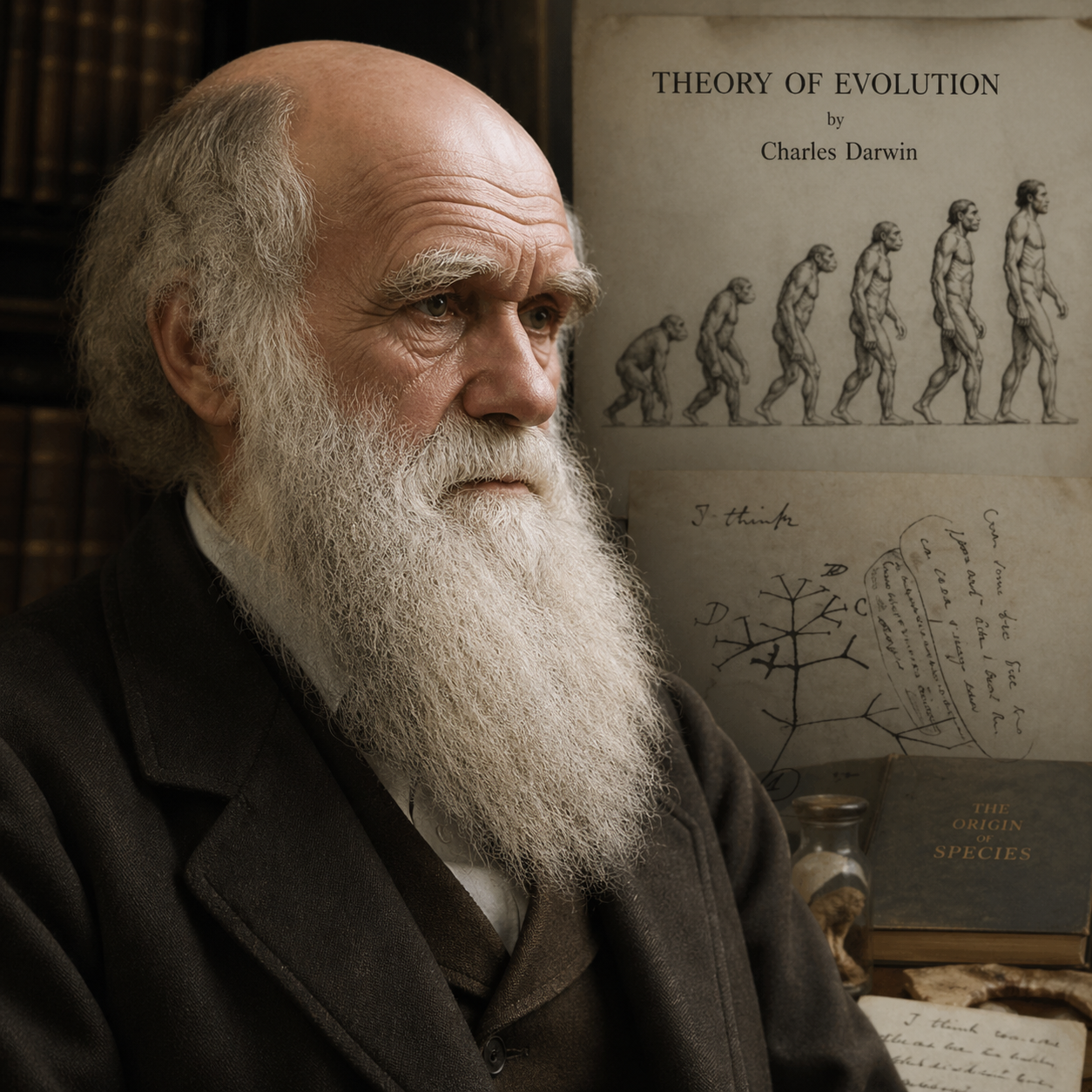
British naturalist whose On the Origin of Species (1859) established evolution by natural selection — the unifying theory of modern biology. Closely associated with Thomas Henry Huxley (his 'bulldog' public defender) and Alfred Russel Wallace (independent co-discoverer of natural selection). For an intellectual contrast, see William Paley, Anglican theologian and Natural Theology author (1743-1805) — Origin of Species is structurally a 400-page reply to Paley — Darwin admired Paley's watchmaker-argument as an undergraduate at Cambridge and then spent 20 years building the empirical machinery to displace him. The cleanest 'design argument vs natural selection' founding rebuttal in science.
The standard scholarly entry points to Charles Darwin's work: Janet Browne (Harvard, history of science) — Charles Darwin: Voyaging (1995) and The Power of Place (2002); Adrian Desmond (UCL, biographer) — Darwin: The Life of a Tormented Evolutionist (1991, with James Moore). These are the works graduate seminars cite when teaching Charles Darwin.
From the opening of his autobiography, a humorous admission.
Date: c. 1870s
Self-DeprecatingFound in 1 providers: grok
1 source checked
This quote captures how self-reflection can begin without conscious intent — a person simply starts examining their own life and finds the act already underway. It acknowledges that autobiography isn't always a deliberate project but can emerge naturally, almost involuntarily. The phrase 'I found myself doing so' suggests an internal momentum beyond the writer's control, as if memory and introspection carry their own gravity, pulling a person toward documentation whether they planned it or not.
Darwin wrote his autobiography in 1876 at age 67, originally titled 'Recollections of the Development of my Mind and Character,' intended solely for his family, not publication. A scientist by temperament, he spent decades cataloguing barnacles, finches, and earthworms — not his own psyche. Yet his lifelong habit of meticulous journaling, beginning with the Beagle voyage, naturally drew him toward self-documentation. His reluctance mirrors the years he spent delaying publication of 'On the Origin of Species' out of characteristic caution and modesty.
Darwin wrote this in 1876, during Victorian autobiography's golden age, when the form gained legitimacy as a way for public figures to shape intellectual legacy. After 'On the Origin of Species' (1859) overturned religious and scientific orthodoxy, Victorian society was intensely curious about the inner lives of transformative thinkers. Darwin had become one of the era's most celebrated and controversial figures, creating cultural pressure — despite his modest instincts — to document how a quiet naturalist arrived at ideas that reshaped humanity's understanding of itself.
AI-generated insights based on extensive research and information for context. Factual errors? Email [email protected].
Your cart is empty