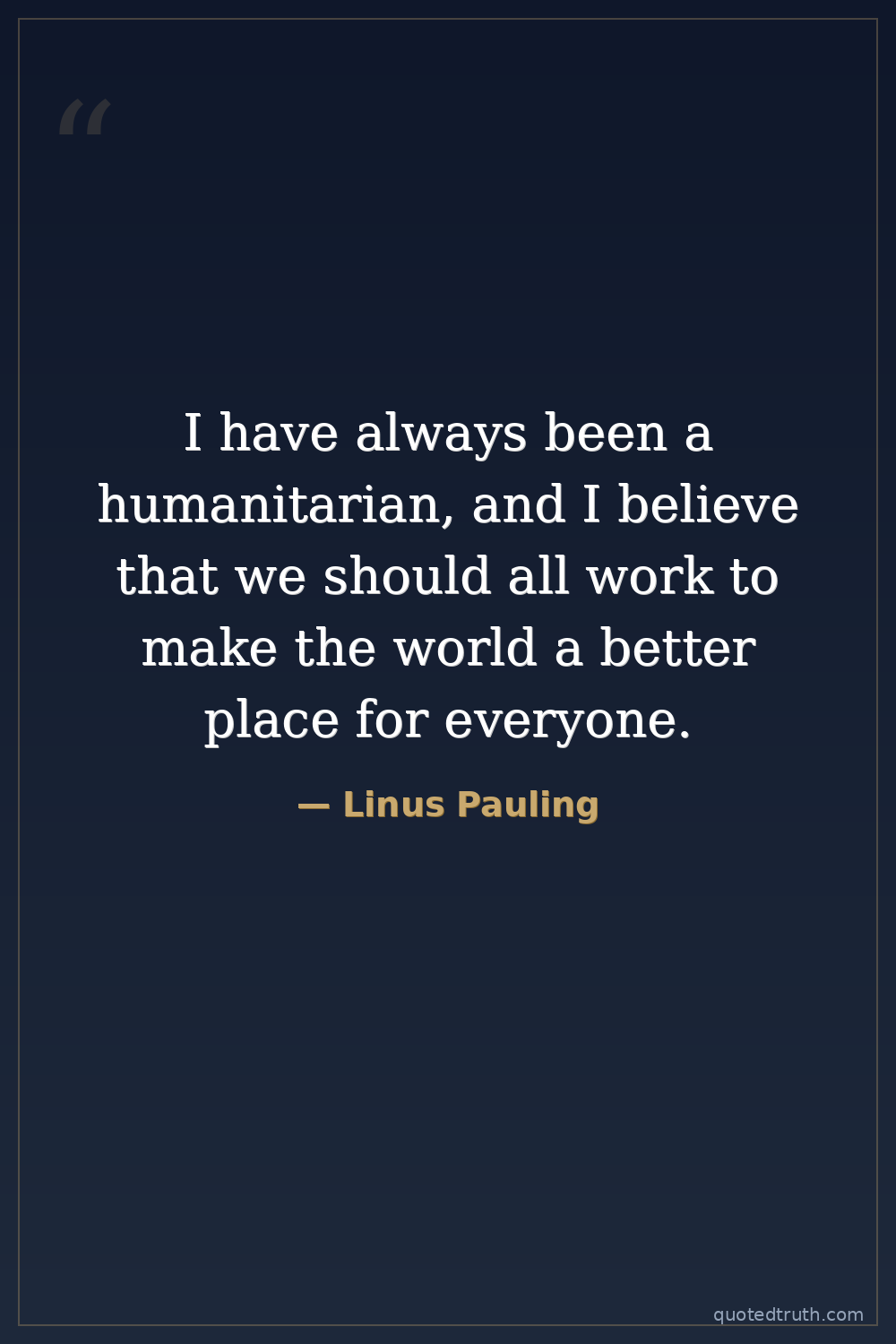
Linus Pauling — "I have always been a humanitarian, and I believe that we should all work to make…"
I have always been a humanitarian, and I believe that we should all work to make the world a better place for everyone.
I have always been a humanitarian, and I believe that we should all work to make the world a better place for everyone.
Click any product to generate a realistic preview. Up to 3 at a time.
* Initial load can take up to 90 seconds — revising the preview in another color is nearly instant.
"A good scientist thinks logically and accurately when conditions call for logical and accurate thinking—but so does any other good worker when he has a sufficient number of well-founded facts to serve…"
"Well, I thought, that's nice of the old guy to say that, but I'm a little skeptical myself. And as the years went by, I thought, I don't do the sort of work for which Nobel Prizes are given."
"There is no such thing as a 'safe' dose of radiation."
"I had begun to think about the theory of the chemical bond very seriously in 1926, '27, after quantum mechanics was discovered and then in 1928 I published a paper, a preliminary paper, and said that …"
"The most important thing in life is to be happy."
Found in 1 providers: grok
1 source checked
The quote expresses a commitment to human welfare above self-interest — the speaker declares that improving life for all people is not just an aspiration but a personal obligation. It frames humanitarianism as active, collaborative work rather than passive goodwill, insisting that bettering the world is a shared responsibility every person should take up.
Pauling lived this conviction literally. He risked his scientific reputation and faced FBI surveillance and passport denial by opposing nuclear weapons testing in the 1950s–60s. His campaign for the 1963 Partial Test Ban Treaty earned him the Nobel Peace Prize, making him one of only two people to win two unshared Nobel Prizes. His chemistry aimed at understanding life itself, not merely academic prestige.
Pauling's humanitarian voice peaked during the Cold War, when nuclear proliferation threatened civilization. The 1950s–60s brought hydrogen bomb tests, the Cuban Missile Crisis, and McCarthyite persecution of dissidents. Scientists debated their moral responsibility for weapons they helped create. Pauling's petitions, signed by thousands of scientists worldwide, helped pressure governments toward the 1963 Partial Nuclear Test Ban Treaty — a landmark arms-control achievement.
AI-generated insights based on extensive research and information for context. Factual errors? Email [email protected].
Your cart is empty