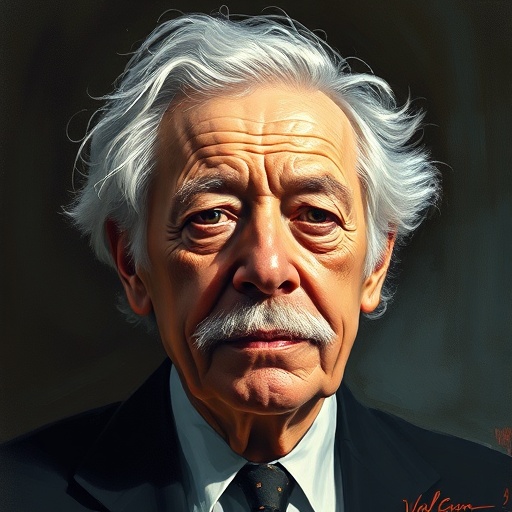
Linus Pauling — "I have always been a rebel."
I have always been a rebel.
I have always been a rebel.
Click any product to generate a realistic preview. Up to 3 at a time.
* Initial load can take up to 90 seconds — revising the preview in another color is nearly instant.
"Science is the search for truth, but it is not the search for certainty. When science is used to search for certainty, it becomes something other than science."
"The scientific method is a never-ending process of observation, hypothesis, experiment, and revision."
"I think that the future of medicine is in prevention, not in treatment."
"I believe that the pursuit of knowledge is one of the most noble endeavors of humanity."
"Orthomolecular medicine is the preservation of good health and the treatment of disease by varying the concentrations of substances normally present in the body."
Found in 1 providers: grok
1 source checked
The speaker embraces nonconformity as a fundamental part of their identity — not as occasional defiance, but as a consistent stance against orthodoxy, authority, and received wisdom. It signals a life lived on one's own terms, prioritizing independent judgment over social acceptance, institutional approval, or conventional paths. Rebellion here is not adolescent contrarianism but a principled refusal to be constrained by others' expectations.
Pauling embodied this across two entirely different domains. In chemistry, he revolutionized understanding of chemical bonds by applying quantum mechanics, defying classical assumptions. Later, he defied Cold War conformity by campaigning against nuclear weapons testing, losing his passport and facing government scrutiny. He won Nobel Prizes in both Chemistry and Peace — an almost unthinkable combination that only a genuine rebel achieves.
Pauling's career spanned the 1930s through Cold War America, when scientific orthodoxy was entrenched and political dissent carried real consequences. McCarthyism punished intellectual independence brutally. Scientists were expected to serve state interests, not challenge them. Pauling's public anti-nuclear stance during the 1950s-60s arms race, when conformity was enforced through social and legal pressure, made his rebellion genuinely dangerous and historically significant.
AI-generated insights based on extensive research and information for context. Factual errors? Email [email protected].
Your cart is empty