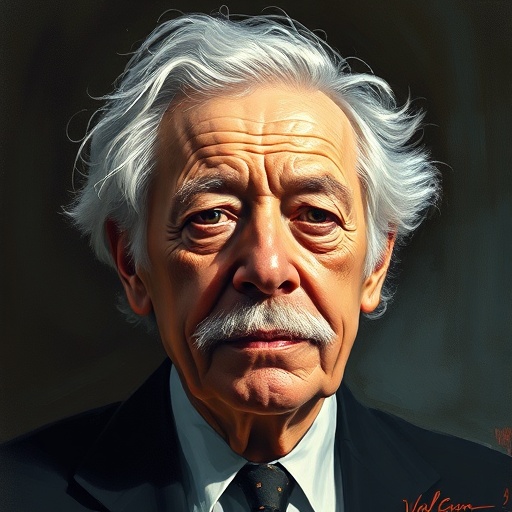
Linus Pauling — "I have always liked working in some directions that people say, 'Well, that's ri…"
I have always liked working in some directions that people say, 'Well, that's ridiculous.'
I have always liked working in some directions that people say, 'Well, that's ridiculous.'
Click any product to generate a realistic preview. Up to 3 at a time.
* Initial load can take up to 90 seconds — revising the preview in another color is nearly instant.
"I am not interested in fame or fortune. I am interested in truth."
"To awaken an interest in chemistry in students we mustn't make the courses consist entirely of explanations, forgetting to mention what there is to be explained."
"The most important thing in life is to be happy, and to make others happy."
"The most important thing is to never stop questioning."
"The only way to get a good idea is to get a lot of ideas and throw the bad ones away."
Found in 1 providers: deepseek
1 source checked
Pursuing ideas others ridicule takes genuine intellectual courage. This expresses a mindset of deliberate contrarianism — finding value precisely where mainstream opinion says none exists. It champions following evidence and intuition over social approval, treating peer skepticism as a signal worth investigating rather than a reason to stop. The truly novel often looks absurd before it looks obvious.
Pauling won two unshared Nobel Prizes — Chemistry (1954) and Peace (1962) — by pursuing exactly this pattern. His quantum-mechanical model of chemical bonding met early resistance. His megadose vitamin C campaign was widely mocked by mainstream medicine, yet he pursued it for decades. His anti-nuclear peace activism cost him his passport under McCarthyism, yet he refused to abandon it. Contrarianism was his operating system.
Pauling's most provocative work emerged during mid-20th century America, when scientific disciplines had rigid boundaries and Cold War conformity pressured public figures to stay in lane. McCarthyism labeled peace activists communist sympathizers. The medical establishment treated vitamin megadosing as quackery. Applying quantum physics to chemistry was daringly interdisciplinary in a siloed era. Institutional authority carried enormous weight, making independent dissent professionally and personally costly.
AI-generated insights based on extensive research and information for context. Factual errors? Email [email protected].
Your cart is empty