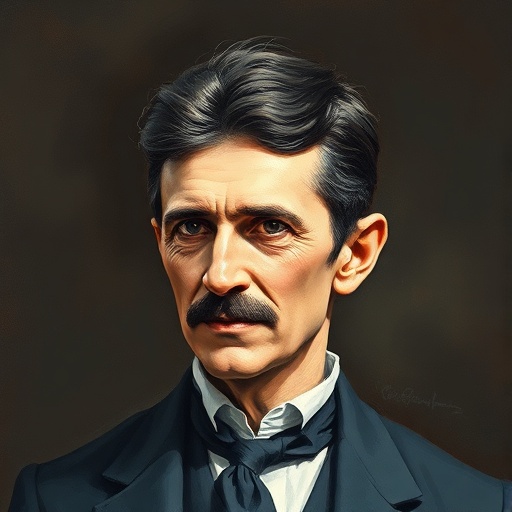
Nikola Tesla — "I have an absolute aversion to pearls."
I have an absolute aversion to pearls.
I have an absolute aversion to pearls.
Click any product to generate a realistic preview. Up to 3 at a time.
* Initial load can take up to 90 seconds — revising the preview in another color is nearly instant.
"Of all things, I liked books best."
"I do not hesitate to state here for the world that there is no electrical principle or device which I have not conceived and substantially perfected in my own mind."
"I have been called by some a visionary, by others a dreamer, but I am a practical man."
"I don't care that they stole my idea . . I care that they don't have any of their own."
"Our senses enable us to perceive only a minute portion of the outside world."
Serbian-American inventor and electrical engineer whose alternating-current designs powered the modern electrical grid; died poor and largely forgotten. Closely associated with George Westinghouse (his AC-power business partner) and Mihajlo Pupin (fellow Serbian-American physicist at Columbia). For an intellectual contrast, see Thomas Edison, American inventor and direct-current advocate — Edison's direct-current power-distribution scheme was displaced by Tesla-Westinghouse AC in the 1890s 'War of Currents'. Edison ran a public-relations campaign electrocuting animals to discredit AC — the most famous engineering-ethics rivalry in American history. Tesla's AC won and powers nearly every electrical grid on Earth.
Reported idiosyncrasy, mentioned in biographies like 'Prodigal Genius' by O'Neill.
Date: Throughout his adult life
GeneralFound in 1 providers: grok
1 source checked
The speaker expresses a strong, unwavering disgust or revulsion toward pearls specifically. This isn't mild dislike but a visceral, physical aversion — the kind that produces genuine discomfort or distress upon encountering the object. It speaks to an intense sensory sensitivity where certain textures, appearances, or associations trigger an involuntary negative reaction that the person cannot simply override through reason or willpower.
Tesla was famously afflicted with severe sensory sensitivities and phobias, particularly toward round objects and certain textures. He reportedly could not stand the sight of pearls on women and would ask them to leave his presence. This hypersensitivity was part of his broader obsessive-compulsive tendencies and neurological peculiarities — traits that coexisted with, and perhaps fueled, his extraordinary capacity for intense mental concentration and visualization.
In the late 19th and early 20th centuries, pearls were among the most coveted luxury accessories for wealthy women, symbolizing refinement and social status in Gilded Age America and Edwardian Europe. Tesla's aversion placed him at odds with fashionable society at a time when he regularly mingled with elites. Sensory processing differences had no clinical framework then — such aversions were considered mere eccentricities rather than neurological conditions.
AI-generated insights based on extensive research and information for context. Factual errors? Email [email protected].
Your cart is empty