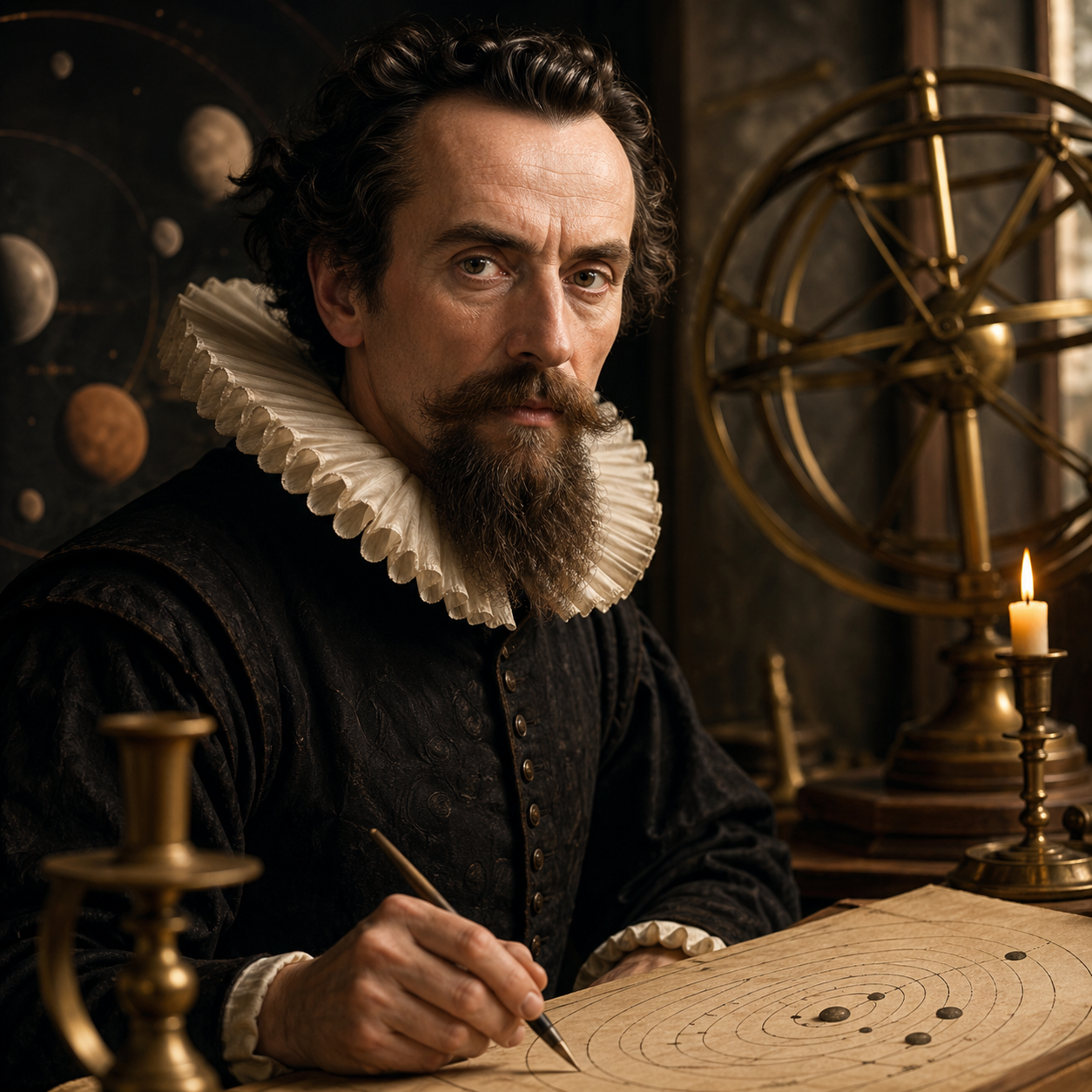
Johannes Kepler — "I have been a man of faith, and I have trusted in God's plan."
I have been a man of faith, and I have trusted in God's plan.
I have been a man of faith, and I have trusted in God's plan.
Click any product to generate a realistic preview. Up to 3 at a time.
* Initial load can take up to 90 seconds — revising the preview in another color is nearly instant.
"I am stealing the golden vessels of the Egyptians to build a tabernacle to my God from them, far far away from the boundaries of Egypt. If you forgive me, I shall rejoice; if you are enraged with me, …"
"I am not ashamed to confess that I have often been mistaken."
"Mathematics is the alphabet with which God has written the universe."
"I have a mind that is always seeking new things."
"The heavenly motions are nothing but a continuous song for several voices, perceived not by the ear but by the intellect."
Found in 1 providers: grok
1 source checked
The speaker is declaring that throughout their life they have held firm religious belief and relied on the conviction that a divine intelligence is directing events toward a purposeful outcome. Rather than depending solely on personal ambition or random chance, they have accepted that a higher order shapes their path. It is an affirmation of trust, humility, and surrender to providence as the guiding framework for how they have lived.
Kepler was deeply devout, originally training for Lutheran ministry before turning to astronomy. He viewed the cosmos as a manifestation of divine geometry and famously called his discoveries 'thinking God's thoughts after Him.' Despite excommunication disputes, losing his mother to witchcraft accusations, and enduring poverty, plague, and religious warfare, he persisted in his planetary research. His faith fueled, rather than opposed, his scientific rigor, making trust in providence central to both his personal resilience and his method.
Kepler lived through the Counter-Reformation and the Thirty Years' War, when Protestant and Catholic powers violently clashed across Central Europe. Astronomers navigated the dangerous transition from Ptolemaic to Copernican cosmology, often risking censure, as Galileo's trial would later show. Science was not separate from theology; natural philosophers framed discoveries as revelations of God's design. For a mathematician publishing heliocentric laws amid sectarian persecution and displacement, declaring trust in divine plan was both spiritually sincere and practically protective.
AI-generated insights based on extensive research and information for context. Factual errors? Email [email protected].
Your cart is empty