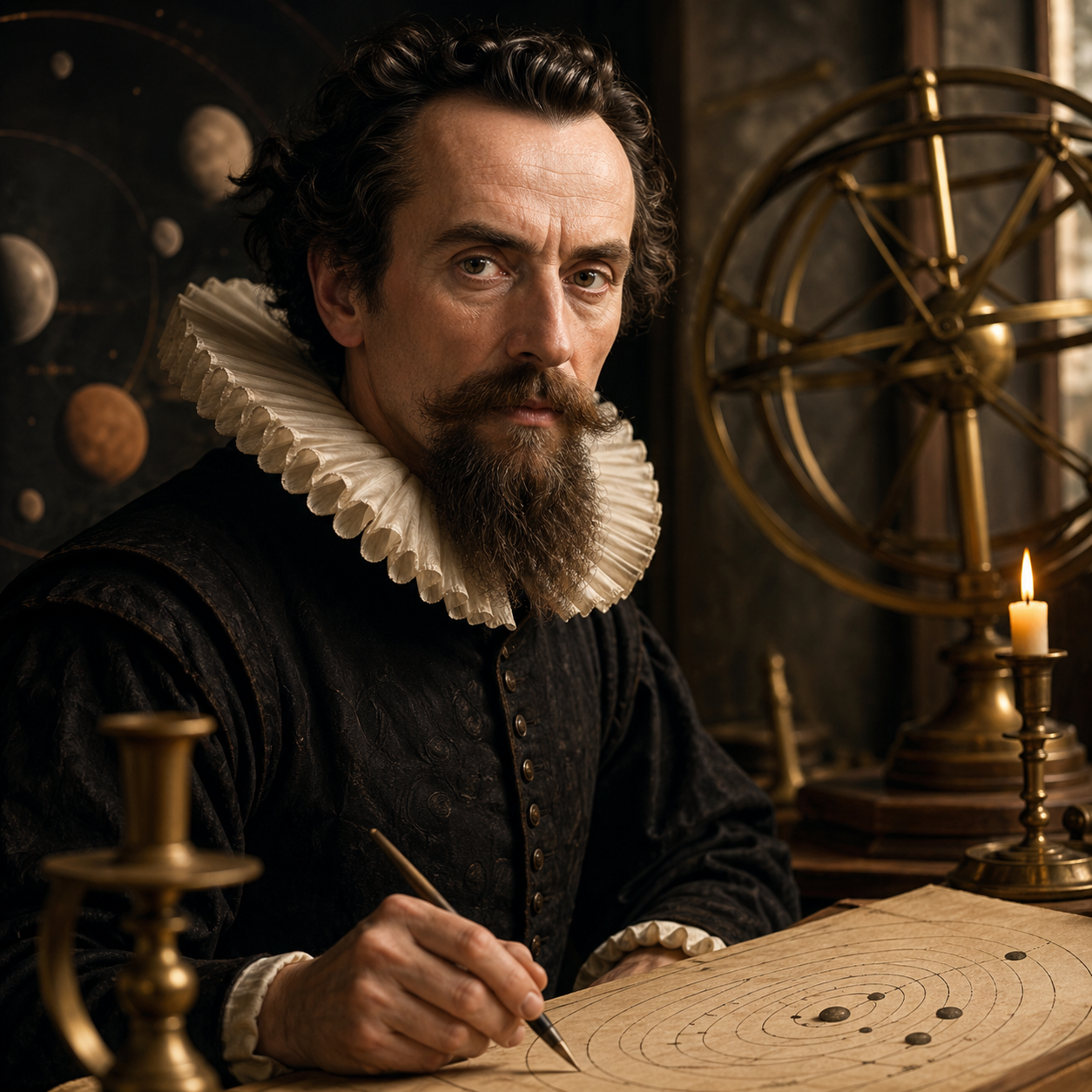
Johannes Kepler — "I have been a solitary man, but I have found joy in my work."
I have been a solitary man, but I have found joy in my work.
I have been a solitary man, but I have found joy in my work.
Click any product to generate a realistic preview. Up to 3 at a time.
* Initial load can take up to 90 seconds — revising the preview in another color is nearly instant.
"I am stealing the golden vessels of the Egyptians to build a tabernacle to my God from them, far far away from the boundaries of Egypt. If you forgive me, I shall rejoice; if you are enraged with me, …"
"I have often been poor, but I have always been rich in spirit."
"The diversity of the phenomena of nature is so great, and the treasures hidden in the heavens so rich, precisely in order that the human mind shall never be lacking in fresh nourishment."
"Some of what these pamphlets [of astrological forecasts] say will turn out to be true, but most of it time and experience will expose as empty and worthless. The latter part will be forgotten [literal…"
"The heavenly motions are nothing but a continuous song for several voices, perceived not by the ear but by the intellect."
Found in 1 providers: grok
1 source checked
The speaker acknowledges living a life largely apart from others, without close companionship or social engagement, yet insists this isolation has not left him empty. Instead of finding fulfillment through relationships or status, he discovers genuine satisfaction and meaning through the labor itself. Work becomes the source of purpose that replaces what solitude denies, turning what could be a lonely existence into one rich with personal reward and quiet contentment.
Kepler endured staggering personal hardship: the early death of his first wife and several children, his mother's witchcraft trial, chronic poverty, and dependence on unstable patrons. Despite constant upheaval, he poured himself into calculating planetary orbits, ultimately deriving his three laws. His deep Lutheran faith framed astronomy as reading God's mind, so solitary computation felt like worship. Joy through obsessive mathematical labor genuinely defined his existence more than family or community ever could.
Early modern Europe was convulsed by the Thirty Years' War, plague outbreaks, and violent Catholic-Protestant conflict that displaced Kepler repeatedly from Graz, Prague, and Linz. The Scientific Revolution was just beginning; Galileo faced the Inquisition, Copernican heliocentrism remained controversial, and scholars worked without institutions, salaries, or peers nearby. Patronage was fickle, communication slow, and intellectual life inherently isolating. A thinker pursuing radical cosmological ideas during this turbulent age had little choice but to find meaning in solitary work.
AI-generated insights based on extensive research and information for context. Factual errors? Email [email protected].
Your cart is empty