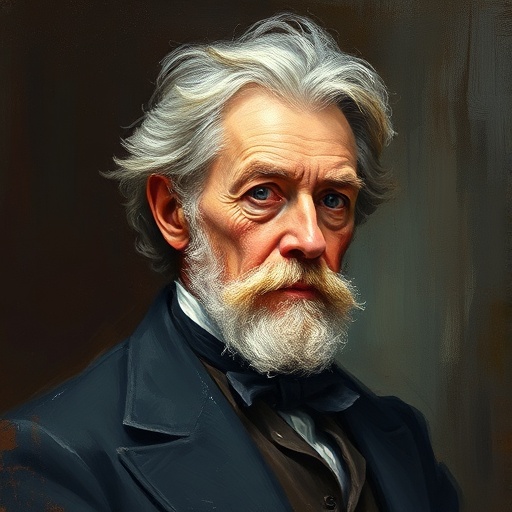
Michael Faraday — "I have been working for some time on the subject of electricity and magnetism, a…"
I have been working for some time on the subject of electricity and magnetism, and I think I have made some discoveries.
I have been working for some time on the subject of electricity and magnetism, and I think I have made some discoveries.
Click any product to generate a realistic preview. Up to 3 at a time.
* Initial load can take up to 90 seconds — revising the preview in another color is nearly instant.
"Let us now consider, for a little while, how wonderfully we stand upon this world. Here it is we are born, bred, and live, and yet we view these things with an almost entire absence of wonder to ourse…"
"I am a simple man, and I have found great joy in the study of nature."
"A man who is certain he is right is almost sure to be wrong."
"I have always tried to make my lectures as clear and simple as possible, so that they may be understood by all."
"The world is full of things that are wonderful, but we only see them when we are looking for them."
Found in 1 providers: grok
1 source checked
The speaker reports they have spent a stretch of time investigating how electricity and magnetism relate, and believes they have uncovered something new. It is a modest, understated announcement of research progress rather than a bold claim of triumph. In plain terms: I have been digging into this problem for a while, and I think I have found something worth sharing.
Faraday was a self-taught bookbinder's apprentice turned Royal Institution experimenter whose patient bench work produced electromagnetic induction in 1831, the principle behind every generator and transformer. The quiet phrasing fits his Sandemanian humility, his distrust of grand theorizing, and his lifelong habit of letting notebook experiments, not rhetoric, carry the argument for him.
In the 1820s and 1830s, natural philosophers across Europe were racing to decode the link Oersted had exposed between current and magnetism. Britain was industrializing rapidly, yet electricity was still a lecture-hall curiosity with no practical power uses. Faraday's induction work, announced in this understated register, gave the coming Victorian age its route to dynamos, telegraphs, and eventually the electrified grid that reshaped modern life.
AI-generated insights based on extensive research and information for context. Factual errors? Email [email protected].
Your cart is empty