Marie Curie — "I have frequently been questioned, especially by women, of how I could reconcile…"
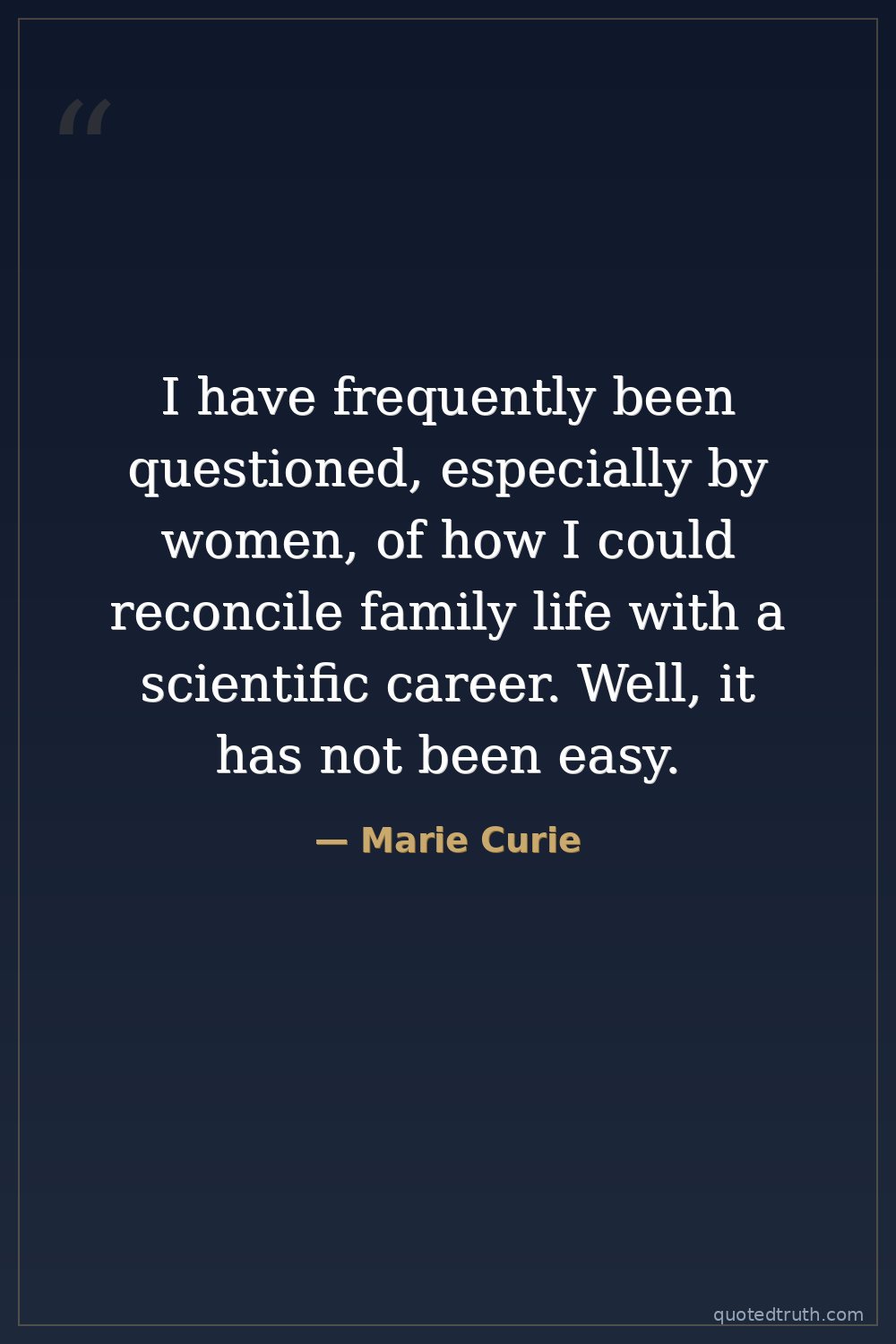
I have frequently been questioned, especially by women, of how I could reconcile family life with a scientific career. Well, it has not been easy.
I have frequently been questioned, especially by women, of how I could reconcile family life with a scientific career. Well, it has not been easy.
Click any product to generate a realistic preview. Up to 3 at a time.
* Initial load can take up to 90 seconds — revising the preview in another color is nearly instant.
"My mind is entirely absorbed by my studies, and I consider it a great privilege to be able to devote myself to them."
"You must never be fearful about what you are doing when it is right."
"There are sadistic scientists who hurry to hunt down errors instead of establishing the truth."
"Life is not easy for any of us. But what of that? We must have perseverance and above all confidence in ourselves."
"I did not come to France to make money. I came to France to study science."
Found in 1 providers: deepseek
1 source checked
Curie acknowledges that combining motherhood and marriage with demanding scientific work was genuinely difficult. She refuses to pretend otherwise or offer a tidy formula. The honesty is the point: women kept asking her for the secret, and her answer is that there was no secret, only persistent effort, sacrifice, and the willingness to keep going while handling competing obligations that men in her field simply never faced.
Curie raised two daughters, Irène and Ève, while conducting the radium research that won her Nobel Prizes in Physics (1903) and Chemistry (1911). She worked alongside husband Pierre until his 1906 death, then continued alone while teaching at the Sorbonne as its first female professor. Her refusal to soften the difficulty matches her lifelong plainspokenness and her awareness that she was a visible exception other women studied.
In the late nineteenth and early twentieth centuries, European universities barely admitted women, married women often lost legal and professional standing, and a scientific career was considered incompatible with motherhood. Curie was repeatedly denied French Academy of Sciences membership despite two Nobels. Working women lacked childcare, maternity protections, or peer networks, so her experience was scrutinized as a referendum on whether women could do serious science at all.
AI-generated insights based on extensive research and information for context. Factual errors? Email [email protected].
Your cart is empty