Charles Darwin — "I have just finished my 'Origin,' and am now going to be a hermit for the rest o…"
I have just finished my 'Origin,' and am now going to be a hermit for the rest of my life.
I have just finished my 'Origin,' and am now going to be a hermit for the rest of my life.
Click any product to generate a realistic preview. Up to 3 at a time.
* Initial load can take up to 90 seconds — revising the preview in another color is nearly instant.
"I have been much struck by the fact that the more I have read about the subject, the less I have understood it."
"There is grandeur in this view of life, with its several powers, having been originally breathed into a few forms or into one; and that whilst this planet has gone cycling on according to the fixed la…"
"What a book a Devil's Chaplain might write on the clumsy, wasteful, blundering, low, and horridly cruel works of nature!"
"It is a wonderful fact that we can understand so much."
"I own that I cannot see as plainly as others do, and as I should wish to do, evidence of design and beneficence on all sides of us. There seems to me too much misery in the world. I cannot persuade my…"
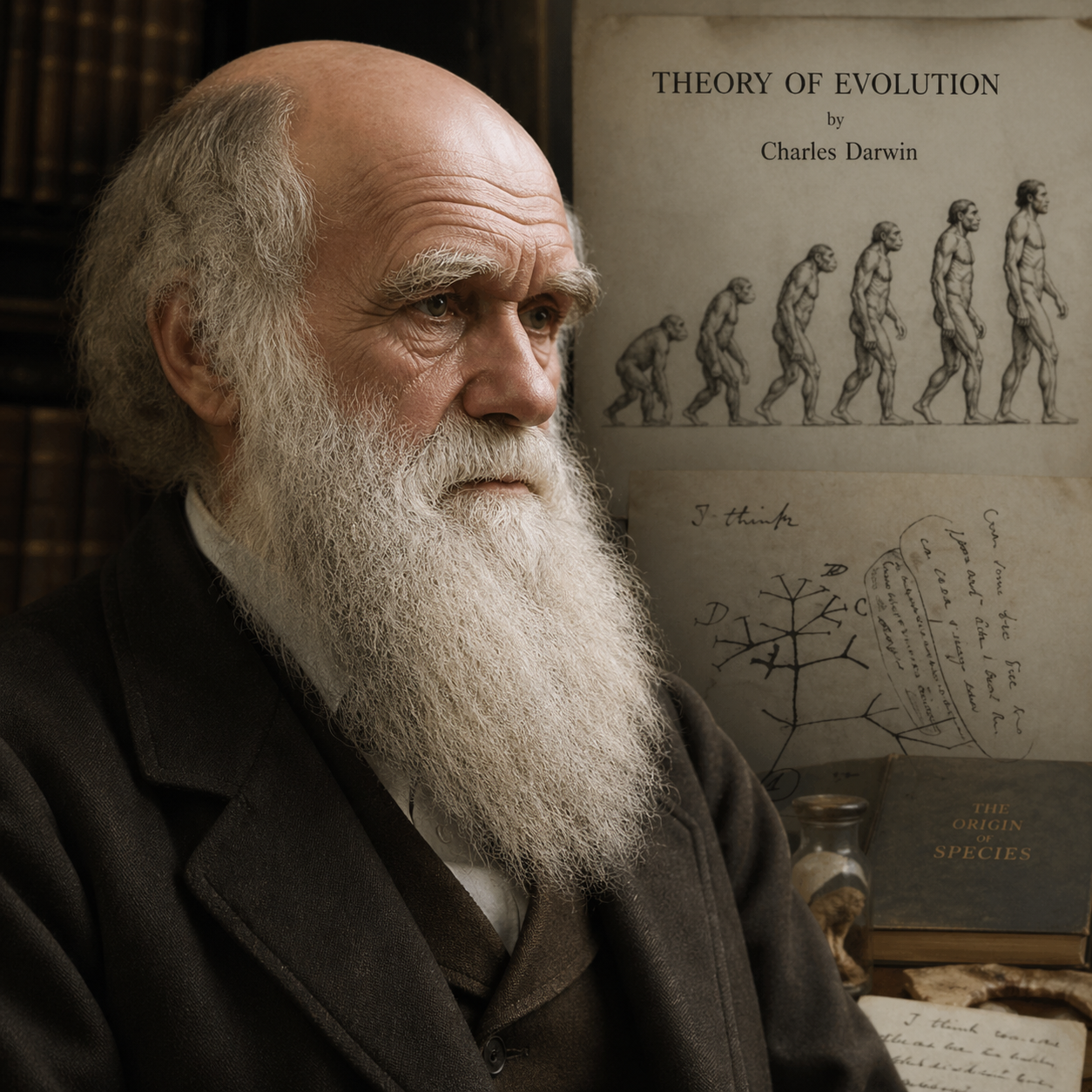
British naturalist whose On the Origin of Species (1859) established evolution by natural selection — the unifying theory of modern biology. Closely associated with Thomas Henry Huxley (his 'bulldog' public defender) and Alfred Russel Wallace (independent co-discoverer of natural selection). For an intellectual contrast, see William Paley, Anglican theologian and Natural Theology author (1743-1805) — Origin of Species is structurally a 400-page reply to Paley — Darwin admired Paley's watchmaker-argument as an undergraduate at Cambridge and then spent 20 years building the empirical machinery to displace him. The cleanest 'design argument vs natural selection' founding rebuttal in science.
The standard scholarly entry points to Charles Darwin's work: Janet Browne (Harvard, history of science) — Charles Darwin: Voyaging (1995) and The Power of Place (2002); Adrian Desmond (UCL, biographer) — Darwin: The Life of a Tormented Evolutionist (1991, with James Moore). These are the works graduate seminars cite when teaching Charles Darwin.
From a letter to Asa Gray, expressing exhaustion after publishing his magnum opus.
Date: 1859
Self-DeprecatingFound in 1 providers: grok
1 source checked
After completing years of painstaking research, Darwin half-jokes about wanting to disappear entirely. The remark captures genuine exhaustion mixed with anticipatory dread — he knew 'Origin' would ignite fierce opposition from the Church and scientific establishment alike. It's the wry humor of a man who had just detonated an intellectual bomb and instinctively wanted to flee the explosion. Relief, wit, and self-preservation are all bundled into one dry sentence.
Darwin spent over 20 years developing his evolution theory before daring to publish, haunted by anticipated backlash. He lived deliberately at Down House in rural Kent, far from London's social circles, suffering chronic illness many believe was anxiety-linked. Genuinely reclusive by nature, he conducted most intellectual exchange by correspondence rather than debate. The hermit quip isn't entirely a joke — it reflects both his preferred mode of existence and his terror of the coming firestorm.
Published in November 1859, 'On the Origin of Species' appeared during a Victorian era defined by both religious orthodoxy and explosive scientific discovery. Britain's Church of England held enormous cultural authority; the idea that species evolved by natural selection without divine design was incendiary. Darwin knew opponents like Richard Owen and Samuel Wilberforce were waiting. His hermit remark reflects clear-eyed awareness that he had just handed Victorian society its most destabilizing idea.
AI-generated insights based on extensive research and information for context. Factual errors? Email [email protected].
Your cart is empty