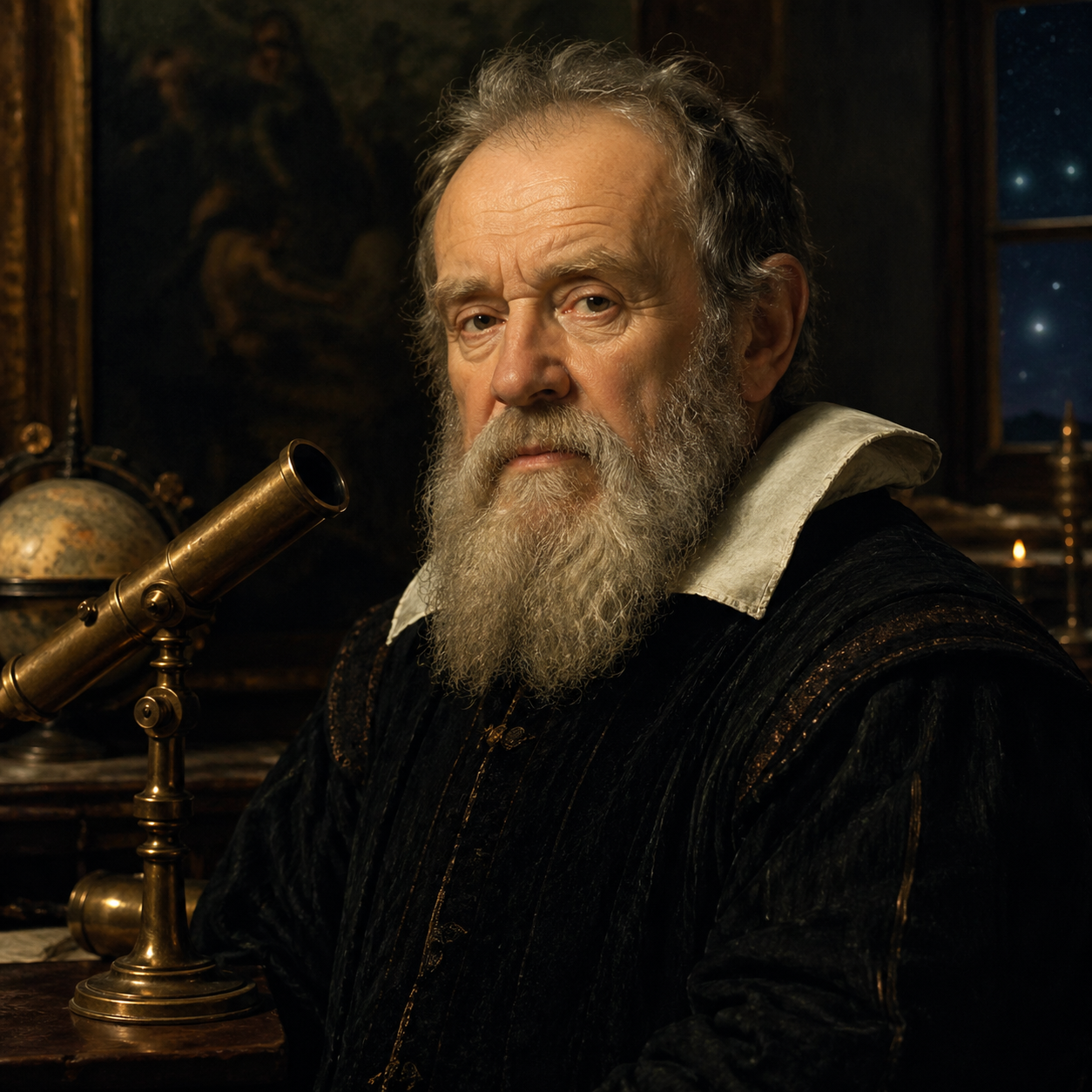
Galileo Galilei — "I have loved the stars too fondly to be fearful of the night."
I have loved the stars too fondly to be fearful of the night.
I have loved the stars too fondly to be fearful of the night.
Click any product to generate a realistic preview. Up to 3 at a time.
* Initial load can take up to 90 seconds — revising the preview in another color is nearly instant.
"Facts which at first seem improbable will, even on scant explanation, drop the cloak which has hidden them and stand forth in naked and simple beauty."
"The universe is a grand book which cannot be understood unless one first learns to comprehend the language and interpret the characters in which it is written."
"It is a great error to believe that the truths of faith are in any way contrary to the truths of reason."
"I have written up many reasons and refutations on the subject, but I have not dared until now to bring them into the open, being warned by the fortunes of Copernicus himself, our master, who procured …"
"To understand the universe, you must understand the language in which it's written. And that language is mathematics."
Often attributed, but not found in his known writings. Likely a modern misattribution.
Date: Uncertain
WisdomFound in 1 providers: grok
1 source checked
When you love something deeply enough, fear loses its power over you. The stars represent beauty, knowledge, and the infinite — while the night stands for uncertainty, danger, and death. This quote says genuine devotion to something greater than yourself dissolves fear entirely. Those who embrace wonder fully — who pursue truth with their whole being — find that what others dread becomes simply the backdrop to what they cherish most.
Galileo spent decades pointing his telescope at the heavens, discovering Jupiter's four largest moons, mapping lunar craters, and confirming Venus orbits the sun. When the Inquisition forced him to recant heliocentrism and placed him under permanent house arrest in 1633, his passion never dimmed — he kept writing and theorizing until blindness took him. His love of celestial truth endured persecution, imprisonment, and eventual darkness — the ultimate night he refused to fear.
The early modern period gave the Church supreme authority over knowledge, and challenging its cosmology carried mortal danger. Copernicus published heliocentrism only on his deathbed in 1543. Giordano Bruno was burned at the stake in 1600 for cosmological views. Night carried literal menace too — no electricity, rampant superstition, disease after dark. In this climate, choosing astronomical truth over personal safety was an act of profound, costly courage that defined the birth of modern science.
AI-generated insights based on extensive research and information for context. Factual errors? Email [email protected].
Your cart is empty