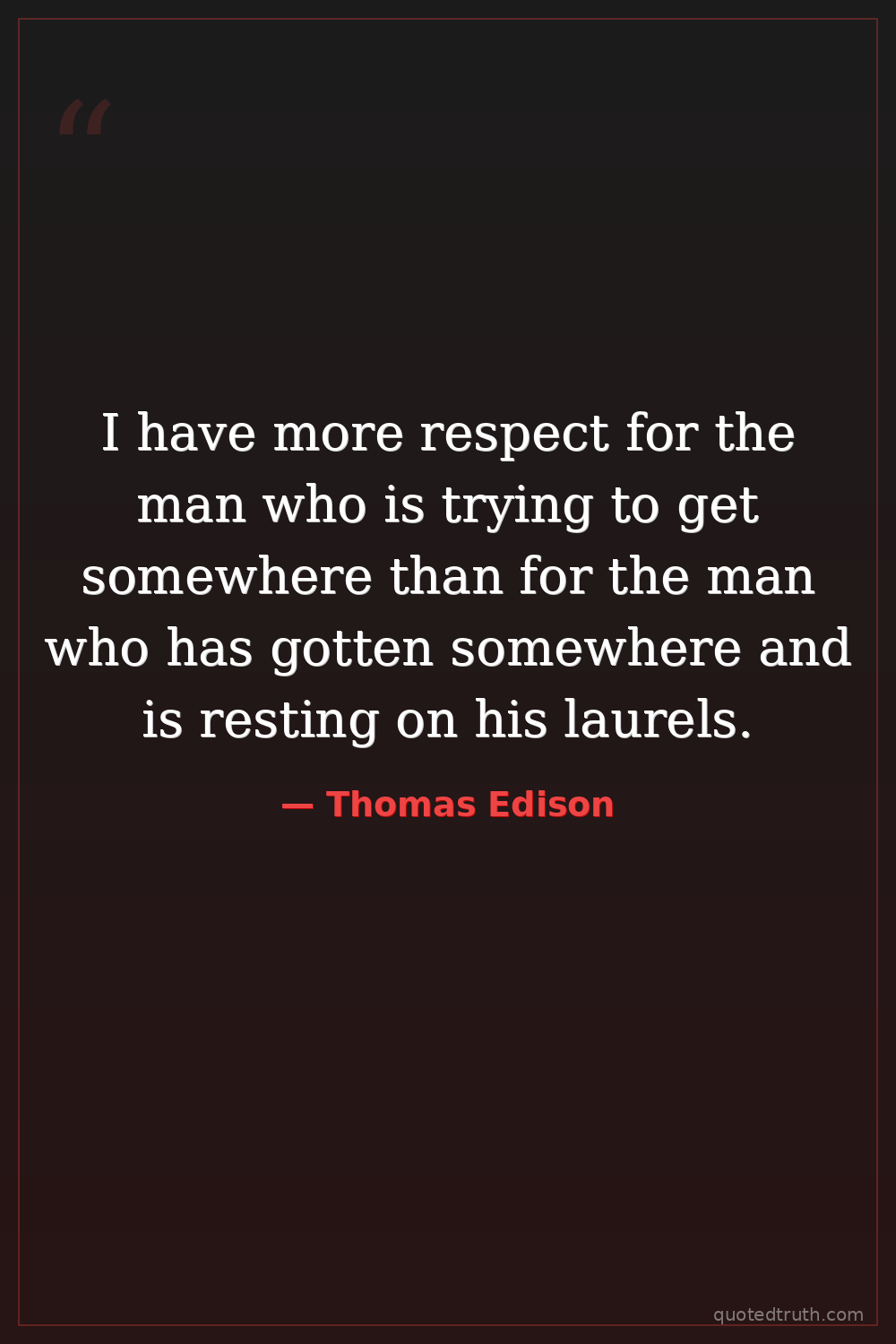
Thomas Edison — "I have more respect for the man who is trying to get somewhere than for the man …"
I have more respect for the man who is trying to get somewhere than for the man who has gotten somewhere and is resting on his laurels.
I have more respect for the man who is trying to get somewhere than for the man who has gotten somewhere and is resting on his laurels.
Click any product to generate a realistic preview. Up to 3 at a time.
* Initial load can take up to 90 seconds — revising the preview in another color is nearly instant.
"Non-violence leads to the highest ethics, which is the goal of all evolution."
"I am not a spiritualist. I am not a medium. I am a scientist. I am trying to build a machine to communicate with the dead. I am trying to prove that there is life after death. I am trying to prove tha…"
"Opportunity is missed by most people because it is dressed in overalls and looks like work."
"What the mind of man can conceive and believe, it can achieve."
"There's a way to do it better - find it."
Found in 1 providers: grok
1 source checked
Edison values the person who is still striving, still pushing toward a goal, over the person who has already succeeded and stopped working. Effort and forward motion matter more than past accomplishments. A climber mid-journey deserves more admiration than someone who reached a peak years ago and now coasts on that old win. The measure of a person is what they are doing now, not what they once did.
Edison embodied this ethic. After inventing the phonograph and practical incandescent lamp, he didn't retire on fame; he kept filing patents until his death, ending with 1,093. His Menlo Park and West Orange labs ran on relentless iteration, famously testing thousands of filament materials. He worked 18-hour days into his 80s, chasing rubber substitutes and storage batteries long after he could have rested on light-bulb royalties.
Edison's era, the Gilded Age into the early 20th century, celebrated the self-made industrialist and the myth of ceaseless productivity. Rockefeller, Carnegie, and Ford built empires through relentless work, and American culture tied moral worth to industry. Meanwhile, inherited wealth and European-style leisure were viewed with suspicion. Against this backdrop, Edison's jab at 'resting on laurels' echoed a wider national creed that striving itself, not arrival, defined the worthy citizen.
AI-generated insights based on extensive research and information for context. Factual errors? Email [email protected].
Your cart is empty