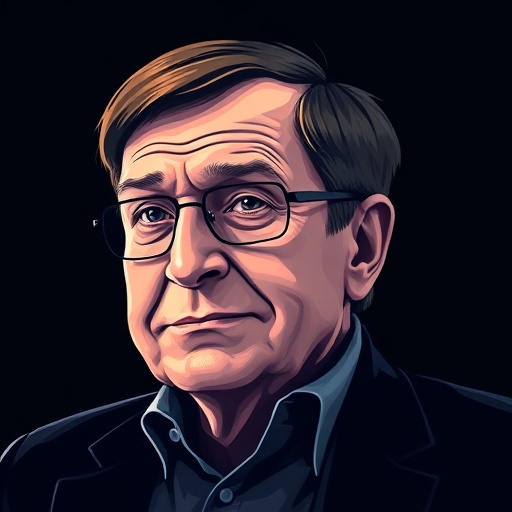
Stephen Hawking — "I have no idea what the future holds, but I'm optimistic."
I have no idea what the future holds, but I'm optimistic.
I have no idea what the future holds, but I'm optimistic.
Click any product to generate a realistic preview. Up to 3 at a time.
* Initial load can take up to 90 seconds — revising the preview in another color is nearly instant.
"I believe that human beings have a duty to explore the universe."
"I believe the simplest explanation is, there is no God. No one created the universe and no one directs our fate. This leads me to a profound realization that there probably is no heaven and no afterli…"
"I deal in tough mathematical questions every day, but please don't ask me to help with Brexit."
"The world is a very dangerous place, not because of those who do evil, but because of those who look on and do nothing."
"The universe is a vast and complex place, and we are only just beginning to understand it."
British theoretical physicist whose Hawking radiation work and A Brief History of Time (1988) brought black-hole physics to a mass audience while he lived with ALS for 55 years. Closely associated with Roger Penrose (his collaborator on singularity theorems) and Carl Sagan (fellow popularizer who wrote Brief History's foreword). For an intellectual contrast, see William Lane Craig, American philosopher of religion — Craig's Kalam cosmological argument depends on the Big Bang requiring a divine first cause; Hawking's no-boundary proposal was specifically designed to remove the moment that would require one — the cleanest cosmology-vs-natural-theology contrast in modern thought.
Found in 1 providers: grok
1 source checked
Acknowledging genuine uncertainty about what comes next while refusing to let that uncertainty breed pessimism or paralysis. The speaker separates knowledge from attitude — not knowing the future is honest, but choosing optimism is a decision. It calls for engaging life's open questions from a position of hope rather than fear, accepting unpredictability as inherent to existence rather than a problem requiring a solution.
Hawking was diagnosed with motor neuron disease at 21 and given two years to live; he survived 55 more years, becoming the world's most recognized physicist. His entire career probed deep uncertainty — whether information escapes black holes, whether time had a beginning. Despite losing all motor function, he lectured, wrote bestsellers, and traveled. His optimism was not naive; it was forged against a prognosis that was repeatedly, triumphantly wrong.
Hawking's working life spanned Cold War existential dread, the moon landings, the digital revolution, and mounting fears about climate change and artificial intelligence. Humanity oscillated between utopian promises of technology and anxieties about nuclear annihilation or ecological collapse. His optimism carried special weight precisely because it came from someone confronting both a terminal diagnosis and a universe that offers no guarantees — a stance that resonated deeply in an era saturated with dread about tomorrow.
AI-generated insights based on extensive research and information for context. Factual errors? Email [email protected].
Your cart is empty