Thomas Edison — "I have not failed 10,000 times. I have successfully found 10,000 ways that will …"
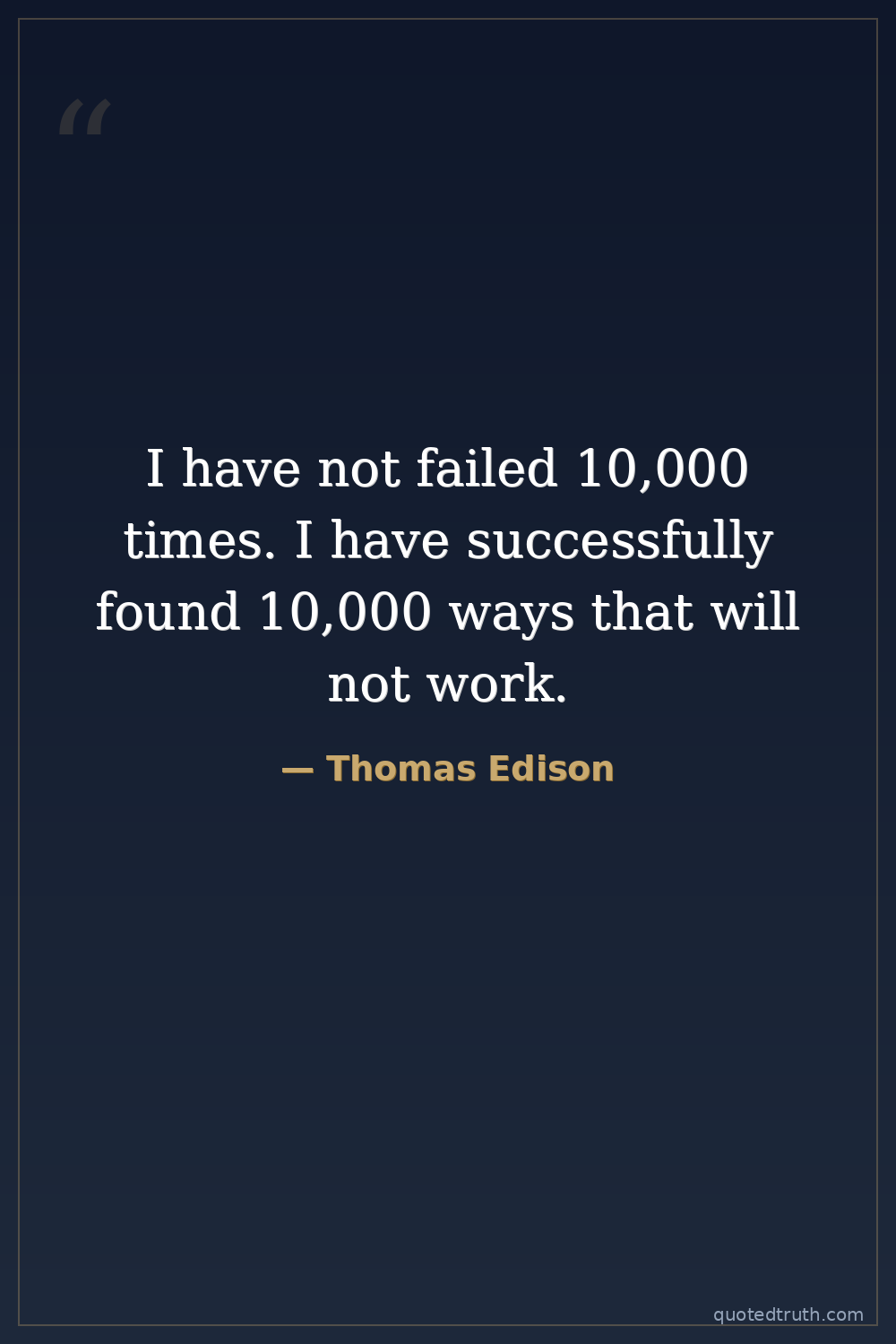
I have not failed 10,000 times. I have successfully found 10,000 ways that will not work.
I have not failed 10,000 times. I have successfully found 10,000 ways that will not work.
Click any product to generate a realistic preview. Up to 3 at a time.
* Initial load can take up to 90 seconds — revising the preview in another color is nearly instant.
"I never had a policy; I have just tried to do my very best each and every day."
"I have friends in the other world. I have had very pleasant conversations with them. I am rather unorthodox in this matter."
"My success is due to the fact that I never went to school and was never forced to learn anything but what I wanted to know."
"I am proud of the fact that I never invented weapons to kill."
"I owe my success to the fact that I never had a watch or a clock in my laboratory."
A variation of his famous quote, often used to emphasize perseverance.
Date: Late 19th Century
Self-DeprecatingFound in 1 providers: grok
1 source checked
Setbacks are not defeats when they teach you something. Every attempt that does not produce the desired result still narrows the search, eliminating dead ends and pointing toward what might actually work. Reframing repeated failure as accumulated knowledge turns a discouraging tally into measurable progress. The speaker insists on counting experiments as data, not as personal shortcomings, so persistence becomes a rational strategy rather than stubbornness.
Edison ran his Menlo Park lab like an industrial experiment factory, famously testing thousands of filament materials, including carbonized bamboo, before settling on one that made the incandescent bulb commercially viable. He held 1,093 US patents and treated invention as methodical trial and error rather than flashes of genius. This quote captures his documented lab philosophy: exhaustive iteration, meticulous notebooks, and a refusal to treat negative results as wasted effort.
Edison worked during the late 19th and early 20th century Second Industrial Revolution, when electricity, telegraphy, and mass manufacturing were remaking daily life. Private research labs, patent races, and investor-funded inventors competed fiercely, with rivals like Tesla and Westinghouse. A culture of self-made progress and empirical tinkering dominated American industry, making a mindset that valorized persistence, systematic experimentation, and public optimism about technology both commercially useful and widely celebrated.
AI-generated insights based on extensive research and information for context. Factual errors? Email [email protected].
Your cart is empty