William Harvey — "I have not only affirmed, but also demonstrated, that the motion of the heart is…"
I have not only affirmed, but also demonstrated, that the motion of the heart is a perpetual circulation of the blood.
I have not only affirmed, but also demonstrated, that the motion of the heart is a perpetual circulation of the blood.
Click any product to generate a realistic preview. Up to 3 at a time.
* Initial load can take up to 90 seconds — revising the preview in another color is nearly instant.
"The knowledge of man is as the waters, some shallow and some deep."
"Nature is a free and open book, to be read and understood by all who have the patience and the power to do so."
"The physician must be a constant student."
"The world is a living creature."
"All animals, even man himself, are produced from an egg."
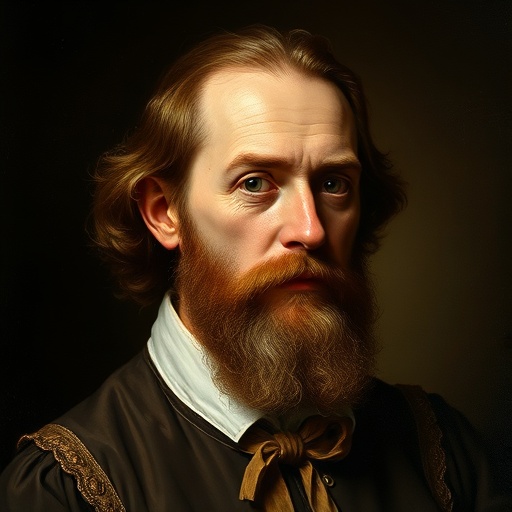
English physician whose On the Motion of the Heart and Blood in Animals (1628) demonstrated blood circulation, overturning 1,400 years of Galenic medicine. Closely associated with Francis Bacon (his contemporary in the new English empiricism). For an intellectual contrast, see Galenic medicine, the 2nd-century Greek medical tradition (humors, blood-as-consumed-fuel) — Harvey calculated that the heart pumps more blood per hour than the body could possibly produce as fuel — a single quantitative observation that demolished the entire Galenic-Aristotelian medical worldview. The cleanest example in medical history of arithmetic disproving 14 centuries of authority.
Found in 1 providers: grok
1 source checked
Harvey is asserting that he didn't merely claim the heart circulates blood continuously throughout the body — he proved it through systematic observation and experiment. The blood moves in a closed loop, pumped by the heart, rather than being consumed by tissues as previously believed. This distinction between assertion and demonstration was central to his scientific identity and methodology.
Harvey spent decades dissecting animals, timing heartbeats, and calculating blood volumes to prove circulation experimentally. His 1628 work De Motu Cordis was the culmination of that rigor. As a physician to King James I and Charles I, and a fellow of the College of Physicians, he staked his professional reputation on empirical proof over inherited authority.
In early modern Europe, Galenic medicine still dominated — blood was thought to be continuously produced in the liver and consumed by organs. Harvey's era saw the Scientific Revolution challenging ancient authority through observation. Vesalius had already corrected anatomical errors, but Harvey went further, using quantitative reasoning to overturn a 1,400-year-old physiological doctrine with measurable, repeatable evidence.
AI-generated insights based on extensive research and information for context. Factual errors? Email [email protected].
Your cart is empty