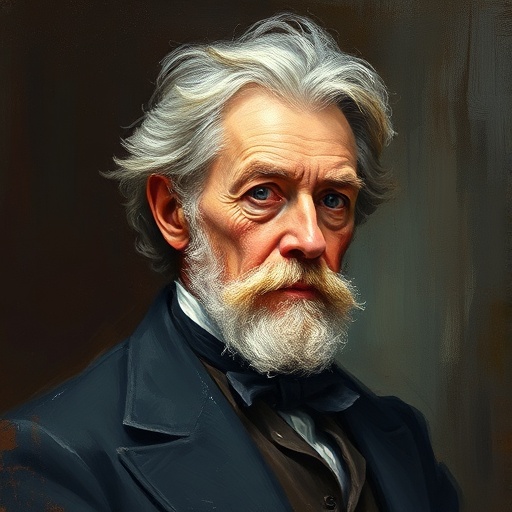
Michael Faraday — "I have often regretted that I was not able to pursue a more regular course of st…"
I have often regretted that I was not able to pursue a more regular course of study.
I have often regretted that I was not able to pursue a more regular course of study.
Click any product to generate a realistic preview. Up to 3 at a time.
* Initial load can take up to 90 seconds — revising the preview in another color is nearly instant.
"Let us now consider, for a little while, how wonderfully we stand upon this world. Here it is we are born, bred, and live, and yet we view these things with an almost entire absence of wonder to ourse…"
"I have in fact been a very lucky fellow; I have often said that I should be a very miserable creature if I could not feel that I was doing something for the good of other people."
"I am no poet, but if you think for a moment of the energy that is in a single drop of water, you will see a poetry in it."
"The philosopher should be a man willing to listen to every suggestion, but determined to judge for himself."
"I have no other guide than the truth, and I will follow it wherever it leads."
Attributed, reflecting his humble beginnings and self-education.
Date: Mid 19th Century (approx.)
EducationalFound in 1 providers: grok
1 source checked
The speaker admits disappointment at never having followed a formal, structured education. He wishes he had been able to learn systematically through school or university, progressing step by step through organized subjects, rather than piecing knowledge together on his own. It is a candid acknowledgment that self-teaching, however successful, left gaps he felt throughout his career and still wished he could have filled.
Faraday left school at thirteen and apprenticed to a bookbinder, reading the volumes he stitched. He had almost no mathematics, which limited how he expressed his field theories and forced Maxwell to later formalize them. Despite discovering electromagnetic induction, the dynamo, and diamagnetism, he remained self-conscious about his lack of formal training, declining honors like the Royal Society presidency partly from this enduring sense of educational inadequacy.
In early-19th-century Britain, science was shifting from gentleman-amateur pursuit to professional discipline requiring university credentials, especially in mathematics at Cambridge. The Royal Institution where Faraday worked was one of few places a working-class man could do research. Class barriers meant Oxford and Cambridge were largely closed to dissenters and the poor, making Faraday's rise exceptional yet leaving him acutely aware of what a Cambridge wrangler's rigorous training offered that he lacked.
AI-generated insights based on extensive research and information for context. Factual errors? Email [email protected].
Your cart is empty