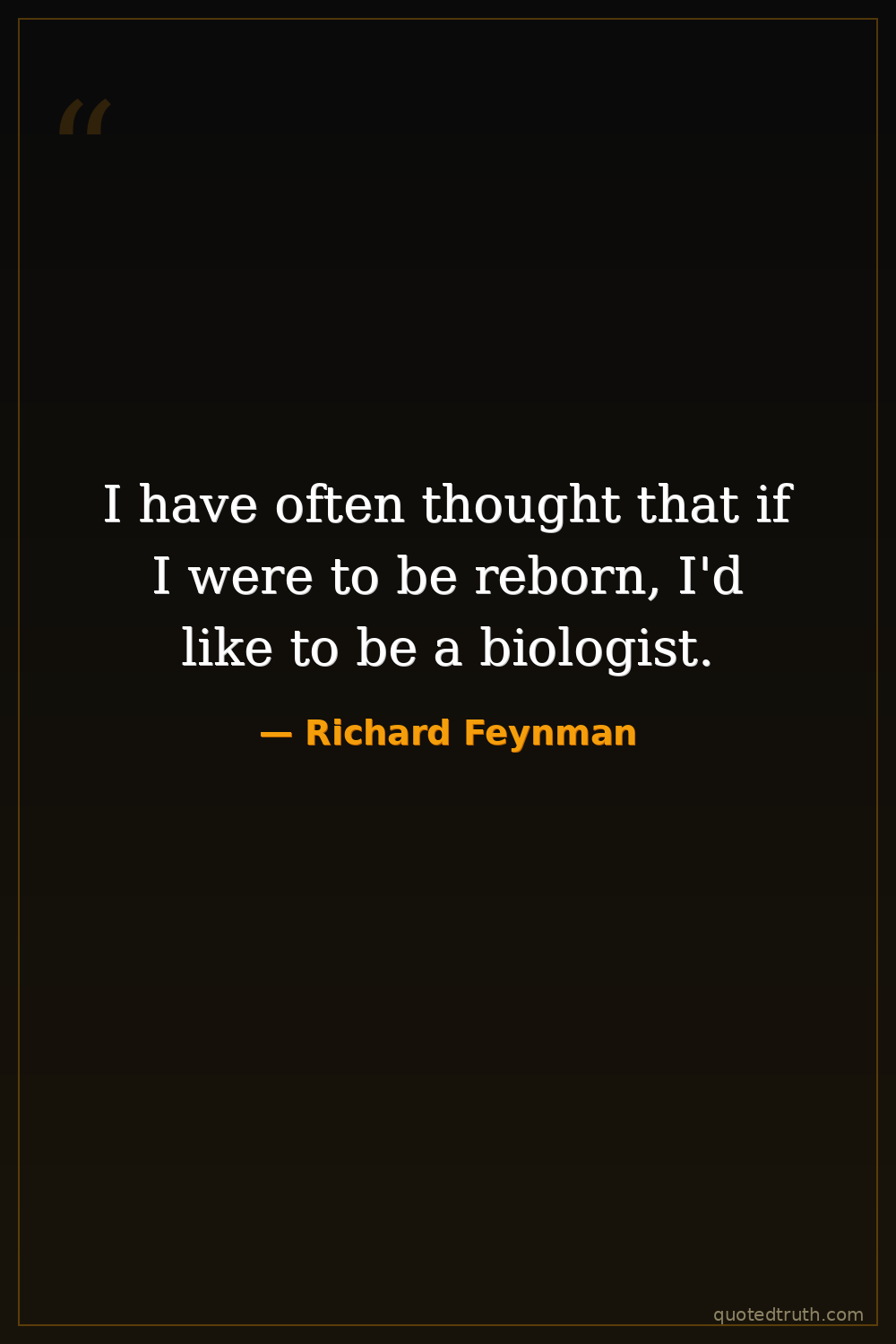
Richard Feynman — "I have often thought that if I were to be reborn, I'd like to be a biologist."
I have often thought that if I were to be reborn, I'd like to be a biologist.
I have often thought that if I were to be reborn, I'd like to be a biologist.
Click any product to generate a realistic preview. Up to 3 at a time.
* Initial load can take up to 90 seconds — revising the preview in another color is nearly instant.
"Our imagination is stretched to the utmost, not, as in fiction, to imagine things which are not really there, but just to comprehend those things which are there."
"Physics is to math what sex is to masturbation."
"You can know the name of a bird in all the languages of the world, but when you're finished, you'll know absolutely nothing whatever about the bird... So let's look at the bird and see what it's doing…"
"I actually did not have to learn a thing for my thesis. It was all stuff I already knew."
"I don't think I'm a very good teacher. I just try to explain things clearly."
American theoretical physicist who shared the 1965 Nobel for QED, developed Feynman diagrams, and wrote the Feynman Lectures on Physics. Closely associated with Julian Schwinger (co-Nobelist for QED) and Murray Gell-Mann (Caltech rival and Eightfold-Way physicist). For an intellectual contrast, see Deepak Chopra, physician and quantum-mysticism author — Feynman's Caltech 'cargo cult science' commencement address is the precise template for what he saw as misuse of physics terminology — Chopra-style appropriation of quantum vocabulary for metaphysical claims is the canonical example of what Feynman called 'fooling yourself'.
Found in 1 providers: grok
1 source checked
The speaker wishes that in another life they would dedicate themselves to biology. It expresses genuine intellectual curiosity and admiration for a field outside their own expertise — an acknowledgment that life's questions extend beyond physics, and that the mysteries of living systems are as profound and worthy of deep investigation as anything in theoretical science.
Feynman was a Nobel Prize-winning physicist famed for quantum electrodynamics, yet he famously resisted narrow specialization. He dabbled in biology, cracking safes, art, and bongo drums. This quote captures his restless curiosity — he saw biology as the next great frontier of deep, unsolved problems, and respected the complexity of life with the same reverence he held for fundamental physics.
Feynman lived through the mid-20th century molecular biology revolution — Watson and Crick decoded DNA in 1953, Crick proposed the central dogma in 1958, and the genetic code was cracked in the 1960s. Biology was transforming from descriptive natural history into a rigorous physical science, making it intellectually compelling to physicists who saw living systems as the next deep problem awaiting mathematical understanding.
AI-generated insights based on extensive research and information for context. Factual errors? Email [email protected].
Your cart is empty