Carl Linnaeus — "I have spent my life in the company of plants, and they have taught me more than…"
I have spent my life in the company of plants, and they have taught me more than men.
I have spent my life in the company of plants, and they have taught me more than men.
Click any product to generate a realistic preview. Up to 3 at a time.
* Initial load can take up to 90 seconds — revising the preview in another color is nearly instant.
"The species and the genus are always the work of nature [i.e. specially created]; the variety mostly that of circumstance; the class and the order are the work of nature and art."
"The world is a book, and those who do not travel read only one page."
"The aim of natural history is to know God in His works."
"God created, Linnaeus arranged. It is astonishing how many new species are discovered every day."
"A world without names is a world without knowledge."
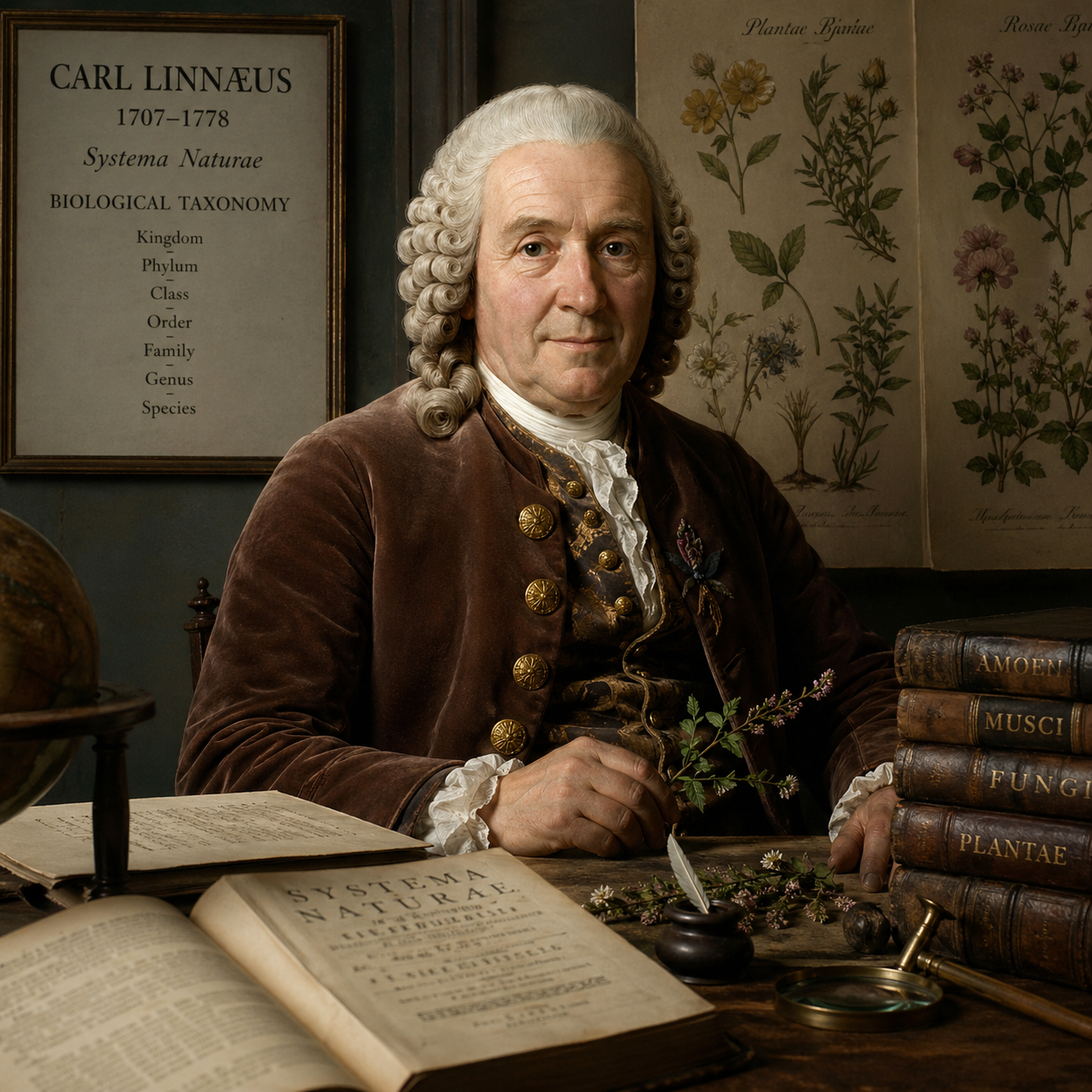
Swedish botanist and the father of modern taxonomy whose Systema Naturae (1735) introduced binomial nomenclature for naming all species. Closely associated with Joseph Banks (British naturalist who carried Linnaean classification on Cook's voyages). For an intellectual contrast, see Comte de Buffon, French naturalist and Histoire Naturelle author (1749-1788) — Buffon explicitly attacked Linnaean fixed-categories taxonomy as artificial and rejected the binomial system; his gradualist, environment-shaped natural history was the explicit alternative. Anticipates the fixed-species-vs-evolution debate Darwin would later resolve.
A personal reflection on his relationship with nature and its instructional value.
Date: c. 1770s
WisdomFound in 1 providers: gemini
1 source checked
Nature offers lessons that human society cannot. Plants reveal truths about life through their diversity, structure, and patterns that human politics, philosophy, and social chatter obscure. Direct observation of the natural world yields reliable knowledge—plants don't deceive, argue, or shift their nature under social pressure. Patient study of living things delivers deeper understanding than any amount of human discourse, intellectual debate, or institutional maneuvering.
Linnaeus spent decades cataloging thousands of plant species, developing the binomial nomenclature system still used today. He led expeditions across Lapland and Europe, finding clarity in botanical observation that academic rivalries and court politics could not provide. Known for meticulous, near-obsessive classification work, he genuinely preferred fieldwork to social maneuvering. His landmark works—Species Plantarum and Systema Naturae—emerged from this lifelong devotion to plants over human company.
The 18th-century Enlightenment prized empirical observation and natural philosophy over inherited authority and scripture. Yet European intellectual life was entangled in academic politics, religious controversy, and rigid social hierarchy. Naturalists like Linnaeus navigated university rivalries and patronage systems that could derail careers overnight. Against this backdrop, studying plants offered retreat into objective, classifiable reality—a domain where truth emerged from careful observation rather than courtly favor, theological debate, or aristocratic whim.
AI-generated insights based on extensive research and information for context. Factual errors? Email [email protected].
Your cart is empty