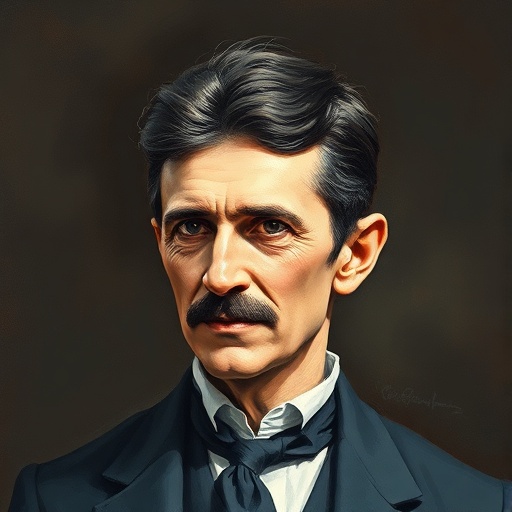
Nikola Tesla — "I have toiled ceaselessly for a quarter of a century for the love of science, to…"
I have toiled ceaselessly for a quarter of a century for the love of science, to benefit humanity.
I have toiled ceaselessly for a quarter of a century for the love of science, to benefit humanity.
Click any product to generate a realistic preview. Up to 3 at a time.
* Initial load can take up to 90 seconds — revising the preview in another color is nearly instant.
"All that was great in the past was ridiculed, condemned, combated, suppressed — only to emerge all the more powerfully, all the more triumphantly from the struggle."
"If you want to find the secrets of the universe, think in terms of energy, frequency and vibration."
"I have been called by some a visionary, by others a dreamer, but I am a practical man."
"With ideas it is like with dizzy heights you climb: At first they cause you discomfort and you are anxious to get down, distrustful of your own powers; but soon the remoteness of the turmoil of life a…"
"The spread of civilization may be likened to a fire; first, a feeble spark, next a flickering flame, then a mighty blaze, ever increasing in speed and power."
Serbian-American inventor and electrical engineer whose alternating-current designs powered the modern electrical grid; died poor and largely forgotten. Closely associated with George Westinghouse (his AC-power business partner) and Mihajlo Pupin (fellow Serbian-American physicist at Columbia). For an intellectual contrast, see Thomas Edison, American inventor and direct-current advocate — Edison's direct-current power-distribution scheme was displaced by Tesla-Westinghouse AC in the 1890s 'War of Currents'. Edison ran a public-relations campaign electrocuting animals to discredit AC — the most famous engineering-ethics rivalry in American history. Tesla's AC won and powers nearly every electrical grid on Earth.
Found in 1 providers: grok
1 source checked
The speaker dedicates their life not for wealth or fame but out of genuine passion for knowledge and a desire to improve the human condition. Twenty-five years of relentless, exhausting work driven purely by love of discovery and service to others. It captures the ideal of scientific vocation as sacrifice and devotion rather than career or commerce.
Tesla worked obsessively and died nearly penniless despite inventing AC power, the induction motor, and radio foundations. He famously tore up his Westinghouse royalty contract to save the company. He rejected commercial compromise repeatedly, prioritizing free wireless energy transmission over profit, embodying exactly this self-sacrificing devotion to science over personal gain.
The late 19th and early 20th centuries saw the Second Industrial Revolution transform civilization through electricity, steel, and communications. Scientists like Tesla, Edison, and Curie were cultural heroes redefining human possibility. Yet inventors often struggled financially amid fierce patent battles and corporate monopolies, making Tesla's framing of labor as love rather than commerce both idealistic and poignant.
AI-generated insights based on extensive research and information for context. Factual errors? Email [email protected].
Your cart is empty