Charles Darwin — "I have tried lately to read Shakespeare, and found it so intolerably dull that i…"
I have tried lately to read Shakespeare, and found it so intolerably dull that it nauseated me.
I have tried lately to read Shakespeare, and found it so intolerably dull that it nauseated me.
Click any product to generate a realistic preview. Up to 3 at a time.
* Initial load can take up to 90 seconds — revising the preview in another color is nearly instant.
"The world will not be inherited by the strongest, it will be inherited by those most able to change."
"The astonishment which I felt on first seeing a party of Fuegians on a wild and broken shore will never be forgotten by me, for the reflection at once rushed into my mind—such were our ancestors."
"The greatest discovery of all is that the world is not as we thought it was."
"False facts are highly injurious to the progress of science, for they often endure long; but false views, if supported by some evidence, do little harm, for every one takes a salutary pleasure in prov…"
"The more I see of the world, the more I am convinced of the fact that it is full of wonders."
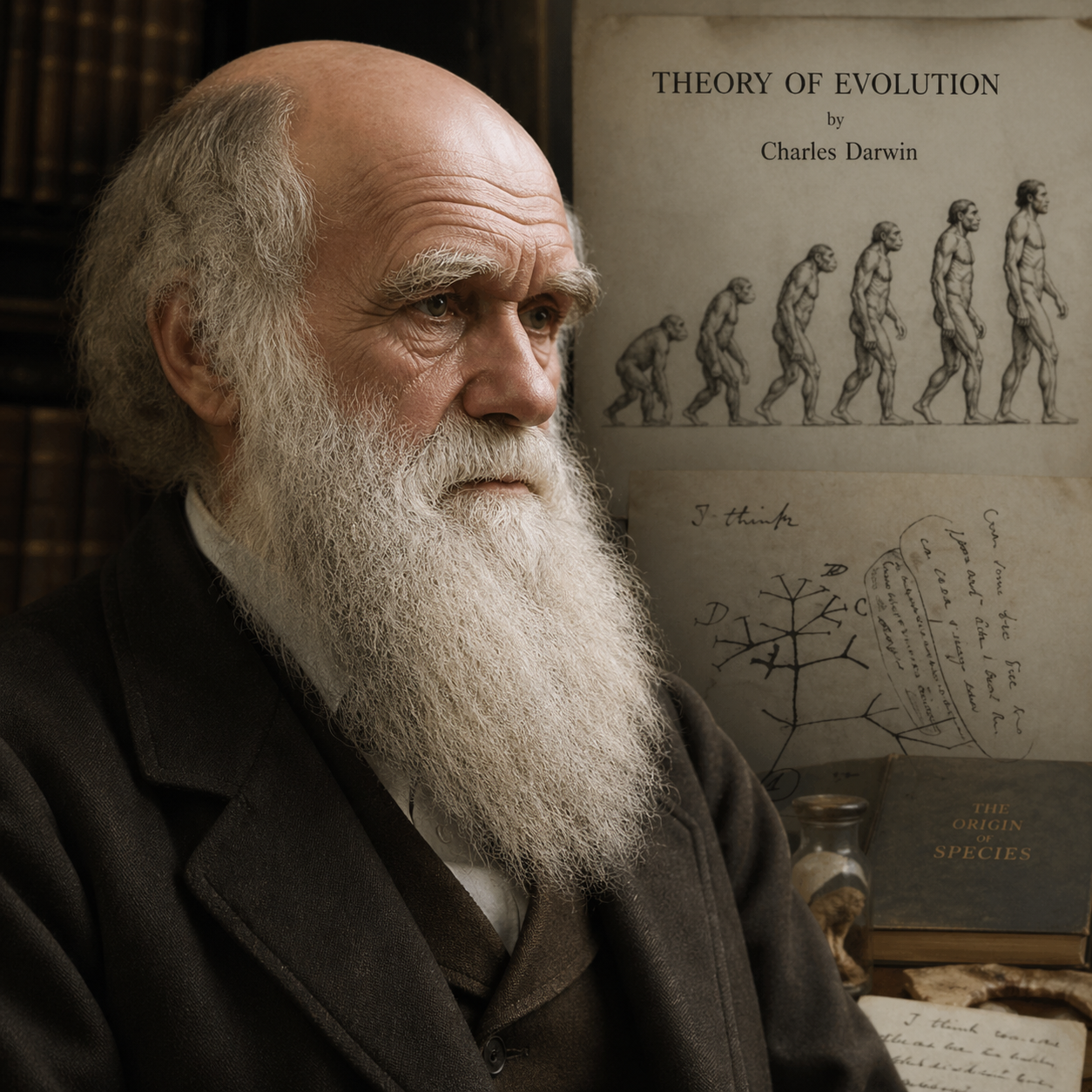
British naturalist whose On the Origin of Species (1859) established evolution by natural selection — the unifying theory of modern biology. Closely associated with Thomas Henry Huxley (his 'bulldog' public defender) and Alfred Russel Wallace (independent co-discoverer of natural selection). For an intellectual contrast, see William Paley, Anglican theologian and Natural Theology author (1743-1805) — Origin of Species is structurally a 400-page reply to Paley — Darwin admired Paley's watchmaker-argument as an undergraduate at Cambridge and then spent 20 years building the empirical machinery to displace him. The cleanest 'design argument vs natural selection' founding rebuttal in science.
The standard scholarly entry points to Charles Darwin's work: Janet Browne (Harvard, history of science) — Charles Darwin: Voyaging (1995) and The Power of Place (2002); Adrian Desmond (UCL, biographer) — Darwin: The Life of a Tormented Evolutionist (1991, with James Moore). These are the works graduate seminars cite when teaching Charles Darwin.
Found in 1 providers: grok
1 source checked
Darwin admits bluntly that reading Shakespeare bores him to the point of disgust. Rather than pretending to appreciate culturally revered literature, he is being brutally honest about his own experience. The quote captures how deep immersion in one mode of thinking — in his case, precise empirical observation — can crowd out aesthetic and imaginative pleasure entirely, leaving a person unable to enjoy art that demands a different kind of attention.
Darwin wrote candidly in his autobiography about losing his taste for poetry, music, and literature as he aged, calling it a lamentable loss. His mind became finely tuned to evidence, pattern, and mechanism, leaving little room for imaginative narrative. The confession also reveals his characteristic intellectual honesty — he never performed admiration he did not feel, the same directness that let him publish a theory he knew would be explosive.
Victorian England treated Shakespeare as a near-sacred cultural monument — his works were school curricula, the subject of public lectures, and a marker of educated taste. Admitting boredom with him was almost socially improper. Meanwhile, Darwin's era saw scientific rationalism rising sharply against humanistic tradition; his 1859 publication of On the Origin of Species had already shaken religion and culture. This confession sits at that exact fault line.
AI-generated insights based on extensive research and information for context. Factual errors? Email [email protected].
Your cart is empty