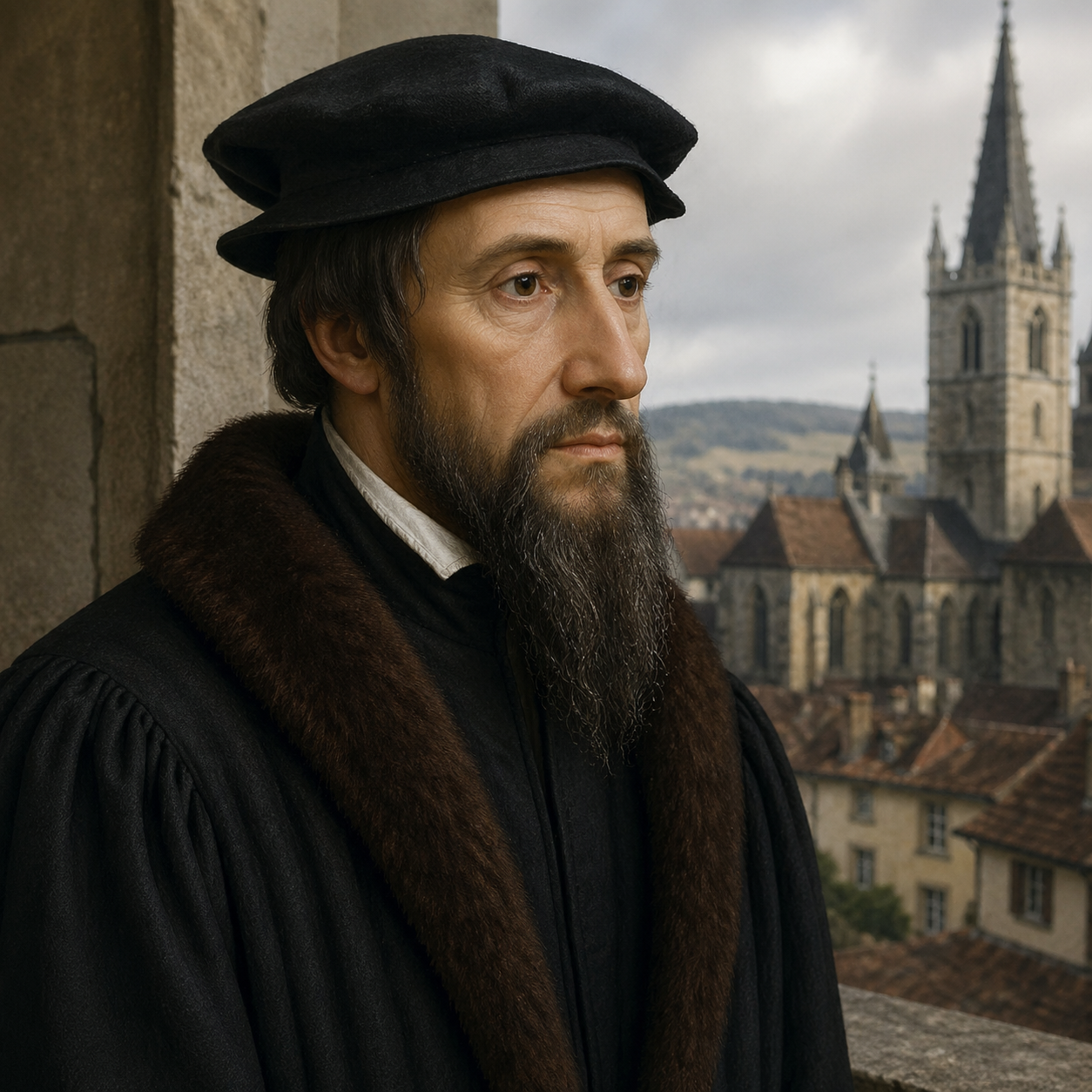
John Calvin — "I hope that the verdict will call for the death penalty."
I hope that the verdict will call for the death penalty.
I hope that the verdict will call for the death penalty.
Click any product to generate a realistic preview. Up to 3 at a time.
* Initial load can take up to 90 seconds — revising the preview in another color is nearly instant.
"The torture of a bad conscience is the hell of a living soul."
"The knowledge of God without the knowledge of ourselves is vain."
"God has his reasons for electing some and reprobating others, though these reasons are hidden from us."
"We are debtors to God, and can never pay the debt."
"All true knowledge of God is born of obedience."
French theologian whose Institutes of the Christian Religion (1536) systematized Protestant Reformed doctrine, including predestination. Closely associated with Martin Luther (Reformation founder, Calvin's predecessor). For an intellectual contrast, see Jacobus Arminius, Dutch Reformed theologian (1560-1609) — Arminius's rejection of strict double-predestination founded Arminianism — the theological tradition modern Methodism, most evangelicalism, and Pentecostalism descend from. The Calvinist-Arminian debate has divided Protestantism for 400 years.
Found in 1 providers: gemini
1 source checked
The quote expresses a speaker's explicit wish that a court will impose the death penalty on the accused. It conveys moral certainty that the offense is grave enough to warrant the ultimate punishment. Rather than advocating mercy or rehabilitation, it reflects a conviction that justice — and possibly divine order — demands severity. The speaker positions themselves as aligned with strict punishment in the face of what they consider a serious, possibly unforgivable, wrong.
Calvin governed Geneva as a strict theocracy where heresy was a capital crime. This quote almost certainly relates to the 1553 trial of Michael Servetus, who denied the Trinity — Calvin actively supported his execution by burning. Calvin believed tolerating heresy was itself sinful, a betrayal of God's truth. His theology demanded civil magistrates enforce divine law, making death an appropriate, even obligatory, sentence for those who publicly corrupted Christian doctrine.
In 16th-century Europe, religious dissent and civil crime were legally intertwined. Both Catholic and Protestant authorities executed heretics as threats to social and spiritual order. The Reformation intensified doctrinal stakes — getting theology wrong could cost your life. Geneva under Calvin was a model Reformed city-state where church discipline merged with civil governance. Capital punishment for heresy was legally and theologically mainstream across Catholic and Protestant Europe alike during this period.
AI-generated insights based on extensive research and information for context. Factual errors? Email [email protected].
Your cart is empty