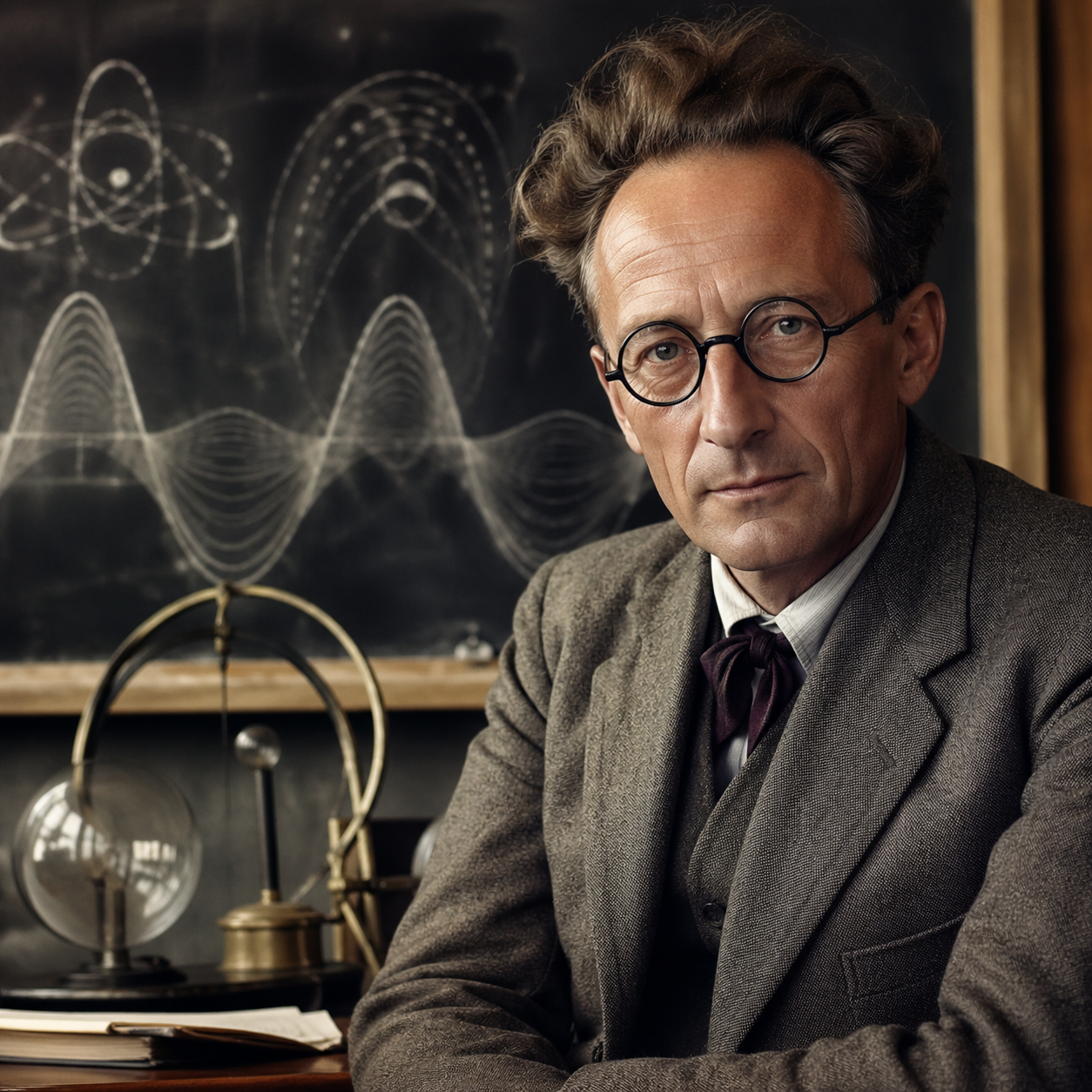
Erwin Schrodinger — "I insist upon the view that 'all is waves'."
I insist upon the view that 'all is waves'.
I insist upon the view that 'all is waves'.
Click any product to generate a realistic preview. Up to 3 at a time.
* Initial load can take up to 90 seconds — revising the preview in another color is nearly instant.
"The total number of minds in the universe is one. In fact, consciousness is a singularity."
"The most important thing is not to stop questioning. Curiosity has its own reason for existence."
"I consider the idea of a personal God as being very childish. We must give up this idea."
"What we observe as material bodies and forces are nothing but shapes and variations in the structure of space."
"The world is full of wonders, and it is our task to explore them."
Austrian physicist who shared the 1933 Nobel for the wave equation that bears his name and the famous cat thought-experiment. Closely associated with Werner Heisenberg (matrix-mechanics rival who reached the same physics by different math) and Albert Einstein (his pen-pal on quantum interpretation). For an intellectual contrast, see Niels Bohr, Danish physicist and architect of the Copenhagen interpretation — Schrödinger's cat thought-experiment was specifically designed to ridicule Bohr's 'observer-dependent reality' reading of quantum mechanics — Schrödinger thought the Copenhagen interpretation was absurd; the cat was meant as reductio ad absurdum.
From 'Schrödinger: Life and Thought', expressing his strong preference for a wave-based interpretation of quantum mechanics.
Date: 1989 (book published, quote from earlier writings)
ShockingFound in 1 providers: gemini
1 source checked
Everything in the universe, at its most fundamental level, consists of waves rather than solid particles. Matter, energy, even particles we think of as discrete objects are expressions of wavelike phenomena. This isn't metaphor but literal physical reality — what we perceive as solid, localized things are actually continuous, spread-out wave patterns governed by mathematical equations describing probability and oscillation.
Schrödinger developed wave mechanics in 1926, expressing quantum behavior through his wave equation rather than Heisenberg's matrix mechanics. He believed wave descriptions were more physically intuitive and complete than particle-based models. His lifelong resistance to purely probabilistic interpretations of quantum mechanics — epitomized by his famous cat paradox — reflected his conviction that waves offered the deeper, more coherent picture of physical reality.
In the 1920s-30s, physics was fracturing between competing quantum frameworks. Einstein, Bohr, Heisenberg, and Schrödinger debated whether reality was particles, waves, or pure probability. The Copenhagen interpretation was solidifying as orthodoxy, sidelining wave realism. Schrödinger's insistence on waves was a philosophical stand against abstraction dominating physics — a period when the nature of reality itself became the central scientific and philosophical battleground.
AI-generated insights based on extensive research and information for context. Factual errors? Email [email protected].
Your cart is empty