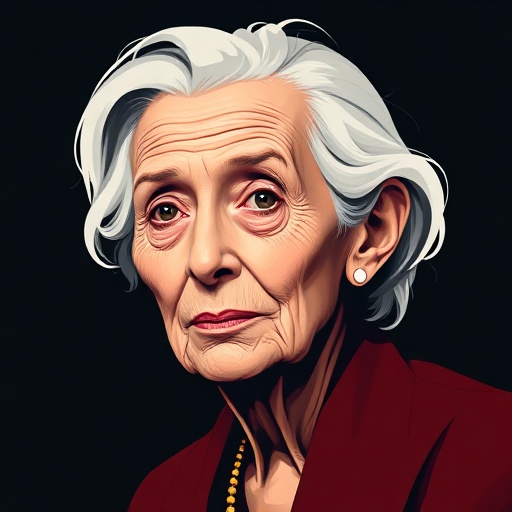
Jane Goodall — "I often feel like I'm a voice for the voiceless."
I often feel like I'm a voice for the voiceless.
I often feel like I'm a voice for the voiceless.
Click any product to generate a realistic preview. Up to 3 at a time.
* Initial load can take up to 90 seconds — revising the preview in another color is nearly instant.
"The only way to make sure that we don't destroy the future is to make sure that our children are educated in a way that they understand the interconnectedness of all life."
"The loss of biodiversity is a tragedy for all of us."
"It is our responsibility to protect the planet and all the species that live on it."
"I believe that every single one of us can make a difference."
"I'm often asked if I get lonely out in the field. And the answer is no, because I'm surrounded by life."
British primatologist who in 1960 began the longest-running wild primate study at Gombe Stream, transforming our understanding of chimpanzees. Closely associated with Dian Fossey (mountain-gorilla researcher) and Birutė Galdikas (orangutan researcher; together with Goodall and Fossey one of Louis Leakey's 'Trimates'). For an intellectual contrast, see Walter Palmer, American dentist who killed Cecil the Lion in Zimbabwe in 2015 — Palmer represents the trophy-hunting tradition Goodall's life's work has been organized against — the colonial-era hunter-naturalist worldview that treated primates and big game as specimens or trophies, which Goodall's Roots & Shoots and Jane Goodall Institute exist specifically to displace.
Found in 1 providers: grok
1 source checked
Some people cannot advocate for themselves — not because they lack intelligence or importance, but because they exist outside systems humans use to make decisions. This captures the idea of acting as a translator between the powerless and the powerful: stepping into policy rooms and public squares to represent interests that would otherwise go unheard. It frames advocacy as a moral calling, not just a profession.
Goodall spent decades at Gombe Stream documenting chimpanzees' intelligence, emotions, and social bonds — evidence the scientific community initially dismissed. She then devoted the second half of her life to conservation, founding the Jane Goodall Institute and the Roots & Shoots youth program. Chimpanzee populations collapsed from one million to roughly 150,000 in her lifetime, giving her voice-for-the-voiceless role urgent, deeply personal weight.
Goodall's advocacy coincides with the modern mass extinction crisis. When she began at Gombe in 1960, biodiversity loss was barely recognized as a political issue. By the 1980s and 90s, deforestation, bushmeat poaching, and the illegal wildlife trade threatened great apes' survival. The 1992 UN Earth Summit created international frameworks, but enforcement depended on sustained public pressure — exactly the role Goodall dedicated her life to filling.
AI-generated insights based on extensive research and information for context. Factual errors? Email [email protected].
Your cart is empty