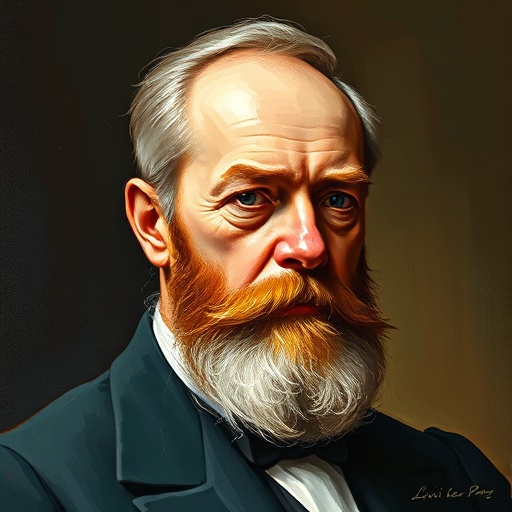
Louis Pasteur — "I only ask of you to look at things as I do."
I only ask of you to look at things as I do.
I only ask of you to look at things as I do.
Click any product to generate a realistic preview. Up to 3 at a time.
* Initial load can take up to 90 seconds — revising the preview in another color is nearly instant.
"The true scientist is a man of faith, for he believes in the order and harmony of the universe."
"The greatest victory is that over oneself."
"The greatest derangement of the mind is to believe in something because one wishes it to be so."
"I am utterly convinced that there is a germ for every disease."
"I am unable to find any experimental evidence that supports the doctrine of spontaneous generation."
Attributed, possibly in a discussion or debate about his theories.
Date: Late 19th Century (approx.)
WisdomFound in 1 providers: grok
1 source checked
The speaker is making a simple but pointed request: set aside your assumptions and examine the evidence the way I have examined it. He is not demanding agreement, only a fair hearing. If you study the same observations with the same honesty, he believes you will reach the same conclusion. It is a plea for intellectual openness rather than blind acceptance, trusting that careful observation will speak for itself.
Pasteur spent his career battling entrenched scientific orthodoxy, from spontaneous generation to the existence of microbes causing disease. Critics dismissed his findings before replicating his experiments. This appeal mirrors his repeated insistence that skeptics visit his laboratory, repeat his swan-neck flask trials, or witness his anthrax vaccinations at Pouilly-le-Fort in 1881. His method rested on reproducible observation, and he asked opponents only to look honestly through the same microscope.
Nineteenth-century French science was dominated by figures like Felix Pouchet who defended spontaneous generation, and physicians who scoffed at invisible germs causing puerperal fever or surgical infection. Pasteur worked when chemistry, biology, and medicine were violently reorganizing under microscopy and experimental rigor. The Academy of Sciences debates were fierce and personal. Convincing colleagues required not only proof but a willingness from them to abandon centuries of inherited dogma about disease, fermentation, and life itself.
AI-generated insights based on extensive research and information for context. Factual errors? Email [email protected].
Your cart is empty