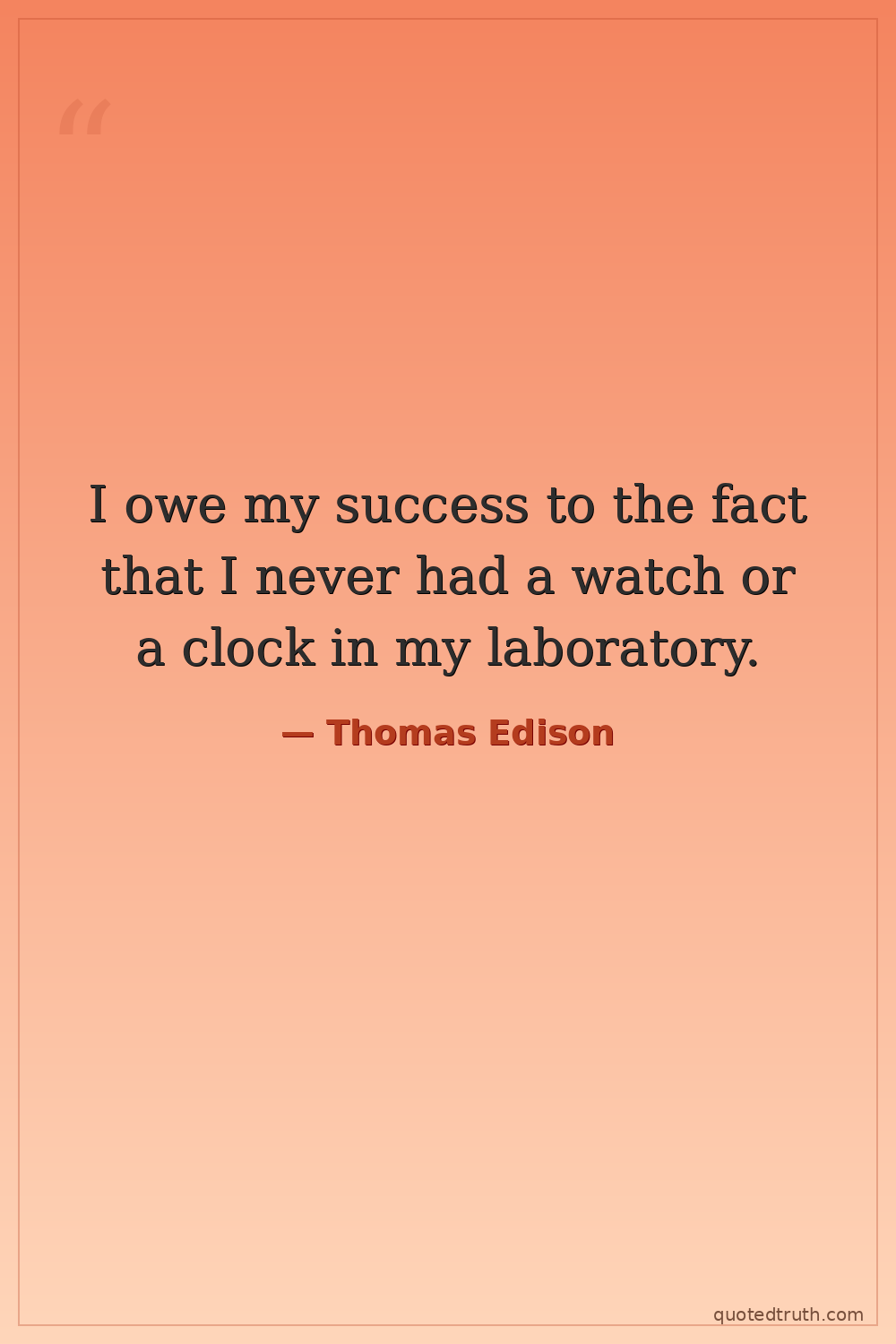
Thomas Edison — "I owe my success to the fact that I never had a watch or a clock in my laborator…"
I owe my success to the fact that I never had a watch or a clock in my laboratory.
I owe my success to the fact that I never had a watch or a clock in my laboratory.
Click any product to generate a realistic preview. Up to 3 at a time.
* Initial load can take up to 90 seconds — revising the preview in another color is nearly instant.
"I don't believe in anything that I cannot prove."
"You will have many opportunities in life to keep your mouth shut: You should take advantage of every one of them."
"My mind is a receptacle for everything useful. I don't care a rap for anything else."
"I am not a scientist. I am an inventor."
"There is no substitute for hard work."
Found in 1 providers: grok
1 source checked
Edison is saying that watching the clock kills real productivity. When you measure work by hours instead of results, you stop early, take breaks on schedule, and treat effort as time served rather than problems solved. By removing timekeeping entirely, he forced himself and his team to work until something was actually finished or discovered, letting curiosity and momentum, not the workday, dictate when to stop.
Edison was famous for marathon work sessions at Menlo Park, often sleeping on benches and pulling all-nighters with his 'muckers.' He held 1,093 US patents earned through relentless trial-and-error, famously testing thousands of filaments before settling on carbonized bamboo for the light bulb. He openly mocked the eight-hour workday and bragged about working 18-hour stretches, treating the laboratory as a place where output, not attendance, defined value.
Edison worked from the 1870s through the 1920s, exactly when American factories were standardizing the time clock, the punch card, and Frederick Taylor's scientific management. Workers were being trained to sell hours rather than results, and labor unions were fighting for the eight-hour day. Edison's anti-clock posture was a deliberate jab at this industrial discipline, positioning the inventor-entrepreneur as someone above factory rules during the Second Industrial Revolution he himself was building.
AI-generated insights based on extensive research and information for context. Factual errors? Email [email protected].
Your cart is empty