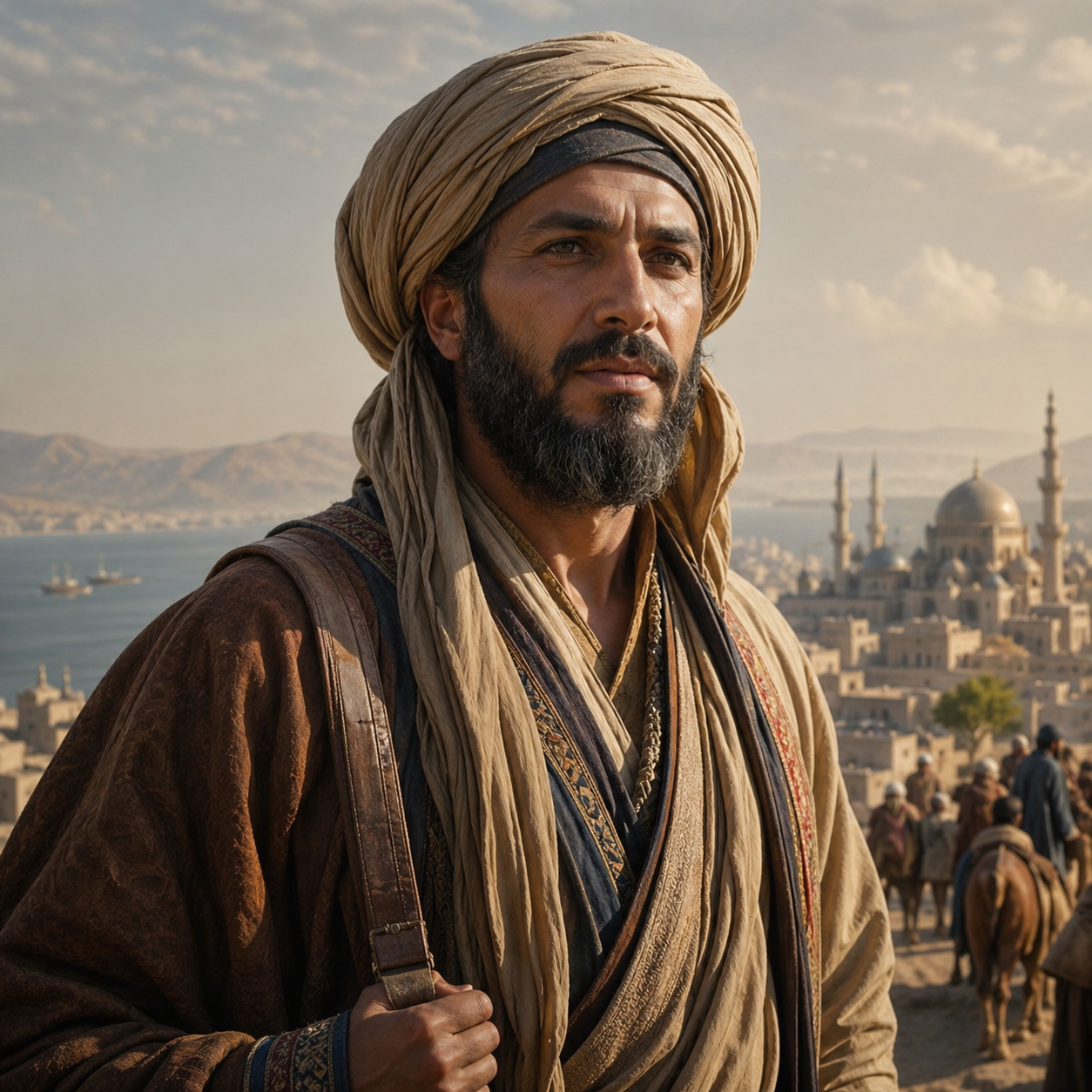
Ibn Battuta — "I saw a man whose body was covered with hair, and he had a tail like a monkey."
I saw a man whose body was covered with hair, and he had a tail like a monkey.
I saw a man whose body was covered with hair, and he had a tail like a monkey.
Click any product to generate a realistic preview. Up to 3 at a time.
* Initial load can take up to 90 seconds — revising the preview in another color is nearly instant.
"The people of this city are very fond of music and dancing."
"I saw a man in this city who could swallow swords. It was a terrifying but fascinating performance."
"Their women are not modest, and they do not veil themselves."
"Who lives sees, but who travels sees more."
"The people of Sumatra eat dogs, which I found disgusting. But when I tried it, it was not so bad."
Moroccan Muslim scholar and explorer whose Rihla (travels) covered ~75,000 miles across the Islamic world from Mali to China — the most-traveled person of the medieval world. Closely associated with Marco Polo (his Venetian counterpart, traveling 50 years earlier in the opposite direction). For an intellectual contrast, see medieval European Christian insularity, the sheltered monastic-feudal worldview of 14th-century Latin Christendom — Ibn Battuta's 30-year journey demonstrates that the 14th-century Dar al-Islam was a single intellectual ecosystem from West Africa to Beijing, while medieval Europe was still tribal and parochial. The cleanest 'connectedness vs insularity' contrast in pre-modern history — Battuta could find a familiar Maliki judge in any city from Mali to Sumatra.
Your cart is empty