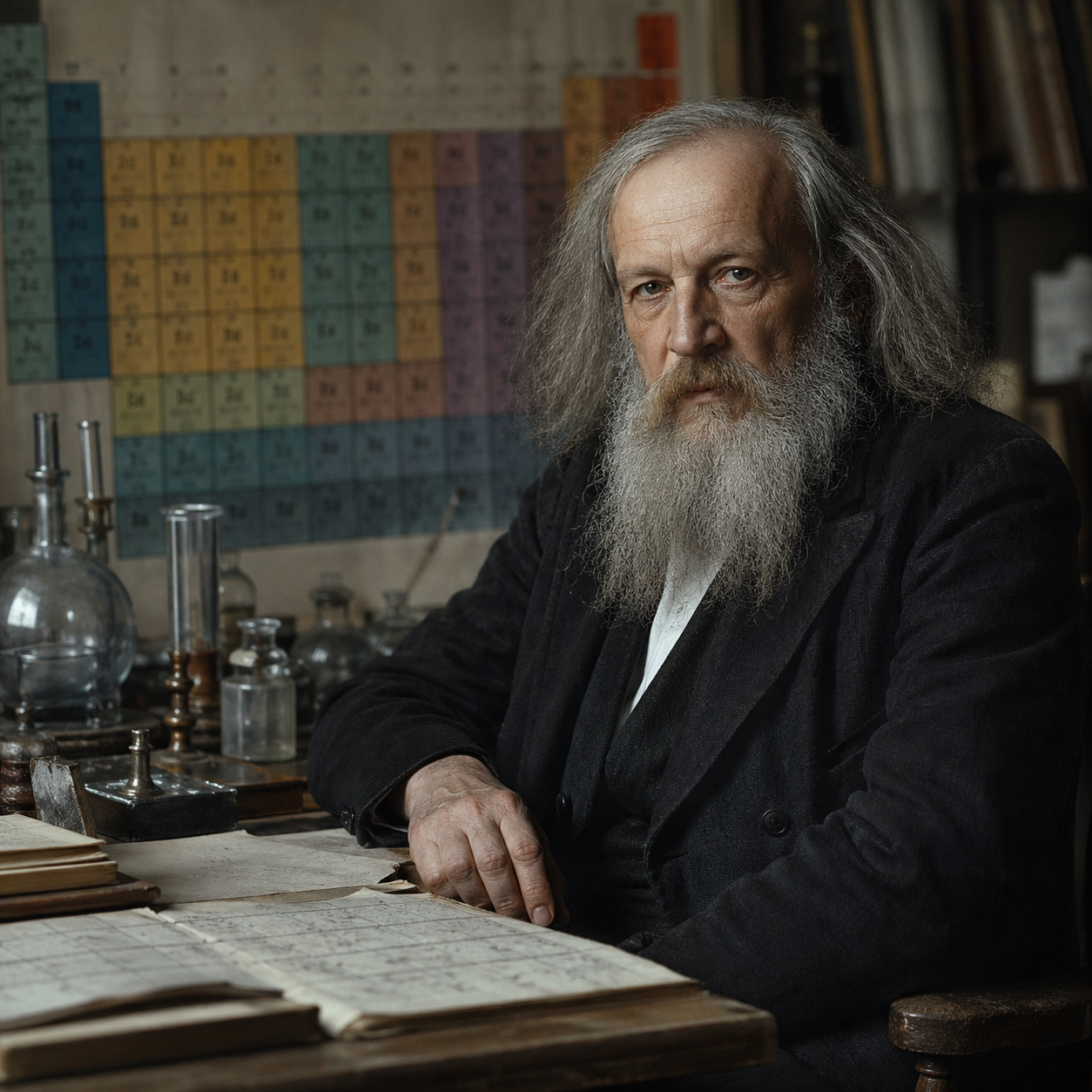
Dmitri Mendeleev — "I saw in a dream a table where all the elements fell into place as required."
I saw in a dream a table where all the elements fell into place as required.
I saw in a dream a table where all the elements fell into place as required.
Click any product to generate a realistic preview. Up to 3 at a time.
* Initial load can take up to 90 seconds — revising the preview in another color is nearly instant.
"The greatest joy of the scientist is in discovering some new truth, some new regularity, some new law."
"I have spent twenty-five years in the study of petroleum and have come to the conclusion that it is a product of the earth's interior, formed at great depths."
"The chemical elements are not created, but are transformed."
"The periodic law is one of the most important generalizations in chemistry."
"Without order, our science is nothing but a miserable collection of facts."
Found in 1 providers: deepseek
1 source checked
Mendeleev describes a moment of sudden insight: after long, conscious struggle to organize the chemical elements, the solution arrived while he was asleep. The sleeping mind finished what the waking mind could not, presenting a complete arrangement where every element occupied its correct position. It captures how creative breakthroughs often emerge unbidden, rewarding sustained effort with a flash of clarity that feels given rather than earned.
Mendeleev spent years wrestling with how to classify the 63 known elements by atomic weight and properties. In February 1869, after an exhausting day of shuffling handwritten element cards like solitaire, he reportedly dozed off and dreamed the complete table. He woke, wrote it down, and famously left gaps predicting undiscovered elements like gallium and germanium, which were later found with properties matching his forecasts.
The mid-19th century was a chaotic period for chemistry: atomic weights were disputed, new elements were being isolated yearly, and no unifying framework existed. The 1860 Karlsruhe Congress had just standardized atomic weights, enabling systematic comparison. Competing classification attempts by Newlands, Meyer, and Odling circulated, but none predicted missing elements. Mendeleev's dream-born table, published 1869, arrived precisely when the field was ripe for synthesis, transforming chemistry into a predictive science.
AI-generated insights based on extensive research and information for context. Factual errors? Email [email protected].
Your cart is empty