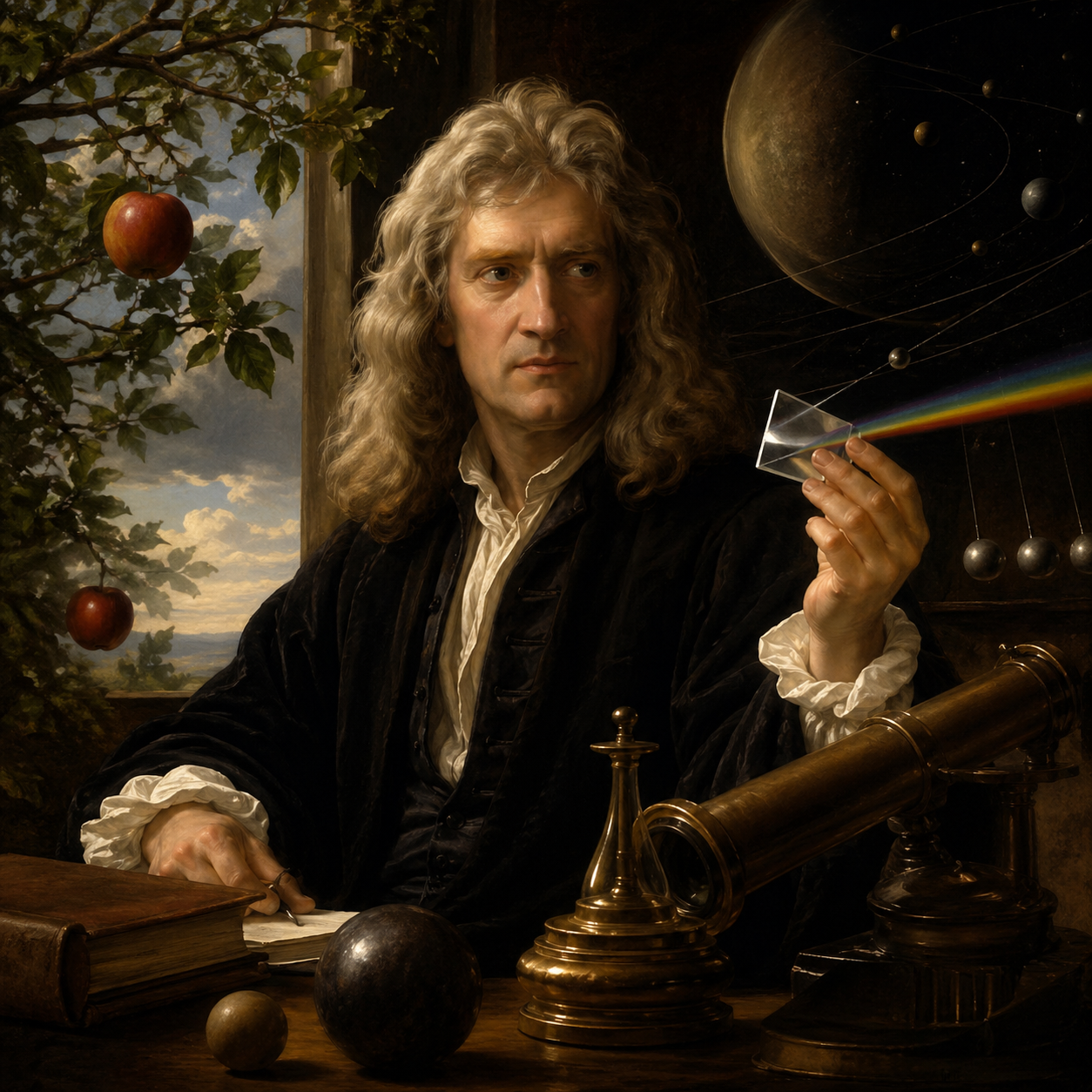
Isaac Newton — "I shall not mingle conjectures with certainties."
I shall not mingle conjectures with certainties.
I shall not mingle conjectures with certainties.
Click any product to generate a realistic preview. Up to 3 at a time.
* Initial load can take up to 90 seconds — revising the preview in another color is nearly instant.
"Nothing can be divided into fewer parts than it hath."
"What is it that induces a man to be a philosopher? It is not the love of truth, but the love of fame, or the love of novelty, or the love of power."
"To explain all nature is too difficult a task for any one man or even for any one age. 'Tis much better to do a little with certainty, & leave the rest for others that come after you, than to explain …"
"Truth is the offspring of silence and meditation."
"The changing of bodies into light, and light into bodies, is very conformable to the course of Nature."
Found in 1 providers: grok
1 source checked
Newton commits to keeping speculation entirely separate from proven fact. He refuses to present guesses as established truths. Don't dress up what you merely suspect as something you actually know. Present only what evidence firmly supports as certain, and label everything else as tentative. It is a discipline of intellectual honesty—never letting plausible-sounding ideas contaminate the credibility of demonstrated, verified conclusions, no matter how tempting those ideas might be.
Newton wrote 'Hypotheses non fingo'—I feign no hypotheses—in his Principia Mathematica, directly echoing this principle. He refused to speculate on why gravity acts at a distance, only proving mathematically that it does. His decades-long delay before publishing the Principia, his meticulous verification of optics experiments, and his sharp separation of published science from his private alchemical investigations all reflect a man who demanded ironclad proof before staking any public claim.
Newton worked during the Scientific Revolution, when natural philosophy was shedding centuries of Aristotelian conjecture. The Royal Society, founded in 1660, explicitly demanded observation over authority. Yet alchemy, astrology, and speculative cosmology still pervaded intellectual life—even Newton privately pursued alchemy. His insistence on separating certainty from conjecture was a radical disciplinary standard in an era where scholastic tradition and theological authority routinely substituted for empirical demonstration.
AI-generated insights based on extensive research and information for context. Factual errors? Email [email protected].
Your cart is empty