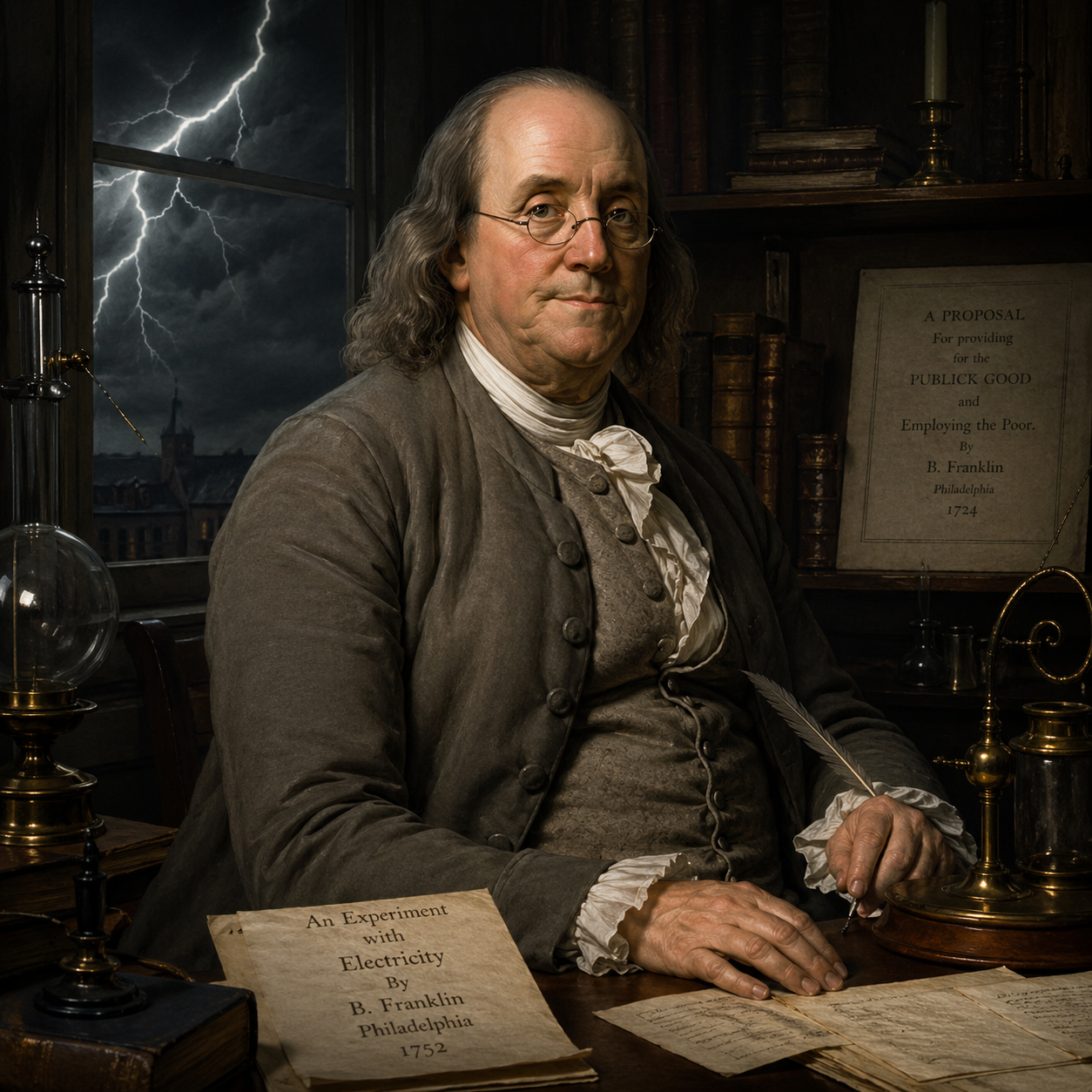
Benjamin Franklin — "I shall rise to apologize for not getting up."
I shall rise to apologize for not getting up.
I shall rise to apologize for not getting up.
Click any product to generate a realistic preview. Up to 3 at a time.
* Initial load can take up to 90 seconds — revising the preview in another color is nearly instant.
"Never spare the parson's wine, nor the baker's pudding."
"The great secret of succeeding in conversation, is to have the address to introduce your own favorite subject, without appearing to take it from others."
"An investment in knowledge always pays the best interest."
"It is easier to prevent bad habits than to break them."
"Keep your eyes wide open before marriage, half shut afterwards."
Polymath Founding Father, diplomat, and Poor Richard's Almanack author who helped draft the Declaration of Independence and the Constitution. Closely associated with John Adams (fellow Founder, Massachusetts statesman) and Thomas Jefferson (fellow Declaration drafter). For an intellectual contrast, see Thomas Hutchinson, last royal governor of colonial Massachusetts — Franklin leaked Hutchinson's loyalist correspondence to Boston in 1772 to inflame revolutionary sentiment — Hutchinson represented the colonial-aristocrat crown-loyalty that Franklin's revolution was organized to dismantle.
Mocking rules of social etiquette due to gout and age
Date: Unknown, likely late in life
GeneralFound in 1 providers: gemini
1 source checked
This quote captures a self-defeating paradox delivered as deadpan wit. The speaker acknowledges he should stand but cannot — yet the very act of rising to offer that apology defeats its own purpose. It is a wry admission of limitation wrapped in verbal irony: the remedy and the problem are the same action, leaving the apology suspended in comic contradiction that makes the listener laugh rather than take offense.
Franklin was celebrated as much for razor-sharp wit as for science and statecraft. His Poor Richard's Almanack overflows with paradoxes and self-deprecating observations. In his later years, plagued by gout at diplomatic gatherings in Paris, he had real cause to remain seated. This verbal sleight of hand — turning a social apology into a logical puzzle — is pure Franklin: charming, self-aware, and disarming all at once.
In 18th-century polite society, rising to greet someone was a fundamental gesture of respect — failing to stand was a genuine social slight requiring acknowledgment. Franklin's era prized wit above almost all conversational virtues; salons in Philadelphia and Paris rewarded the cleverest turn of phrase. A quip that exposed the absurdity of formal etiquette while simultaneously performing it was considered the height of cultivated, gentlemanly humor.
AI-generated insights based on extensive research and information for context. Factual errors? Email [email protected].
Your cart is empty