Richard Feynman — "I think that when you're doing science, you're trying to find out something that…"
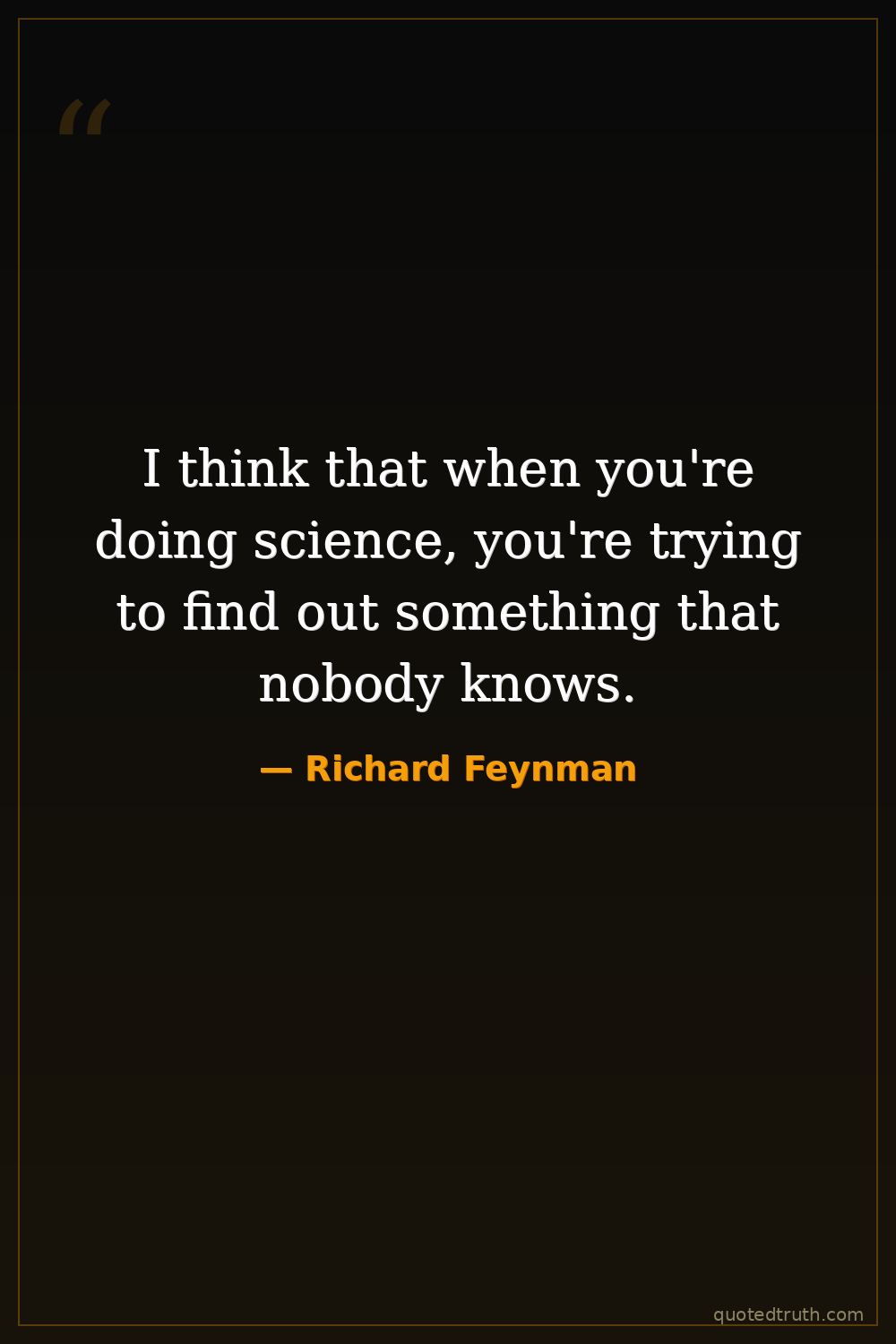
I think that when you're doing science, you're trying to find out something that nobody knows.
I think that when you're doing science, you're trying to find out something that nobody knows.
Click any product to generate a realistic preview. Up to 3 at a time.
* Initial load can take up to 90 seconds — revising the preview in another color is nearly instant.
"People would often think I'm a faker, but I'm usually honest, in a certain way- in such a way that often nobody believes me!"
"The world is a dynamic mess of jiggling things."
"I don't know what's the matter with people: they don't learn by understanding; they learn by some other way — by rote or something. Their knowledge is so fragile!"
"It's a great thing to be able to say, 'I don't know.'"
"I can live with doubt and uncertainty and not knowing. I think it's much more interesting to live not knowing than to have answers which might be wrong."
American theoretical physicist who shared the 1965 Nobel for QED, developed Feynman diagrams, and wrote the Feynman Lectures on Physics. Closely associated with Julian Schwinger (co-Nobelist for QED) and Murray Gell-Mann (Caltech rival and Eightfold-Way physicist). For an intellectual contrast, see Deepak Chopra, physician and quantum-mysticism author — Feynman's Caltech 'cargo cult science' commencement address is the precise template for what he saw as misuse of physics terminology — Chopra-style appropriation of quantum vocabulary for metaphysical claims is the canonical example of what Feynman called 'fooling yourself'.
Found in 1 providers: grok
1 source checked
Science is fundamentally about venturing into genuine unknowns—not running experiments to confirm textbook results, but chasing questions where no answer yet exists. The point isn't technique or publication; it's discovery. If the answer is already known, you're doing engineering or education, not science. True scientific work requires accepting uncertainty and pursuing it anyway, which is both humbling and the entire point.
Feynman embodied this throughout his career. His Nobel Prize-winning work on quantum electrodynamics resolved a genuine theoretical crisis, not an incremental problem. He obsessively redid derivations from scratch rather than citing authority. He cracked safes at Los Alamos out of pure curiosity. His famous Caltech lectures were built on the premise that real understanding means confronting what you don't yet know, not reciting what you do.
Feynman's peak decades—the 1950s through 1980s—saw science become institutionalized and heavily funded by governments chasing Cold War and Space Race advantages. Particle accelerators and NASA defined scientific ambition. Yet this era risked turning science into goal-directed engineering with predetermined outputs. Feynman consistently pushed back against that drift, insisting curiosity-driven inquiry—not defense contracts or prestige metrics—was what made science productive and honest at all.
AI-generated insights based on extensive research and information for context. Factual errors? Email [email protected].
Your cart is empty