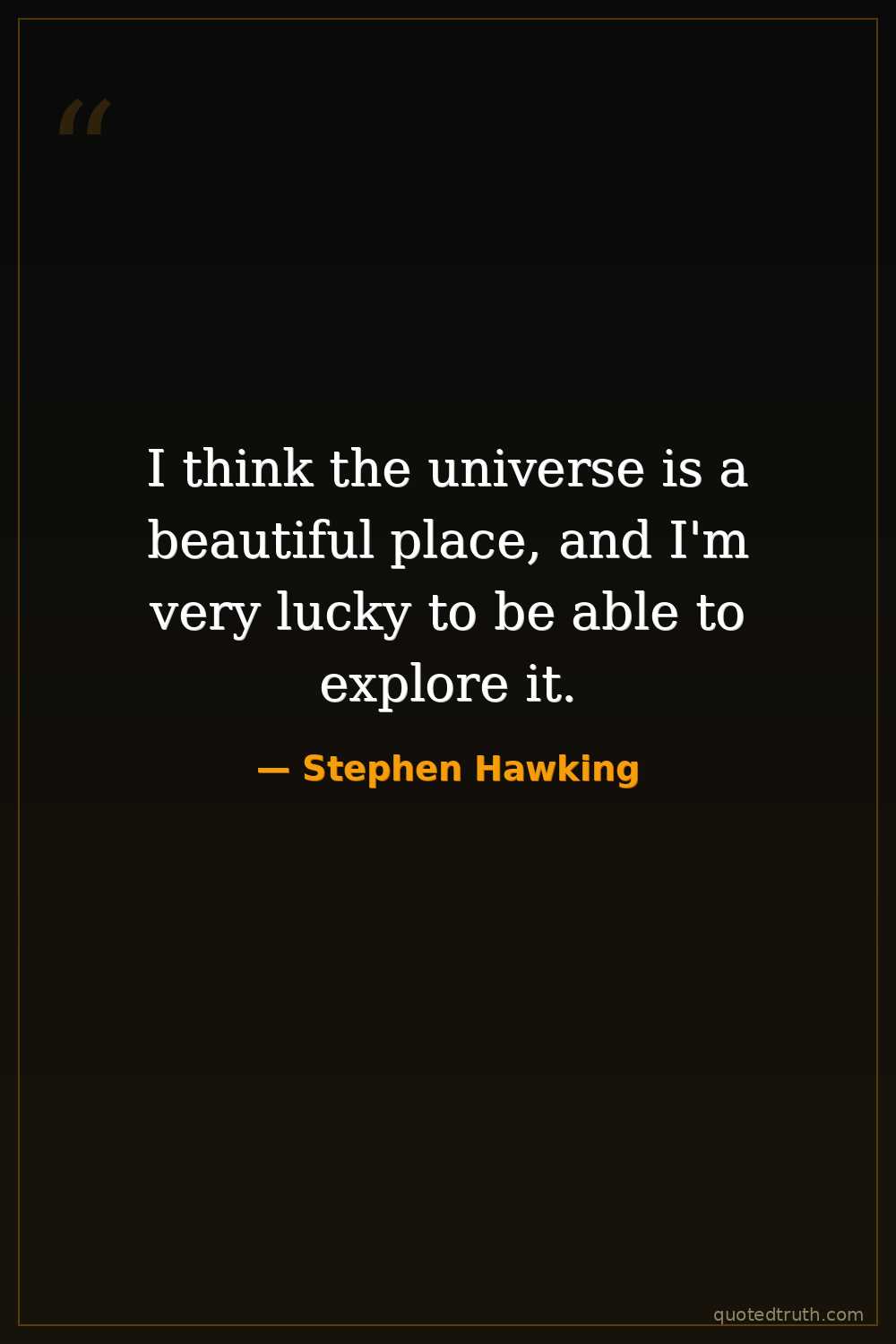
Stephen Hawking — "I think the universe is a beautiful place, and I'm very lucky to be able to expl…"
I think the universe is a beautiful place, and I'm very lucky to be able to explore it.
I think the universe is a beautiful place, and I'm very lucky to be able to explore it.
Click any product to generate a realistic preview. Up to 3 at a time.
* Initial load can take up to 90 seconds — revising the preview in another color is nearly instant.
"Black holes ain't as black as they are painted. They are not the eternal prisons they were once thought. Things can get out of a black hole, both to the outside, and possibly, to another universe. So,…"
"Even if there is only one possible unified theory, it is just a set of rules and equations. What is it that breathes fire into the equations and makes a universe for them to describe?"
"Finally, a question about something important. My advice to any heartbroken young girl is to pay close attention to the study of theoretical physics. It would not be beyond the realms of possibility t…"
"I believe that human beings have a duty to explore the universe."
"We are close to the tipping point, where global warming becomes irreversible. Trump's action could push the Earth over the brink, to become like Venus, with a temperature of 250 degrees [Celsius], and…"
British theoretical physicist whose Hawking radiation work and A Brief History of Time (1988) brought black-hole physics to a mass audience while he lived with ALS for 55 years. Closely associated with Roger Penrose (his collaborator on singularity theorems) and Carl Sagan (fellow popularizer who wrote Brief History's foreword). For an intellectual contrast, see William Lane Craig, American philosopher of religion — Craig's Kalam cosmological argument depends on the Big Bang requiring a divine first cause; Hawking's no-boundary proposal was specifically designed to remove the moment that would require one — the cleanest cosmology-vs-natural-theology contrast in modern thought.
Found in 1 providers: grok
1 source checked
The universe holds genuine beauty worth appreciating, and having the capacity to investigate it scientifically is a rare privilege. This reflects gratitude paired with intellectual wonder — not passive admiration but active exploration. The speaker sees scientific inquiry as fortunate access to something magnificent, framing curiosity as gift rather than obligation.
Hawking, paralyzed by ALS from his twenties yet producing landmark work on black hole radiation and the Big Bang, embodied this sentiment viscerally. His condition made physical exploration impossible, yet his mind ranged across cosmic scales. His gratitude wasn't rhetorical — he genuinely considered his ability to think about the universe a compensation for profound physical loss.
Hawking worked through decades of cosmological revolution: quasars discovered, CMB confirmed, black holes moved from theory to observable candidates. His career spanned the space race, the Hubble telescope launch, and gravitational wave detection. Public science communication exploded with Sagan and Hawking leading it, making universe-wonder culturally mainstream rather than academically confined.
AI-generated insights based on extensive research and information for context. Factual errors? Email [email protected].
Your cart is empty