Francis Crick — "I was never a very good experimentalist."
I was never a very good experimentalist.
I was never a very good experimentalist.
Click any product to generate a realistic preview. Up to 3 at a time.
* Initial load can take up to 90 seconds — revising the preview in another color is nearly instant.
"If you want to be a scientist, you have to be prepared to be wrong a lot."
"If you want to understand life, you have to understand DNA."
"I am an atheist, and I don't believe in God."
"What is true of the brain is true of the universe."
"The brain is a machine that makes theories."
Found in 1 providers: grok
1 source checked
An honest admission that Crick lacked hands-on laboratory skill — running experiments, operating equipment, generating clean data. It acknowledges that scientific greatness can be decoupled from technical execution. Some minds excel at synthesizing others' data, spotting structural patterns, and building theoretical frameworks. Being a poor experimentalist doesn't disqualify you from transforming a field; it means your contribution comes through thinking and interpretation rather than generating raw results yourself.
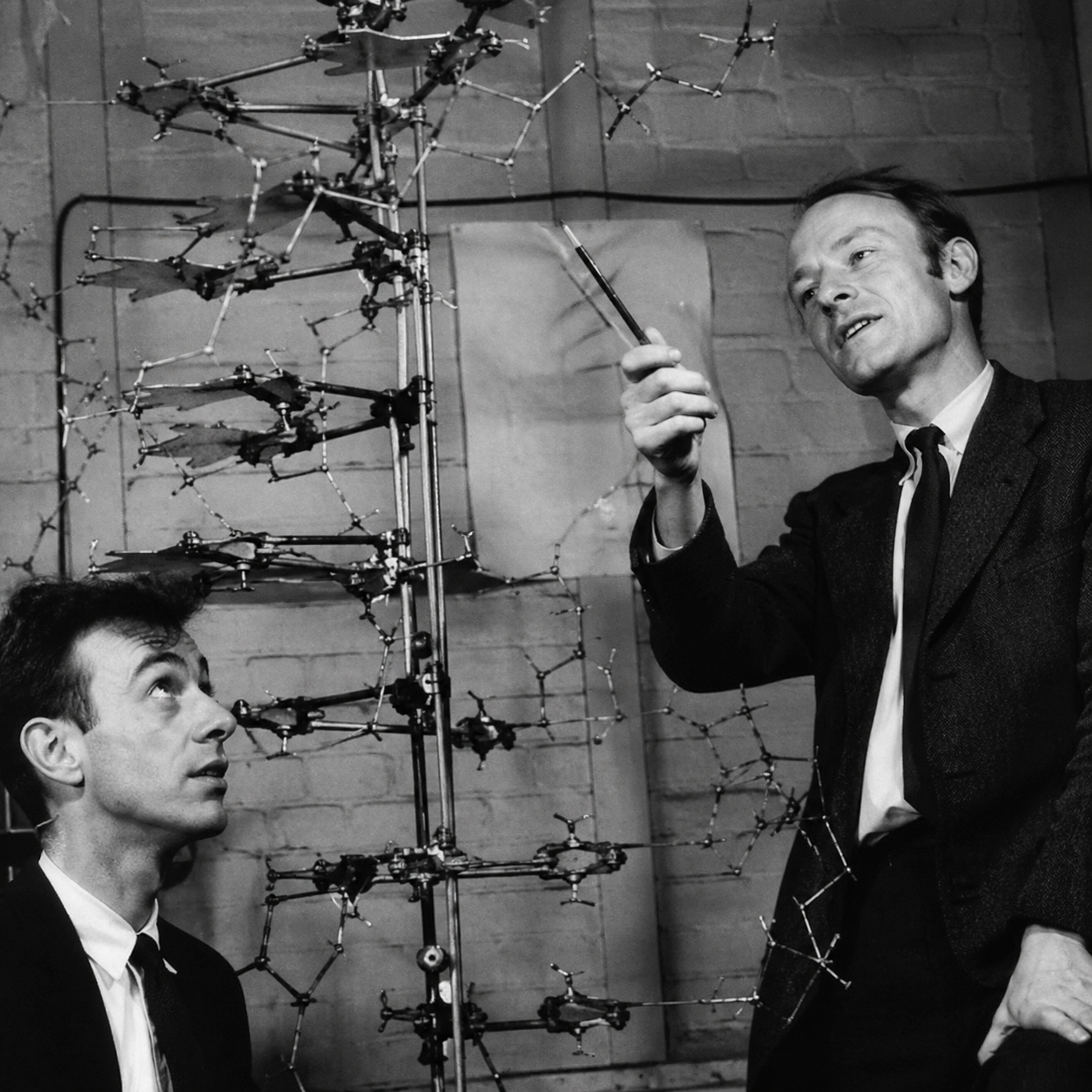
Crick trained as a physicist before pivoting to biology in his 30s, arriving without formal biochemistry bench skills. His greatest achievement — the double helix model — came from theorizing and model-building, relying heavily on Rosalind Franklin's X-ray crystallography data and Chargaff's base-pairing rules. He never ran the decisive experiments himself. His strength was conceptual integration: seeing how scattered pieces fit. This quote is disarming honesty from a Nobel laureate who knew precisely where his genius resided.
The 1950s marked the birth of molecular biology, where X-ray crystallography, biochemical assays, and theoretical modeling intersected for the first time. Science was growing specialized; the solo generalist was giving way to collaborative teams. Cold War funding poured into biological research after the atomic age redefined what science could accomplish. In this environment, Crick's archetype — the big-picture theorist synthesizing experimental work done by others — became a legitimate and transformative model for scientific discovery.
AI-generated insights based on extensive research and information for context. Factual errors? Email [email protected].
Your cart is empty