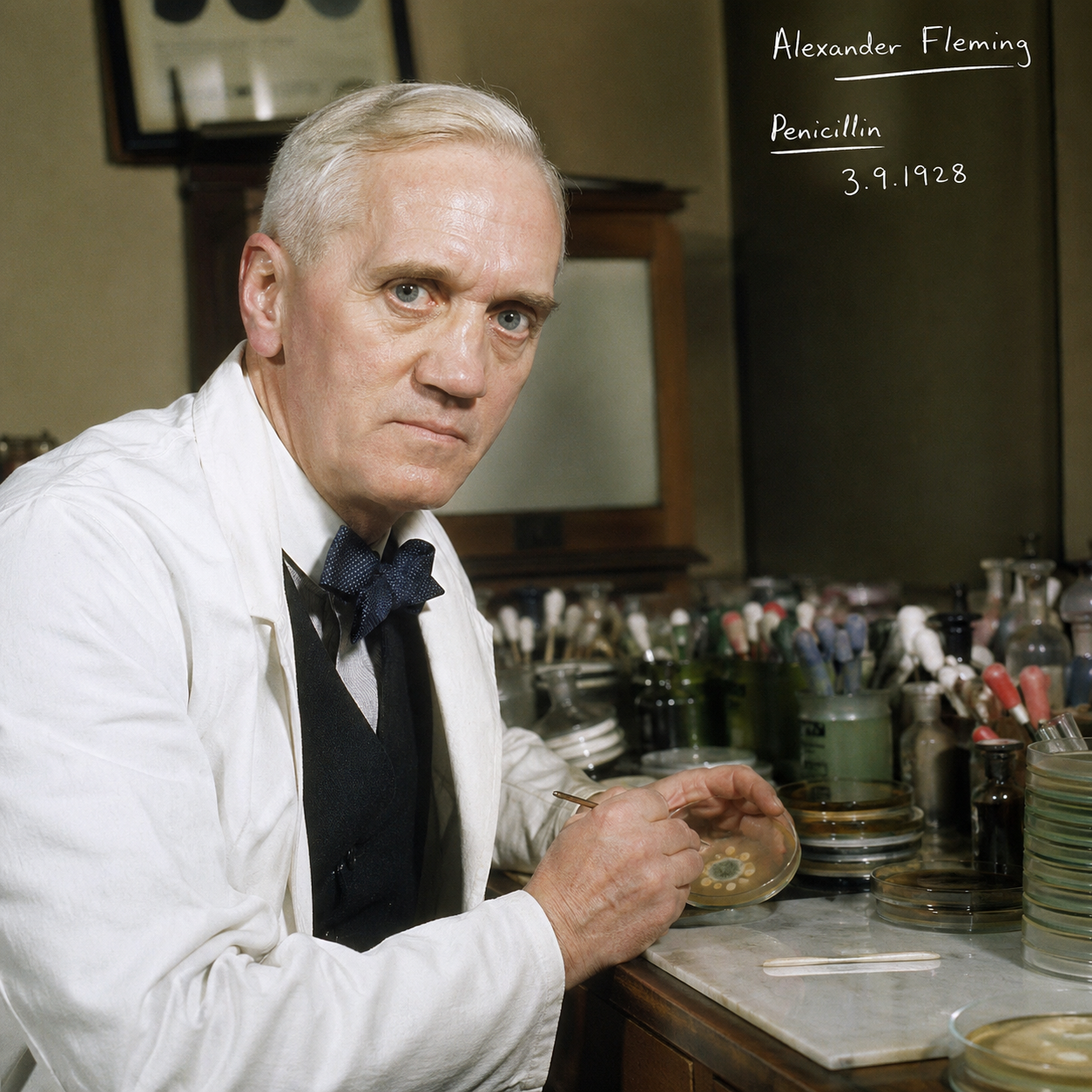
Alexander Fleming — "I was not looking for penicillin when I discovered it. I was looking for a bette…"
I was not looking for penicillin when I discovered it. I was looking for a better antiseptic.
I was not looking for penicillin when I discovered it. I was looking for a better antiseptic.
Click any product to generate a realistic preview. Up to 3 at a time.
* Initial load can take up to 90 seconds — revising the preview in another color is nearly instant.
"I have always been interested in the effect of one microbe on another."
"My only merit is that I did not discard the cultures at an early stage."
"I have been accused of being untidy. I confess to being untidy, but I have never allowed my untidiness to interfere with my work."
"I was just a dirty old man who left his dishes unwashed."
"I am only one of many who have contributed to the development of penicillin."
Found in 1 providers: grok
1 source checked
Fleming is admitting that his world-changing discovery was not the result of a deliberate hunt for an antibiotic. He set out to solve a smaller, practical problem: finding a less toxic wound disinfectant than the harsh chemicals of his day. The penicillin mold appeared by accident on a contaminated petri dish. The quote reframes scientific breakthrough as something that often arrives sideways, while you are chasing a different, more modest goal.
Fleming was a Scottish bacteriologist at St Mary's Hospital, London, who served as a battlefield medic in World War I and watched soldiers die from infected wounds because carbolic-acid antiseptics killed the patients' immune cells too. That trauma drove his lifelong search for a gentler antibacterial. In 1928 a stray Penicillium mold killed staphylococci on a forgotten plate. He shared the 1945 Nobel Prize and credited observation, not genius, for the find.
Fleming spoke in the early-to-mid twentieth century, when bacterial infections still killed routinely: pneumonia, sepsis, tuberculosis, and battlefield wounds had no real cure, and a scratch could be fatal. World War I had exposed the inadequacy of existing antiseptics, and World War II created urgent demand for mass-produced antibiotics. Penicillin, scaled by Florey and Chain in the 1940s, saved countless Allied soldiers and launched the antibiotic era, fundamentally reshaping medicine, surgery, and life expectancy.
AI-generated insights based on extensive research and information for context. Factual errors? Email [email protected].
Your cart is empty