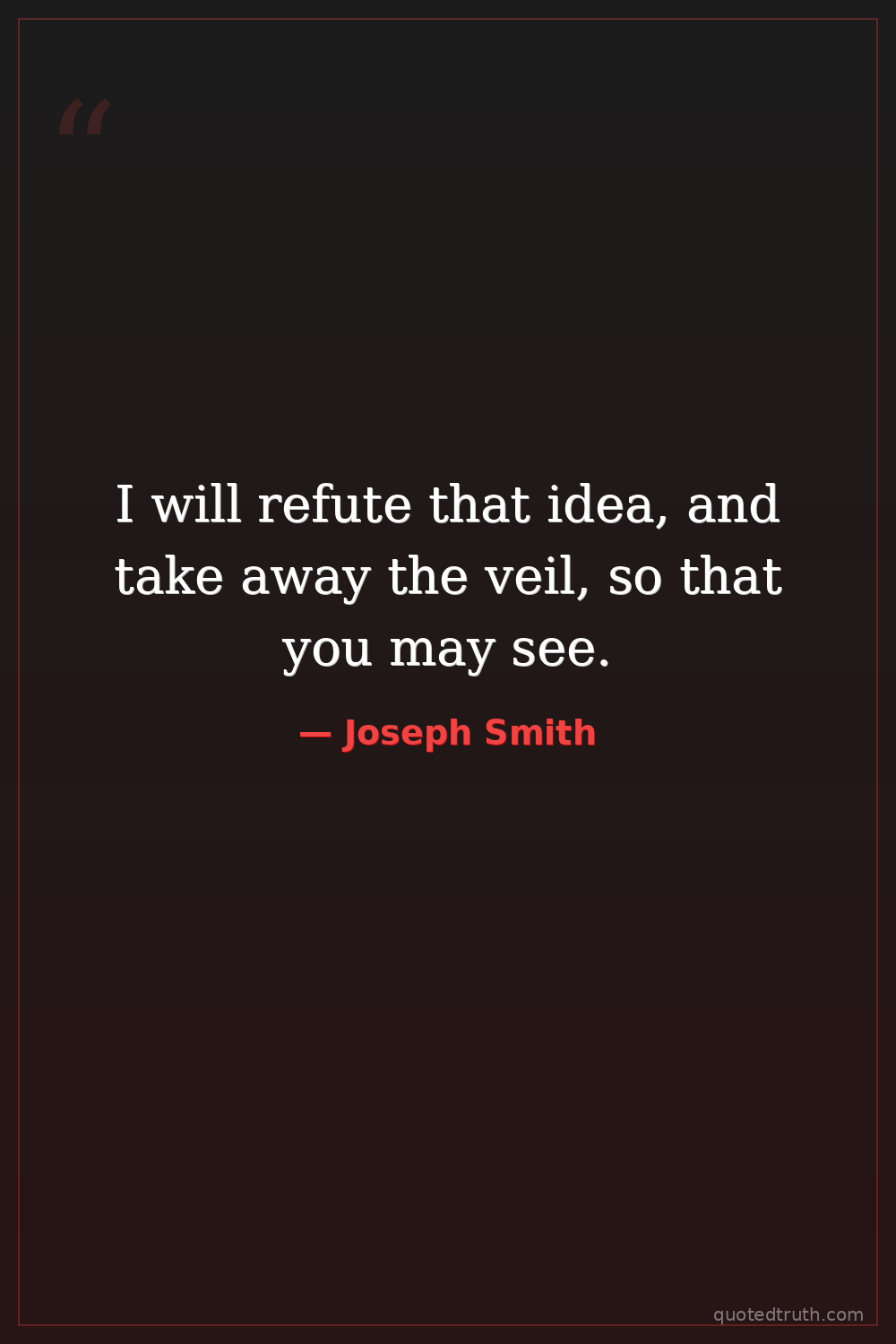
Joseph Smith — "I will refute that idea, and take away the veil, so that you may see."
I will refute that idea, and take away the veil, so that you may see.
I will refute that idea, and take away the veil, so that you may see.
Click any product to generate a realistic preview. Up to 3 at a time.
* Initial load can take up to 90 seconds — revising the preview in another color is nearly instant.
"God himself was once as we are now, and is an exalted man, and sits enthroned in yonder heavens! That is the great secret. If the vail was rent today, and the great God who holds this world in its orb…"
"I have the best of feelings for all men, and I wish them all to be saved."
"There are two churches only; the one is the church of the Lamb of God, and the other is the church of the devil; wherefore, whoso belongeth not to the church of the Lamb of God belongeth to that great…"
"For behold, the Lord shall curse the land with much heat, and the barrenness thereof shall go forth forever; and there was a blackness came upon all the children of Canaan, that they were despised amo…"
"No man knows my history. I cannot tell it. I shall never tell it. I make no apologies for my life."
King Follett Discourse, referring to the traditional Christian understanding of God
Date: 1844
GeneralFound in 1 providers: gemini
1 source checked
The speaker commits to dismantling a false or misleading belief and revealing hidden truth beneath it. Rather than simply disagreeing, they promise active demolition of the error and full transparency—lifting a metaphorical veil so others can perceive reality directly. It implies the speaker possesses knowledge others lack and feels obligated to share it, prioritizing clarity and revelation over comfort or conformity.
Smith built his entire ministry on claims of revealed truth hidden from the world. He described himself as a prophet who received divine visions, translated buried scripture, and restored a church corrupted over centuries. This quote mirrors his foundational identity: the one chosen to lift the veil between humanity and divine knowledge, actively refuting mainstream Christianity's doctrines through direct revelation and prophetic authority.
Smith lived during the Second Great Awakening (1820s–1840s), a period of intense religious ferment in America where competing denominations each claimed exclusive truth. Skepticism toward established churches was widespread, and new religious movements flourished. In this environment, claims to special revelation and direct access to hidden divine knowledge held enormous cultural power, making Smith's promise to 'remove the veil' resonate deeply with seekers questioning traditional Protestant authority.
AI-generated insights based on extensive research and information for context. Factual errors? Email [email protected].
Your cart is empty