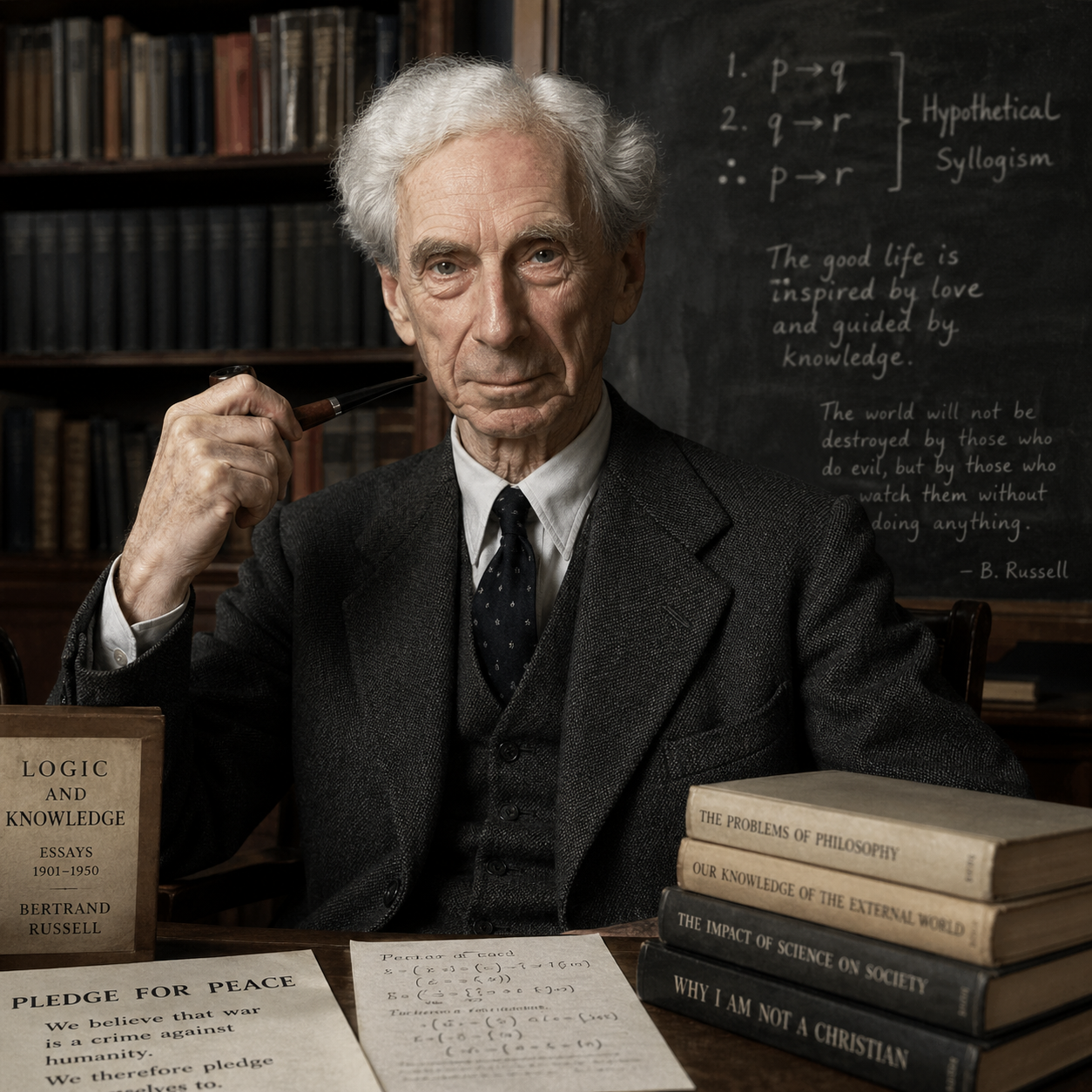
Bertrand Russell — "I would rather be a man of paradoxes than a man of prejudices."
I would rather be a man of paradoxes than a man of prejudices.
I would rather be a man of paradoxes than a man of prejudices.
Click any product to generate a realistic preview. Up to 3 at a time.
* Initial load can take up to 90 seconds — revising the preview in another color is nearly instant.
"I am firmly convinced that the better we know the world, the less we shall be inclined to believe in God and immortality."
"Men are born ignorant, not stupid; they are made stupid by education."
"The deeply irrational attitude of each sex toward women may be seen in novels, particularly in bad novels. In bad novels by men, there is the woman with whom the author is in love, who usually possess…"
"Many a marriage hardly differs from prostitution, except being harder to escape from."
"Free thought has always been a perquisite of aristocracy."
British philosopher, logician, and Nobel literature laureate (1950) who co-authored Principia Mathematica with Whitehead and led 20th-century pacifist and nuclear-disarmament campaigns. Closely associated with Alfred North Whitehead (Principia Mathematica co-author) and Ludwig Wittgenstein (his student-then-rival). For an intellectual contrast, see F.H. Bradley, British Idealist philosopher — Russell's 1898 break with Bradley's neo-Hegelian Idealism — and his subsequent logical-atomism — is the founding moment of the Anglo-American analytic philosophy tradition that displaced Idealism for a century. Russell's entire early career is structured against Bradley's metaphysics of internal relations.
The standard scholarly entry points to Bertrand Russell's work: Ray Monk (Southampton, philosophy biographer) — Bertrand Russell: The Spirit of Solitude 1872-1921 (1996); A.C. Grayling (New College of the Humanities) — Russell: A Very Short Introduction (1996). These are the works graduate seminars cite when teaching Bertrand Russell.
Your cart is empty