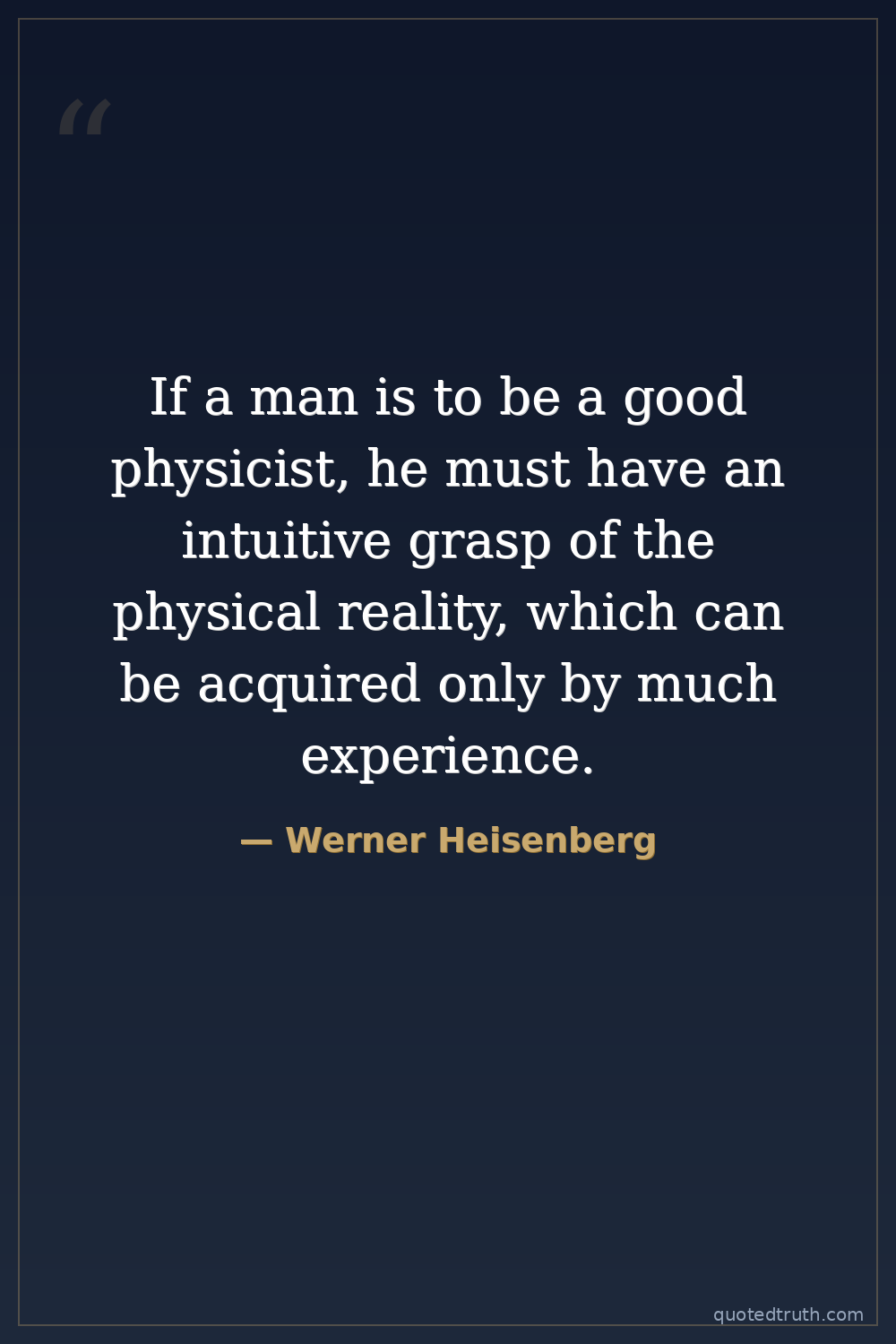
Werner Heisenberg — "If a man is to be a good physicist, he must have an intuitive grasp of the physi…"
If a man is to be a good physicist, he must have an intuitive grasp of the physical reality, which can be acquired only by much experience.
If a man is to be a good physicist, he must have an intuitive grasp of the physical reality, which can be acquired only by much experience.
Click any product to generate a realistic preview. Up to 3 at a time.
* Initial load can take up to 90 seconds — revising the preview in another color is nearly instant.
"Our proposition that the physicists on both sides should not advance the production of atomic bombs, was thus indirectly, if one wants to exaggerate the point, a proposition in favor of Hitler."
"The more I think about the physical aspects of the electron, the more it becomes a puzzle."
"The reality we can put into words is never reality itself."
"I would say that I was absolutely convinced of the possibility of our making a uranium engine. but I never thought that we would make a bomb. and at the bottom of my heart. I was really glad that it w…"
"We have to remember that what we observe is not nature in itself but nature exposed to our method of questioning."
Found in 1 providers: grok
1 source checked
Becoming truly skilled in physics requires more than mastering equations or memorizing theory. You need a deep, gut-level feel for how nature actually behaves, and that instinct cannot be taught from books alone. It develops gradually through years of hands-on work, wrestling with real problems, making mistakes, and watching patterns emerge. Expertise lives in trained intuition, and intuition is built only through sustained, direct engagement.
Heisenberg pioneered quantum mechanics and the uncertainty principle precisely because he trusted his physical intuition over rigid formalism. His 1925 breakthrough on Helgoland came from abandoning visualizable orbits and feeling his way toward matrix mechanics. Mentored by Bohr and Sommerfeld, he absorbed physics through intense debate and calculation rather than pure textbook learning, making experiential intuition central to how he personally discovered the laws governing atoms.
Heisenberg worked during the 1920s-1970s, when classical physics shattered and quantum theory demanded radically new thinking. Physicists faced phenomena no prior experience had prepared them for: wave-particle duality, probability-based reality, and atomic behavior defying common sense. Universities in Göttingen, Copenhagen, and Munich became crucibles where young theorists built intuition through relentless discussion and problem-solving. The atomic age, WWII, and the nuclear era further demanded physicists who understood reality, not just mathematics.
AI-generated insights based on extensive research and information for context. Factual errors? Email [email protected].
Your cart is empty