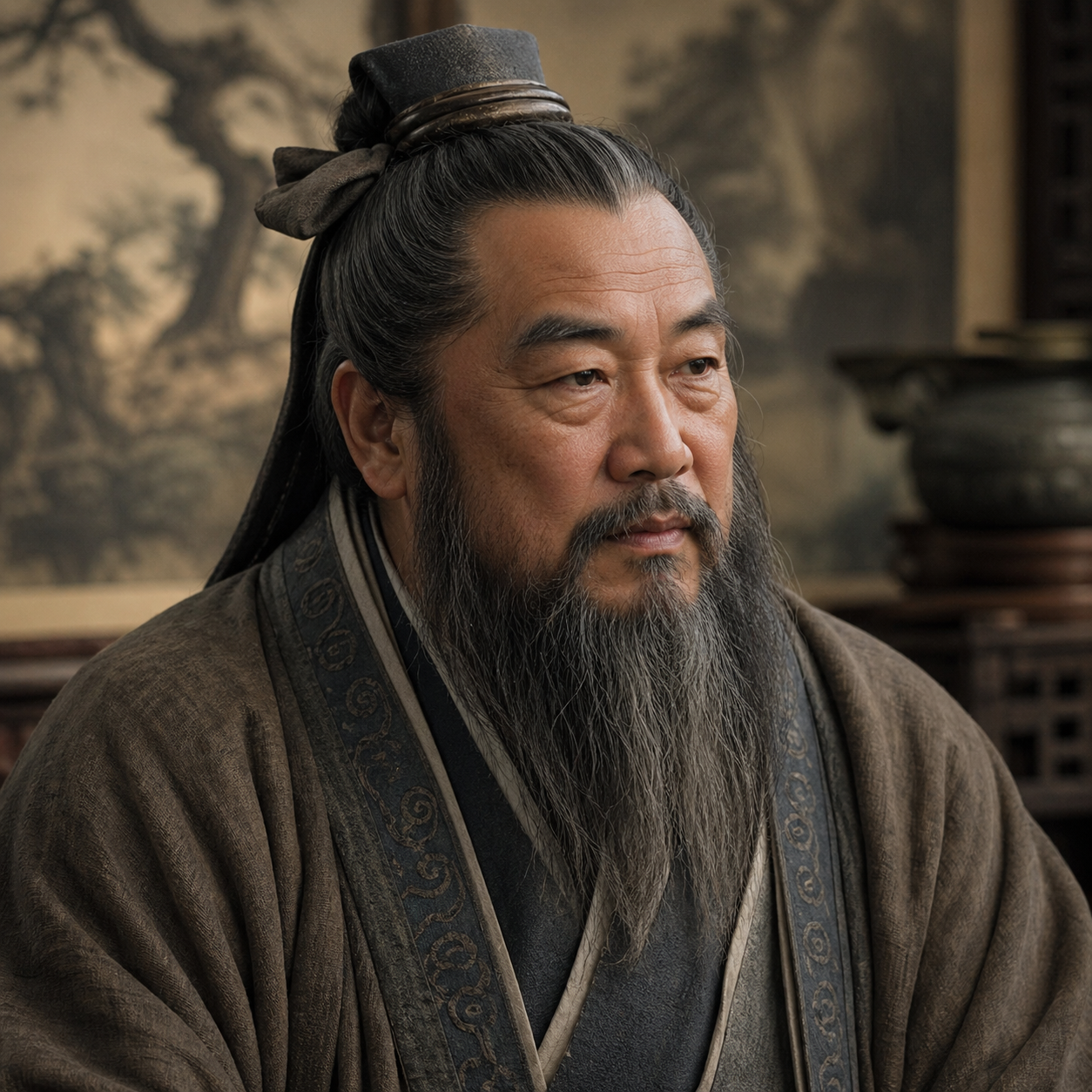
Confucius — "If a man takes no thought about what is distant, he will find sorrow near at han…"
If a man takes no thought about what is distant, he will find sorrow near at hand.
If a man takes no thought about what is distant, he will find sorrow near at hand.
Click any product to generate a realistic preview. Up to 3 at a time.
* Initial load can take up to 90 seconds — revising the preview in another color is nearly instant.
"The gentleman is not a tool."
"Riches and honors are the things people desire; but if one obtains them by not following the Way, then one will not be able to hold them. Poverty and low position in society are the things that people…"
"The Master said, 'He who acts with a constant view to his own advantage will be much murmured against.'"
"Learning without thought is labor lost; thought without learning is perilous."
"The superior man thinks of virtue; the small man thinks of comfort."
Chinese philosopher and teacher whose teachings (compiled by his students in the Analects) became the foundational ethical framework of East Asian civilization for 2,500 years. Closely associated with Mencius (his most-influential follower a century later). For an intellectual contrast, see Laozi, near-contemporary Chinese sage and Tao Te Ching author — Confucius systematized social order through ritual and family hierarchy; Laozi's Taoist effortless-action philosophy argued such systems were the disease, not the cure. The two founding poles of Chinese moral philosophy — every East Asian moral tradition since has positioned itself between them.
The standard scholarly entry points to Confucius's work: Philip J. Ivanhoe (Georgetown, Chinese philosophy) — Confucian Moral Self Cultivation (2000); Edward Slingerland (UBC, Asian Studies) — Effortless Action: Wu-wei as Conceptual Metaphor (2003); Tu Weiming (Harvard, Confucian scholar) — Confucian Thought: Selfhood as Creative Transformation (1985). These are the works graduate seminars cite when teaching Confucius.
Found in 2 providers: deepseek,grok
2 sources checked
Failing to think ahead about future consequences leads to immediate troubles. When you ignore long-term planning and only focus on the present moment, problems quickly appear in your daily life. The saying warns that neglecting to consider distant outcomes, whether months or years away, creates avoidable hardship right now. Foresight prevents suffering, while short-sightedness guarantees regret. Planning and reflection about the future are essential survival tools, not luxuries.
Confucius built his entire teaching around self-cultivation, moral foresight, and the careful preparation required to govern a family, state, or oneself. As a scholar-official who advised rulers and trained disciples for public service, he constantly stressed deliberate planning, ritual preparation, and studying history to avoid future errors. This saying reflects his belief that the junzi, or exemplary person, must cultivate long-range thinking, because wisdom means anticipating consequences rather than reacting to crises.
Confucius lived during the Spring and Autumn period (roughly 551-479 BCE), an era of collapsing Zhou authority, constant warfare between feudal states, and political instability. Rulers who failed to plan diplomatically or economically lost territory, thrones, and lives. Ordinary families faced famine, conscription, and displacement without foresight. In this volatile landscape, long-term strategic thinking was literally a matter of survival, making Confucius's emphasis on prudent planning a practical response to chaotic times.
AI-generated insights based on extensive research and information for context. Factual errors? Email [email protected].
Your cart is empty