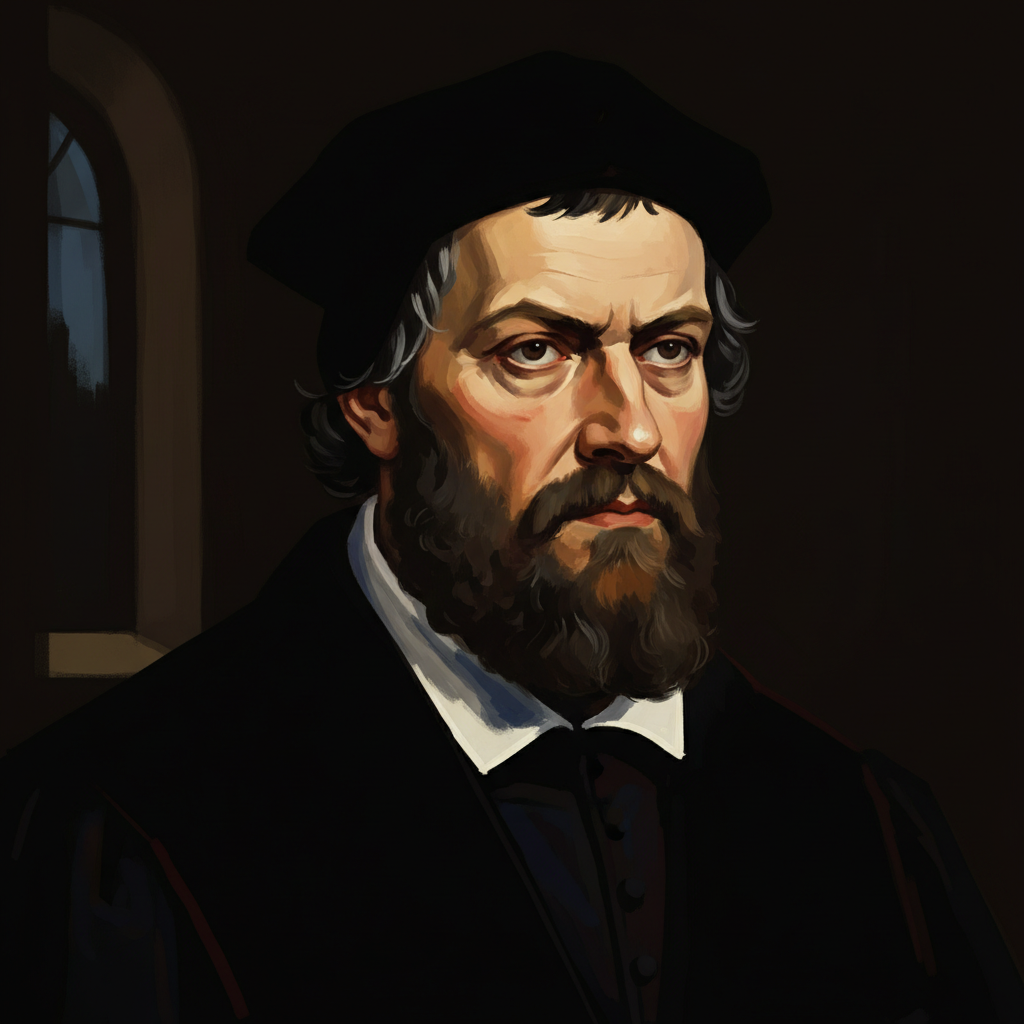
Martin Luther — "If I am to be a Christian, I must be a Jew."
If I am to be a Christian, I must be a Jew.
If I am to be a Christian, I must be a Jew.
Click any product to generate a realistic preview. Up to 3 at a time.
* Initial load can take up to 90 seconds — revising the preview in another color is nearly instant.
"The book of Esther I toss into the Elbe. I am such an enemy to the book of Esther that I wish it did not exist, for it Judaizes too much and has in it a great deal of heathenish foolishness."
"I am a peasant's son; my father, grandfather, and great-grandfather were genuine peasants. So I am a peasant and shall remain one."
"I am much afraid that schools will prove to be great gates of hell unless they diligently labor in explaining the Holy Scriptures, engraving them in the hearts of youth. I advise no one to place his c…"
"Medicine causes illness, Mathematics melancholy, and Theology sinful people."
"Your home, once the holiest of all, has become the most licentious den of thieves, the most shameless of all brothels, the kingdom of sin, death, and hell. It is so bad that even Antichrist himself, i…"
German theologian whose 95 Theses (1517) launched the Protestant Reformation and broke the Catholic Church's monopoly on Western Christianity. Closely associated with Philipp Melanchthon (Lutheran systematizer) and John Calvin (later Reformer who built on Luther's break). For an intellectual contrast, see Pope Leo X, Renaissance pope (1513-1521) — Leo X's indulgence sales triggered Luther's break and Leo excommunicated him in 1521 — Luther's entire Reformation is structured as a direct answer to the indulgence-funded Vatican Leo represented.
Found in 1 providers: grok
1 source checked
Christianity cannot be separated from its Jewish roots. To follow Jesus authentically means accepting that the faith grew out of Judaism, that Jesus himself was Jewish, and that the Hebrew scriptures remain foundational. Anyone claiming Christian identity is implicitly claiming a heritage that runs through Israel's prophets, patriarchs, and covenants. You cannot embrace the branch while rejecting the root that feeds it.
Luther staked his entire reform on returning to Scripture, and Scripture meant the Hebrew Bible alongside the Greek New Testament. He learned Hebrew, translated the Old Testament into German, and early in his career wrote sympathetically about Jews in 'That Jesus Christ Was Born a Jew' (1523). This line reflects that earlier phase, before his later notorious anti-Jewish writings contradicted it and complicated his legacy.
In early sixteenth-century Europe, Jews were ghettoized, expelled, and forcibly converted across Christian kingdoms. The Reformation reopened questions about Scripture's original languages, sending scholars back to Hebrew sources and Jewish commentators like Rashi. Luther's 1517 break with Rome coincided with humanist Hebrew revival led by Reuchlin. Asserting Christianity's Jewish foundation was theologically radical when church tradition had spent centuries defining itself against Judaism rather than from it.
AI-generated insights based on extensive research and information for context. Factual errors? Email [email protected].
Your cart is empty