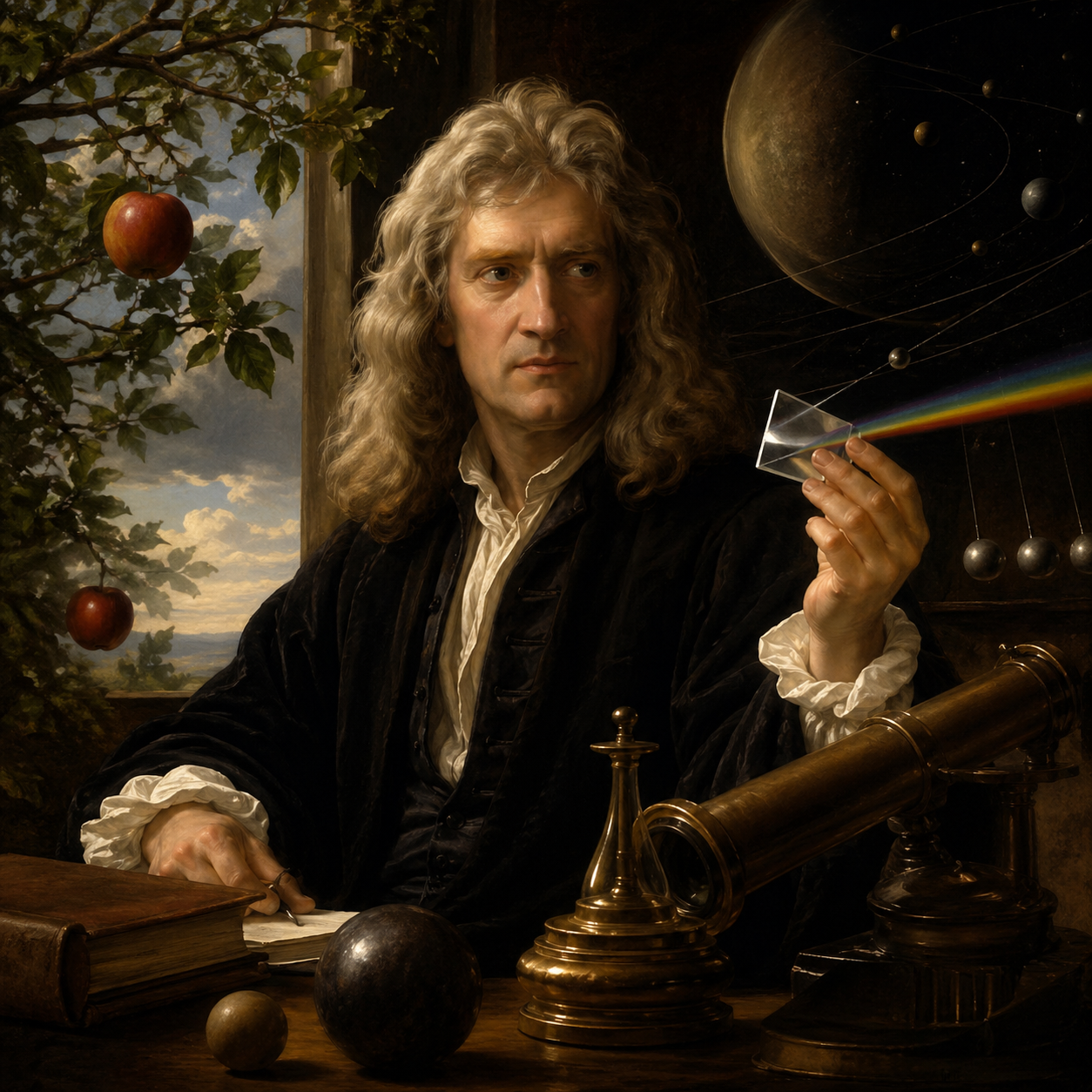
Isaac Newton — "If I have seen further than others, it is by standing upon the shoulders of gian…"
If I have seen further than others, it is by standing upon the shoulders of giants.
If I have seen further than others, it is by standing upon the shoulders of giants.
Click any product to generate a realistic preview. Up to 3 at a time.
* Initial load can take up to 90 seconds — revising the preview in another color is nearly instant.
"I was born in the year of the comet."
"I can calculate the motion of heavenly bodies, but not the madness of people."
"I shall not mingle conjectures with certainties."
"Gravity must be caused by some agent acting constantly according to certain laws; but whether this agent be material or immaterial, I have left to the consideration of my readers."
"For it is the property of true philosophy to deduce the causes of all natural effects from the simplest possible principles."
Found in 3 providers: gemini,grok,deepseek
3 sources checked
Progress is cumulative, not the work of isolated geniuses. Every breakthrough depends on frameworks, discoveries, and tools built by predecessors. When someone achieves something remarkable, they are extending a chain of inherited knowledge, not creating from nothing. Genuine intellectual greatness includes recognizing what you owe to those who cleared the path before you. Ambition and humility coexist: reach as far as you can, but acknowledge who made the climb possible.
Newton's discoveries didn't emerge in a vacuum. His law of universal gravitation extended Kepler's planetary laws and Galileo's kinematics. His calculus built on Barrow and Wallis. He wrote these words in a 1675 letter to rival Robert Hooke — making the humility striking given their bitter disputes. Newton absorbed centuries of mathematics and natural philosophy at Cambridge, then synthesized them into a framework that defined physics for 200 years.
Newton lived during the Scientific Revolution, when Copernicus, Galileo, and Kepler had dismantled Aristotelian cosmology within a single century. The Royal Society, founded 1660, was creating a new culture of published, peer-reviewed discovery. Natural philosophers now built explicitly on each other's documented work rather than scholastic authority. In this emerging collaborative republic of letters, acknowledging intellectual debts wasn't just humility — it was the foundation of the new scientific method itself.
AI-generated insights based on extensive research and information for context. Factual errors? Email [email protected].
Your cart is empty