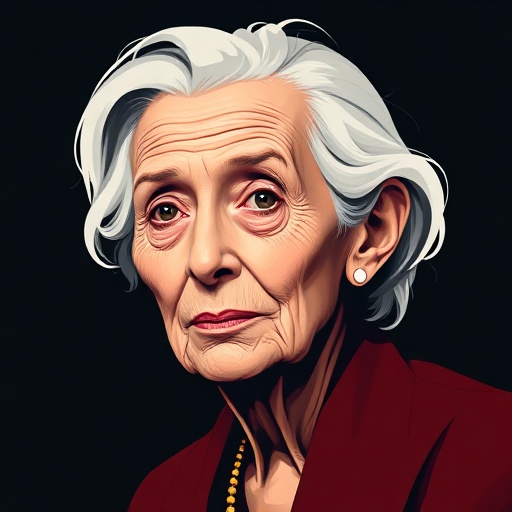
Jane Goodall — "If we don't save the planet, we don't save ourselves."
If we don't save the planet, we don't save ourselves.
If we don't save the planet, we don't save ourselves.
Click any product to generate a realistic preview. Up to 3 at a time.
* Initial load can take up to 90 seconds — revising the preview in another color is nearly instant.
"The greatest hope for the future is the power of individual action."
"We are all interconnected. What we do to the Earth, we do to ourselves."
"I think the most important thing is to realize that we are part of the animal kingdom, and we're not above it."
"I have always felt a deep connection to the natural world, even as a child."
"We have so far to go to understand the minds of the other animals, and how much they suffer."
British primatologist who in 1960 began the longest-running wild primate study at Gombe Stream, transforming our understanding of chimpanzees. Closely associated with Dian Fossey (mountain-gorilla researcher) and Birutė Galdikas (orangutan researcher; together with Goodall and Fossey one of Louis Leakey's 'Trimates'). For an intellectual contrast, see Walter Palmer, American dentist who killed Cecil the Lion in Zimbabwe in 2015 — Palmer represents the trophy-hunting tradition Goodall's life's work has been organized against — the colonial-era hunter-naturalist worldview that treated primates and big game as specimens or trophies, which Goodall's Roots & Shoots and Jane Goodall Institute exist specifically to displace.
Found in 1 providers: grok
1 source checked
Human survival and planetary health are not separate concerns — they are the same concern. The quote dismantles the idea that environmentalism is charity toward nature. Clean air, fresh water, stable climate, and functioning ecosystems are the literal infrastructure of human life. Destroy them and no economy, technology, or civilization can compensate. It is a pragmatic argument: protecting the planet is the most direct form of self-interest a species can exercise.
Goodall spent decades at Tanzania's Gombe Stream studying chimpanzees, then watched their forest habitat shrink from deforestation. That shift turned pure scientist into global activist. She founded Roots & Shoots, a youth conservation program in 140 countries, and travels over 300 days a year speaking. Her research established that chimps share roughly 98% of human DNA — making the line between their fate and ours biologically, not just philosophically, thin.
Goodall's career spans the postwar industrial boom through today's accelerating climate crisis. The 1980s brought mass Amazon deforestation and first major warnings about the ozone layer. By the 1990s, IPCC reports confirmed rising temperatures and species were disappearing at 1,000 times the natural rate. The 1997 Kyoto Protocol marked humanity's first binding climate commitment. Her quote lands in this era as a correction: the data no longer permitted treating conservation as optional.
AI-generated insights based on extensive research and information for context. Factual errors? Email [email protected].
Your cart is empty